Oshkosh Has Built 25,000 JLTVs — and Says Its Commercial Side Is the Real Capacity

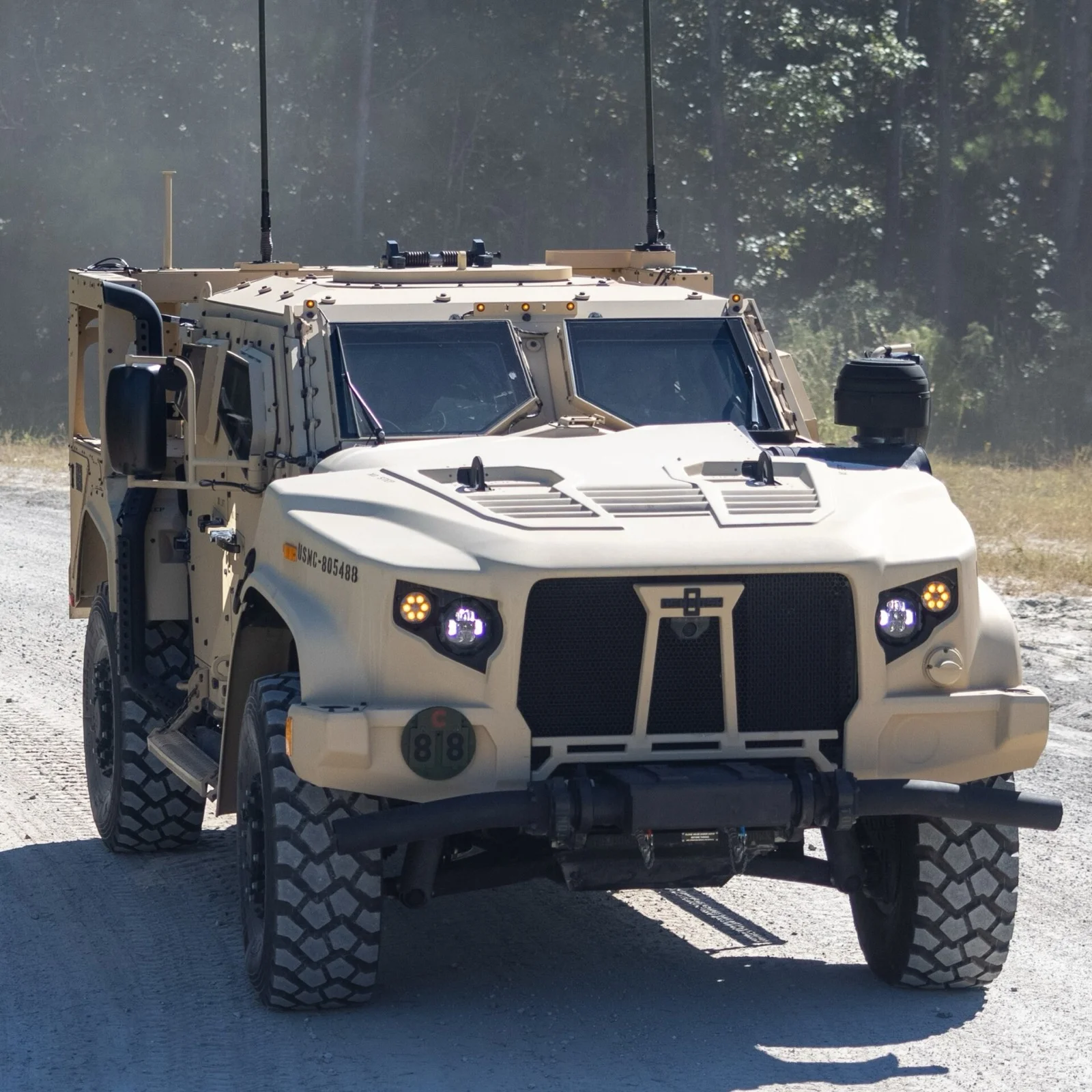
Oshkosh has entered the defence capacity debate from an unusual angle: the company argues its real strength sits not on the defence line but in the commercial manufacturing base behind it. It says it has built more than 25,000 JLTVs (Joint Light Tactical Vehicles) since winning the contract in 2015, supported by a network of more than 300 suppliers.
The remarks came around Defense Secretary Hegseth’s 24 August visit to the company’s facilities. His own framing captured the point: “What’s special about Oshkosh is that 90 percent of your work is for commercial civilian use.”
Why the commercial base matters
Scaling has a habit of failing at the same place. Defence-specific lines are built narrow because peacetime orders are low volume; when demand spikes, new tooling, new hires and new supplier qualification are needed. That process takes years, not months.
Oshkosh’s argument is that a product range running from fire trucks to telehandlers to refuse vehicles unties that knot. The same welding, painting and assembly infrastructure, the same heavy-chassis experience and the same supplier network can be turned toward military orders as latent capacity.
Executive Nordlund put the claim directly: “We have the people, infrastructure and production expertise in place today to move quickly and scale.” CEO Pfeifer described the defence arm as “backed by the scale, innovation and manufacturing strength of our global commercial enterprise.”
What the JLTV is
The JLTV was developed for the US Army and Marine Corps to replace the Humvee. Losses inflicted on the HMMWV fleet by improvised explosive devices in Iraq and Afghanistan had shown that an unprotected light vehicle was not survivable in a modern operating environment. The JLTV set out to combine near-MRAP mine and ballistic protection with something close to Humvee mobility.
It also found buyers abroad. Lithuania, North Macedonia, Slovenia, Montenegro and Romania have all procured JLTVs, and those export lines account for part of the 25,000 total.
What comes next
Alongside JLTV, the programmes that will test the scaling claim include the Family of Medium Tactical Vehicles and ROGUE-Fires, the remotely operated ground platform developed for expeditionary fires. The company also names autonomy and modular open-systems architectures as the next integration priority.
Where the argument runs out
Converting commercial capacity into military output is harder than it sounds. Qualification is the first obstacle: ballistic steel, mine-protected floors and the welding procedures behind them sit inside a certification regime that commercial vehicle production simply does not carry. Handing over a shop floor is not the same as handing over a qualified line.
Supplier depth is the second. Among those 300-plus suppliers, the firms making heavy gearboxes, protection panels and specialised electronics have capacity limits independent of final assembly. Doubling the main line changes nothing if the supplier tier does not grow with it — the American experience with 155 mm ammunition production over the past three years is the clearest illustration.
Putting 25,000 in context
The figure is cumulative programme output. Original US Army and Marine Corps requirements exceeded 50,000 vehicles, but later budget cycles pulled that number down, and the Army moved in 2025 to reduce JLTV procurement. The company’s current emphasis on scalable capacity reads, in that light, as part of a pivot toward exports and new programmes as domestic demand narrows.
Sources
- Oshkosh Corporation statements; US Department of Defense visit remarks, 24 August 2026
- Defence Industry Europe, 25 August 2026