PARS 675N vs REAP-IR 60 and TWS13D: what does it offer?


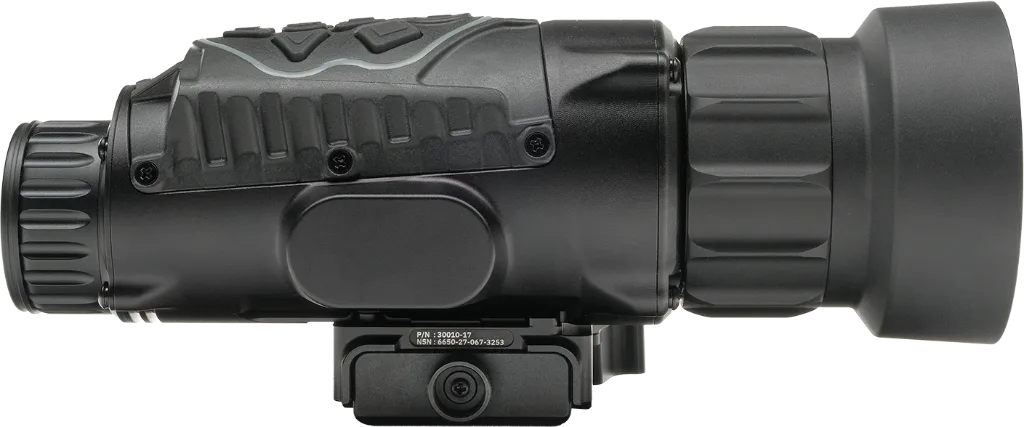
Quick answer: the PARS 675N is 3E Elektro-Optik’s flagship thermal weapon sight. The US market has two well-known products in the same mission class: the Trijicon REAP-IR 60 and the N-Vision Optics TWS13D. All three are uncooled, 640-class thermal sights mounted on individual weapons. This comparison places the three manufacturers’ own published data side by side in a single table; since no independent test data exists, it does not rank one above another.
The frame of the comparison
All three products solve the same problem: target detection and aiming from a rifle at night and in low visibility. Three axes decide the technical comparison: sensor resolution and pixel pitch, image processing and recording capabilities, and housing durability. Price was left out of the table because it is not comparable as a public list price for all three products. The full PARS family is examined in a separate file.
Table: three sights on manufacturer data
| Feature | 3E PARS 675N | Trijicon REAP-IR 60 | N-Vision TWS13D |
|---|---|---|---|
| Country | Turkey | USA | USA |
| Sensor | 640×512 uncooled LWIR | 640×480 uncooled VOx | 640×512 uncooled VOx |
| Pixel pitch | 17 um | 12 um | 17 um |
| Frame rate | Not officially disclosed. | 60 Hz | 30 Hz |
| Objective | Not officially disclosed. | 60 mm, 3x optical base | 50 mm class |
| Digital zoom | PiP window, e-zoom | 8x (24x combined) | 2x-4x |
| Recording | Built-in video and photo, Wi-Fi streaming, BT remote | External DVR and USB power support | Analog video output |
| Reticle | On-device custom reticle creation | Multiple preset patterns, digital thumbstick | Multiple preset patterns |
| Housing | Aluminum, IP67, MIL-STD-810 | -40/+55 C operating range | Military grade, manufacturer statement |
All values are taken from the respective manufacturers’ official pages; blank fields have not been published by the manufacturer.

The pixel pitch debate: 12 or 17?
The most visible difference in the table is pixel pitch. With its newer-generation 12-micron sensor, Trijicon delivers the same resolution in a smaller, lighter optic; a smaller pixel yields finer angular resolution at the same focal length. 3E, for its part, ties its 17-micron choice to collecting more thermal energy per pixel and to signal strength in low contrast. How the two approaches play out in the field depends on lens diameter, processing software and the mission. That N-Vision has also stayed at 17 microns shows 3E is not alone in this choice. Until independent side-by-side testing is published, no firm verdict can be reached on this axis.
Differences in the capability set
The PARS 675N’s distinguishing claims are on the software side: the user can draw a reticle on the device itself, the image can be streamed to an external screen over Wi-Fi, and the sight can be operated remotely by Bluetooth. The REAP-IR, with its 60 Hz frame rate and 8x digital zoom, offers a smoother chain on paper for tracking moving targets. The TWS13D, at 30 Hz, has a more conservative profile. For a Turkish user, the practical difference is the supply chain: US thermal sights are subject to ITAR and export licensing regimes; the domestically produced PARS carries no such dependency. The same logic applies in the night vision and laser systems categories.
Instead of a conclusion: what data is missing?
Three critical data points needed for a sound comparison are not public: the PARS 675N’s frame rate, objective focal length and detection-recognition-identification (DRI) range table. Trijicon and N-Vision publish some of these fields. 3E’s catalog pages offer marketing-oriented text without a numerical specification table; since the technical data sheets shared in tender processes do not reach the public, the comparison stays within these limits. For the company’s overall profile, see the 3E company file; for the other groups in the catalog, the products guide.
Frequently asked questions
Is the PARS 675N superior to the REAP-IR?
Since no independent side-by-side test has been published, this question cannot be answered with data. On paper, PARS offers higher vertical resolution (512 versus 480) and a richer recording and connectivity set; the REAP-IR offers a smaller pixel pitch and a 60 Hz frame rate.
Why were these two counterparts chosen?
Both are individual-weapon-mounted, uncooled 640-class products aimed at military users with official specifications in the public domain. Clip-on devices such as the HENSOLDT IRV series are a different category and were left out of scope.
Is a 17-micron sensor old technology?
A smaller pixel (12 um) reflects newer manufacturing processes, but 17 microns remains in production and in use because of its per-pixel energy advantage. The choice depends on optical design and mission profile.
What is the range of the PARS 675N?
Not officially disclosed. The manufacturer does not publish a detection-recognition-identification (DRI) table, so no range comparison was made.
Why does ITAR matter?
Exports of US-origin thermal sights are subject to US licensing regimes; procurement and spare parts continuity depend on those approvals. Domestic production removes this approval chain.
Sources and verification note
- https://3eeos.com/catalog/pars-675n — Accessed: August 13, 2026
- https://www.trijicon.com/products/details/reap-60-4 — Accessed: August 13, 2026
- https://nvisionoptics.com/product/tws13d-thermal-weapon-sight/ — Accessed: August 13, 2026
- https://www.hensoldt.net/products/irv-mr-uncooled-thermal-clip-on-system — Accessed: August 13, 2026
All values in the table are manufacturer statements; there is no independent test data. Undisclosed fields are marked “Not officially disclosed.” This article is not a procurement recommendation, and no ranking has been made between the products.