From DLIRIL to the MLRF: 3E’s laser systems

Quick answer: 3E Elektro-Optik’s laser catalog is organized around three functions: target designation (DLIRIL and REMUS), range measurement (MLRF and BLRF) and bore alignment (LRB G2). The series runs from weapon-mounted modules to ballistic-computing rangefinders, and the ready integration with US-origin Applied Ballistics software and Kestrel wind meters on the MLRF-M and BLRF XR models stands out. All values are manufacturer statements.
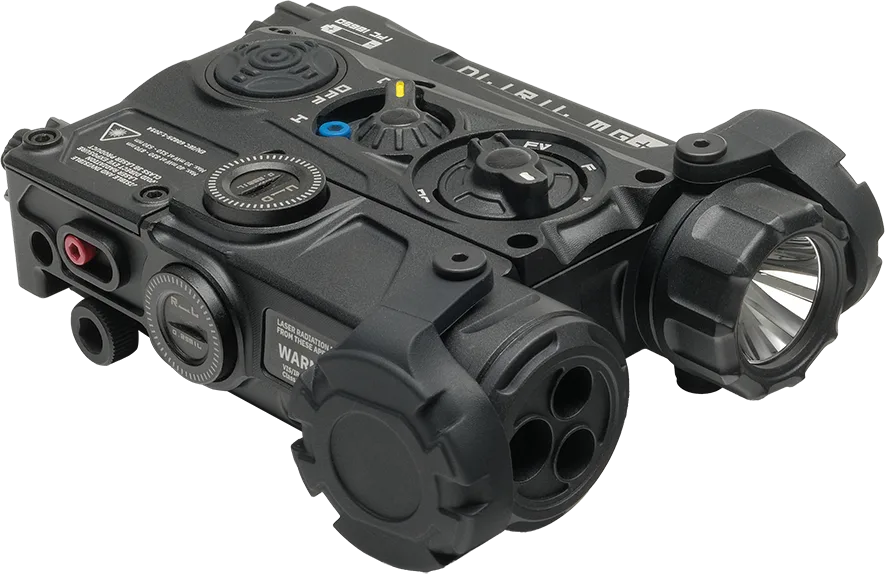
DLIRIL MG+ and MR+: four functions in one housing
DLIRIL is the domestic counterpart of the LAM (Laser Aiming Module) class in the US ecosystem. The housing, powered by a single 18650 battery, contains four systems: a visible laser (520 nm green on the MG+ model, 650 nm red on the MR+, up to 30 mW), an 850 nm IR laser (up to 40 mW), an 850 nm IR illuminator adjustable between 2 and 100 mRad, and a white LED with strobe. The visible and IR lasers are co-aligned; a zero set on one holds on the other. A mechanical safety screw locks the device into low- or high-power mode; the laser channels are Class 3B. The manufacturer reports 10-meter submersion for IP protection and MIL-STD-810 testing. These modules are positioned to work alongside night vision devices such as the NOX and M14.
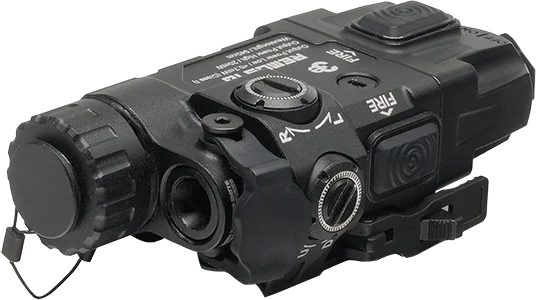
REMUS: squad-level designation
The REMUS series consists of single-function, AA-powered pointers: GX green (520 nm), RX red (650 nm) and IX infrared (940 nm). All three have low and high output modes, a three-position selector switch, a pressure switch and 0.33 MOA adjustment increments; runtime exceeds 30 hours on a single battery. The IX’s 940 nm wavelength sits in a band that many older-generation night vision devices struggle to detect; the beam is visible only with suitable equipment.
MLRF and BLRF: from range to firing solution
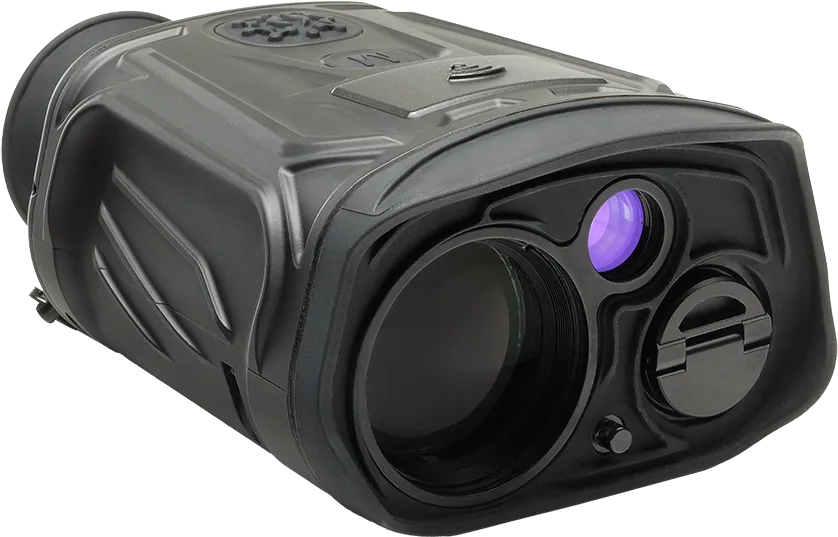
| Model | Type | Range | Laser | Ballistics | Weight |
|---|---|---|---|---|---|
| MLRF-S | 7x monocular | 2,500 m | 905 nm Class 1 | – | 260 g |
| MLRF-M | 7x monocular | 2,500 m | 905 nm Class 1 | Applied Ballistics Ultralite built in, Kestrel 5700 Elite link | 270 g |
| MLRF-PRO | 7x monocular | 6,000 m | 1550 nm Class 1 | Optional; GPS target coordinates (MGRS/UTM/DMS), compass | 440 g |
| BLRF XR | 10×42 binocular | 5,000 m | 905 nm Class 1 | Applied Ballistics built in, Kestrel link | Not disclosed |
The series’ common claim is an accuracy of plus or minus 2 meters out to 1,000 meters with an eye-safe Class 1 laser. The MLRF-PRO is the high end, aimed at sniper and forward observer use: it generates the grid coordinates of the target it measures using a digital compass and GPS, and connects over Bluetooth to the 3E LaserLink app and to ballistic calculators. This chain completes the sniper team’s measurement layer together with the KESKIN scopes and İZCİ spotting scopes.
LRB G2: zeroing without firing
The LRB G2 is a 115-gram tool that uses a red laser placed in the bore to align an optical sight without firing a round. The kit includes sleeves for 5.56 mm, 7.62 mm, 8.59 mm and 12.7 mm NATO as well as 9 mm. Initial alignment requiring no ammunition or range time is the standard step before final zero is confirmed by live fire. The 10-meter distance cord in the same kit is meant to make the procedure repeatable across armorers.
The series’ place in the catalog
The laser line is the third leg of 3E’s soldier-carried equipment strategy: the AVCI day optics and the PARS thermal sights handle seeing the target, while the laser series handles designating and measuring it. The Applied Ballistics and Kestrel integrations show a choice to plug the products into the established fire-solution ecosystem of the Western market. The full catalog breakdown is in the 3E products guide.
Frequently asked questions
What does Class 1 laser mean?
It is the lowest risk tier in eye-safety classification; it is considered harmless to the eye in normal use. All of 3E’s rangefinders are declared Class 1. The DLIRIL’s designation lasers, however, are Class 3B and must not be pointed directly at the eye.
What does the Applied Ballistics integration provide?
The MLRF-M and BLRF XR convert the measured range into a firing correction with the ballistic engine inside the device; the Kestrel 5700 Elite link adds wind and atmospheric data to the solution. The user carries no separate calculator.
What is the difference between 905 nm and 1550 nm?
A 1550 nm laser can use stronger pulses within the same class because its eye-safety limits are higher; this is the technical basis of the MLRF-PRO’s 6,000-meter range. 905 nm uses more common and more economical detector technology.
Which foreign products is DLIRIL comparable to?
Its function set overlaps with the class of multi-function weapon-mounted laser modules in the US ecosystem. A direct model comparison would require numerical data sheets from both sides; since no full public data sheet exists on the 3E side, no comparison was made in this article.
Does zeroing with the LRB G2 remove the need to fire?
Initial alignment is done without firing, but since final zero depends on the ammunition and the weapon, confirmation by live fire is standard practice. The LRB G2 aims to reduce the ammunition spent before that confirmation.
Sources and verification note
- https://3eeos.com/catalog/dliril-mg-plus — Accessed: August 13, 2026
- https://3eeos.com/catalog/mlrf-pro — Accessed: August 13, 2026
- https://3eeos.com/catalog/mlrf-m — Accessed: August 13, 2026
- https://3eeos.com/catalog/blrf-xr — Accessed: August 13, 2026
- https://3eeos.com/catalog/lrb — Accessed: August 13, 2026
- https://3eeos.com/catalog/remus-gx — Accessed: August 13, 2026
Range, accuracy and output power values are manufacturer statements; no independent test data has been published. User units and procurement contracts have not been officially disclosed.