MBDA CROSSBOW High-Energy Laser: The Weapon That Breaks the Economics of Air Defence

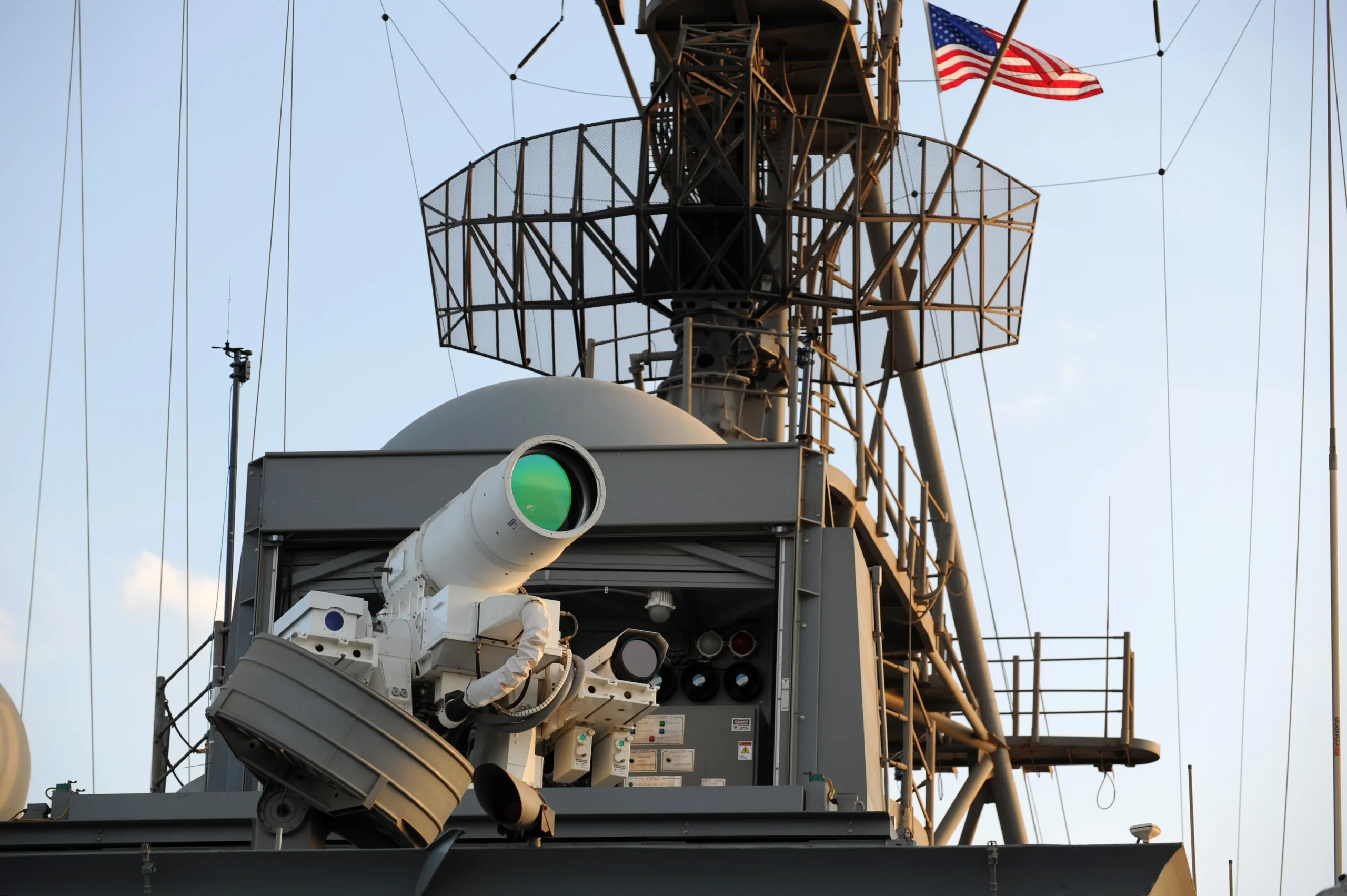
The fundamental problem of modern air defence is economic, not technical. A Shahed-136 costs $20,000–50,000 to build. A Patriot PAC-3 interceptor costs $3–4 million. Every nation that must engage loitering munitions or drone swarms with guided missiles is losing a financial war — the attacker’s factory can outproduce the defender’s missile stocks indefinitely at those ratios. MBDA’s CROSSBOW is a structural solution: a High-Energy Laser (HEL) system with a marginal cost per engagement measured in dollars, not hundreds of thousands.
1. Physics of Directed Energy Defeat
CROSSBOW operates by concentrating photon energy on a target until structural or functional defeat occurs. The defeat mechanisms vary by target type:
- Thermal ablation: Surface temperature exceeds material melting point — drone motor housings, composite airframes, battery cells fail within seconds to minutes depending on power density
- Structural failure: Localised heating on a rocket or mortar shell body creates uneven expansion, causing trajectory deviation before target reach
- Optical sensor defeat: Lower power, shorter dwell — camera and seeker sensor arrays burned out without necessarily destroying the airframe
2. Technical Parameters
| Parameter | Value / Status |
|---|---|
| Laser power class | 50–100 kW (development phase dependent) |
| Effective range | 1–5 km (atmosphere dependent) |
| Engagement duration | 2–10 seconds per target |
| Cost per engagement | <$5 (electricity consumption) |
| Magazine capacity | Theoretically unlimited (power source constrained) |
| Target classes | Group 1–3 UAV, rockets, mortars, optical sensors |
| Platform | Ground vehicle, fixed installation; naval integration planned |
| Programme status | MBDA demonstration complete; pre-production phase |
3. The Economics Argument
Traditional air defence cost exchange ratios favour the attacker when cheap weapons are used at scale:
| Effector | Cost per shot | Effective against |
|---|---|---|
| Patriot PAC-3 | ~$3–4 million | Ballistic missiles, hypersonics |
| Mistral VSHORAD | ~$100–200K | Aircraft, helicopter, Group 3 UAV |
| CROSSBOW laser | <$5 | Group 1–3 UAV, rockets, mortars |
When the marginal cost of defence is near zero, the attacker’s stock-depletion strategy fails. A drone swarm that would cost $5 million to intercept with missiles costs $500 to intercept with a laser — at which point the cost asymmetry has reversed, and the attacker bears the economic penalty of attrition rather than the defender.
4. Atmospheric Constraints
High-energy laser systems are fundamentally limited by atmospheric transmission. Key operational constraints:
- Humidity and fog: Water vapour scatters photons — effective range can drop 30–60% in high-humidity conditions
- Dust and sand: Particularly significant in Middle East operational environments — particles scatter and absorb laser energy
- Thermal turbulence: Ground heating creates convective columns that distort laser beam coherence at longer ranges
- Smoke screens: Dense smoke can block laser propagation — tactically relevant in urban and industrial environments
These constraints mean CROSSBOW is not a standalone all-weather system — it is a primary effector in suitable conditions and a supplementary effector otherwise, always paired with kinetic backup.
5. MBDA’s Demonstrated HEL Capability
MBDA has progressed beyond conceptual proposals:
- HEL CVS-NT: Completed engagements against both ground and aerial targets in formal demonstration programme
- EMPOWER consortium: France, Germany, UK, and Italy joint laser weapon programme with MBDA as prime contractor — validates multi-nation demand signal
- Platform integration studies: Land vehicle integration complete; naval platform integration with Type 26/FREMM frigates in assessment phase
6. Assessment
CROSSBOW’s operational value is not in replacing kinetic air defence — it is in restructuring which effector handles which threat class. A layered system that routes Group 1–2 UAV and rockets to the laser (near-zero cost) and reserves missiles for Group 3 threats and aircraft creates a dramatically more sustainable engagement budget than any single-layer kinetic system. Ukraine has demonstrated the attritional cost of the alternative. CROSSBOW is MBDA’s answer to a problem that becomes more expensive to ignore with each passing conflict.