MBDA Akeron LP (LMM): The Lightweight Missile Designed for Drones and Small Platforms


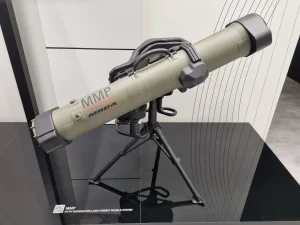
Modern warfare has produced a tactical problem that heavier missiles cannot efficiently solve: the proliferation of small, fast, asymmetric surface threats — speedboats, light vehicles, infantry concentrations — in environments where a Brimstone or Akeron MP would be logistically and financially disproportionate. The Akeron LP (Lightweight Multirole Missile, formerly LMM) is MBDA’s answer. At 13 kg with a 6 km semi-active laser guided engagement, it fits on platforms — from unmanned aerial vehicles to coastal patrol boats — that cannot carry conventional air-to-surface missiles.
1. Technical Specifications
| Parameter | Value |
|---|---|
| Length | 1.30 m |
| Diameter | 76 mm |
| Launch weight | ~13 kg |
| Warhead | ~3 kg dual-purpose HE |
| Range | ~6 km |
| Speed | Mach 1.5 (terminal) |
| Guidance | Semi-active laser (SAL) |
| Mode | Fire-and-update (laser lock maintained) |
2. Platform Integrations
| Platform | Country | Role |
|---|---|---|
| AW159 Wildcat | UK Royal Navy | Anti-surface warfare, coastal defence |
| Watchkeeper WK450 | UK Army | Tactical UAV, lightweight payload compatible |
| AH-64 Apache | Various | Integration trials |
| Land rover / wheeled vehicle | UK/France | Ground-launched coastal defence |
| RHIB / patrol boat | UK Royal Navy | Maritime patrol and force protection |
3. The UAV Warfare Problem
The widespread adoption of tactical UAVs by state and non-state actors since 2015 has created a demand signal that traditional missile arsenals could not answer: small precision munitions, lightweight enough for 500 kg UAVs, accurate enough for discriminating engagement, cheap enough for attrition use. Akeron LP fits that profile. With a 13 kg total weight, a capable medium-altitude UAV can carry two to four rounds, providing persistent armed overwatch without the payload penalty of Brimstone or Hellfire.
4. SAL Guidance: Strengths and Constraints
Semi-active laser guidance requires the designator — onboard sensor or third-party ground/airborne — to maintain a laser spot on the target throughout terminal flight. This creates dependence on clear line-of-sight conditions:
- Advantage: Simple, reliable, low-cost seeker with no RF emissions from the missile — no radar warning signature
- Advantage: Operator can steer impact point until milliseconds before detonation
- Constraint: Heavy smoke, thick cloud, or dust degrades accuracy — terminal guidance fails if laser spot is lost
- Constraint: Platform must maintain positional stability during terminal phase — turbulent hover or high-speed maneuvering degrades accuracy
5. UK Royal Navy Integration: AW159 Wildcat
The AW159 Wildcat Helicopter Armed with LMM (LWHM configuration) represents the most operationally mature deployment of the Akeron LP. The capability gives Royal Navy frigates and destroyers an organic precision strike option against small vessel threats — a gap identified after the Falklands campaign when surface combatants lacked an efficient anti-small-boat weapon. Wildcat crews can engage targets from standoff ranges that keep the parent ship outside effective small-boat weapon range.
6. Assessment
Akeron LP addresses the tactical reality that emerged from drone-heavy conflicts in Syria, Nagorno-Karabakh, Ukraine, and the Red Sea: small platforms with precision-guided munitions have changed the cost calculus of warfare. At 13 kg with a 6 km range and Mach 1.5 terminal speed, Akeron LP gives small platforms — UAVs, patrol helicopters, coastal boats — credible precision strike capability without the weight, cost, or logistical complexity of larger guided weapons. For NATO navies and allied air forces developing counter-asymmetric capabilities, it fills an engagement envelope that neither general-purpose bombs nor heavier guided missiles can occupy efficiently.