Bolivia’s Military Strength: How Many Tanks, Aircraft and Ships in the Inventory? (2026)

Bolivia’s military inventory belongs to one of the most procurement-constrained armed forces in South America. The country ranks 82nd among 145 militaries; its tank fleet consists of a single type, its air force has no fighter aircraft at all, and it operates not one ground-based surface-to-air missile system. Yet despite having been landlocked since 1879, it maintains a navy of roughly 5,000 personnel — and made the largest defence investment of the past decade in a radar network rather than in aircraft or tanks. This article examines Bolivia’s land, air, missile and naval inventory item by item, using open sources.
At a Glance
- Active personnel: ≈ 40,000 active and 40,000 reserve (Global Firepower); some compilations put active personnel at 34,100, while open-source estimates place the total in the 40,000-70,000 range
- Main battle tanks: 54 SK-105 Kürassiers, of which Global Firepower lists 30 as combat-ready; there is no other tank type in the inventory
- Military aircraft: ≈ 67 (37 serviceable); zero fighters, zero attack aircraft and zero attack helicopters. The only armable jet is a fleet of four K-8 Karakorums
- Air-defence missiles: There is no ground-based surface-to-air missile system; the only layer is roughly 50 Chinese-built HN-5 shoulder-launched missiles. The 13-radar SIDACTA network bought from Thales is, however, operational
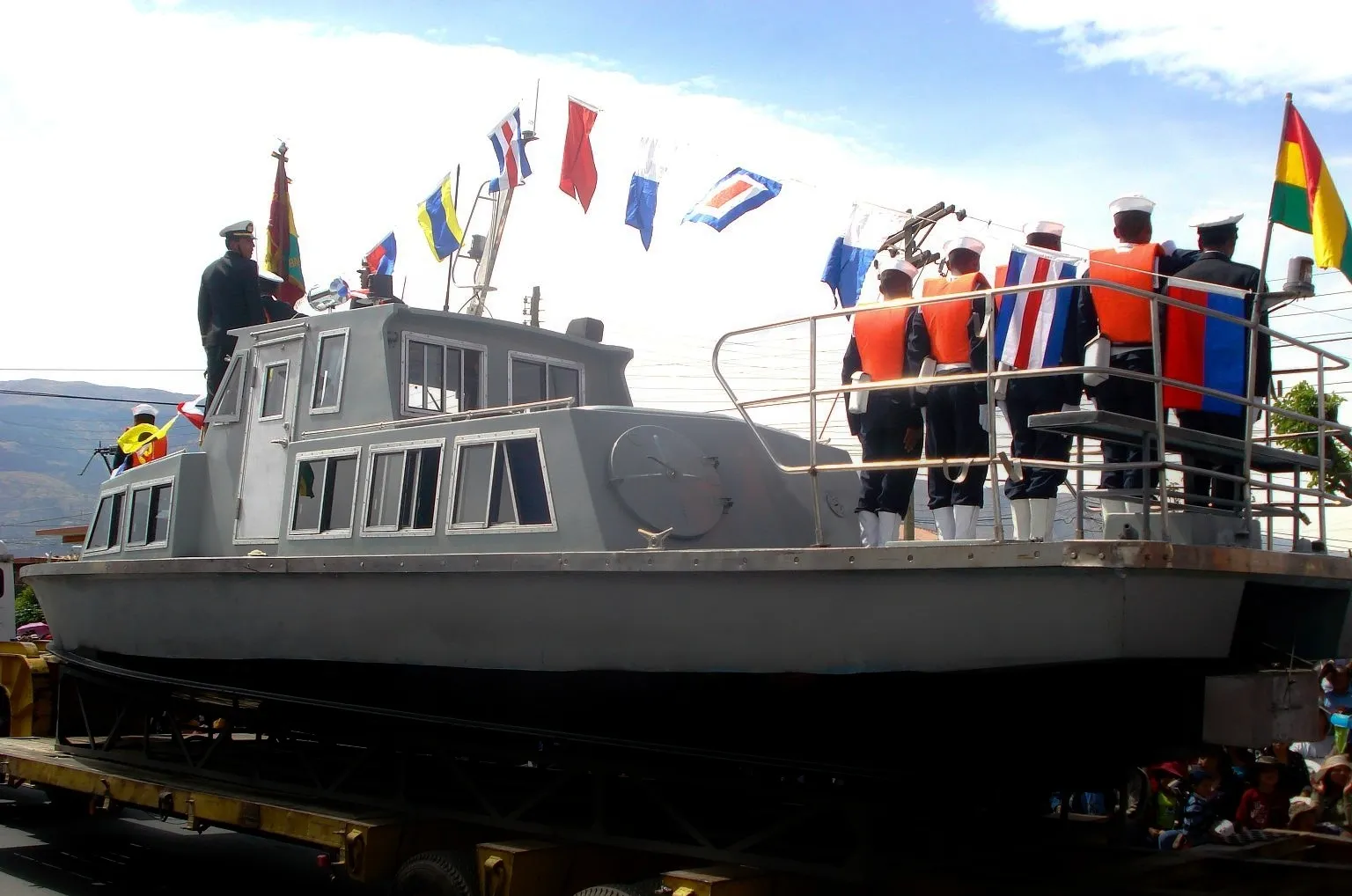
- Naval power: The country has been landlocked since 1879, yet it maintains a river-and-lake navy of roughly 5,000 personnel and about 173 craft
- GFP ranking and budget: 82nd of 145 militaries with a PwrIndx of 1.8301. Global Firepower puts the defence budget at $467.7 million, while some compilations give $659 million, or about 1.4 per cent of GDP
Note: The inventory figures below are approximate values drawn from open sources such as Global Firepower, the IISS Military Balance and SIPRI.
About the Bolivia Armed Forces
The Bolivian Armed Forces (Fuerzas Armadas de Bolivia) comprise three services: the Bolivian Army, the Bolivian Air Force and the Bolivian Navy. In addition, the Bolivian National Police, though answerable to the Ministry of Government in peacetime, counts as a reserve component under the Organic Law of the Armed Forces. In Global Firepower’s 2026 data the country ranks 82nd of 145 militaries with a PwrIndx of 1.8301. Active personnel are given as 40,000 and reserves as 40,000. Personnel figures vary widely between sources: some compilations put active strength at 34,100, while the scarcity of official data leaves open-source estimates for the overall total in the 40,000 to 70,000 range.
The spread on the budget side is similar. Global Firepower gives a defence budget of $467.7 million, while some compilations put it at $659 million; defence spending stands at roughly 1.4 per cent of GDP in both 2025 and 2026. The gap is largely a matter of exchange rates and accounting method, and the country’s foreign-currency shortage makes the dollar value of the budget volatile from year to year.
The armed forces have passed through two consecutive political crises in as many years. On 26 June 2024 the commander of the army, General Juan José Zúñiga, mounted a failed coup attempt against then-President Luis Arce; troops advanced as far as the presidential palace in La Paz, the attempt collapsed the same day, Zúñiga was arrested and the commanders of all three services were dismissed. Under President Rodrigo Paz Pereira, who took office in November 2025, the country then saw large-scale protests between 1 May and 23 June 2026: road blockades that began with the December 2025 decision to remove fuel subsidies and the dispute over Law 1720 lasted 53 days, Congress authorised military deployment on 26 May, a 90-day state of emergency was declared on 20 June, and 24 people had died by 9 July.
The command structure was renewed while the crisis was still under way. On 18 June 2026 President Paz formalised the High Military Command by Presidential Decree 5632: General Víctor Hugo Balderrama Quezada continues as Commander in Chief of the Armed Forces, with General Gonzalo Edwin Ruiz Cisneros as chief of staff, General Héctor Alejandro Alarcón Antezana as Commander of the Army, General Sergio Fernando Lora Araoz as Commander of the Air Force and Vice Admiral Ernesto Adalid Alfaro Palma as Commander of the Navy. The defence ministry changed hands during the year as well: Ernesto Justiniano Urenda replaced Marcelo Salinas on 3 June 2026.
The new administration is seeking to set defence policy within a framework running to 2050. The stated priorities are border security, the fight against smuggling and narcotics, protection of strategic resources — lithium above all — and cooperation with neighbours, particularly Argentina, Chile and Paraguay. On the procurement side the list runs to 4×4 tactical vehicles, patrol boats for the navy, interceptor aircraft to reinforce airspace defence, assault rifles and ammunition, and unmanned aerial vehicles to monitor remote regions. The obstacle to delivering that list is not political will but the foreign-currency shortage and the wider economic crisis.
A twenty-year break in external military relations also came to an end. In May 2026 Major General Philip J. Ryan, commander of US Army South, met then-Defence Minister Marcelo Salinas in the first official visit by a senior US military commander in two decades; the meeting produced understandings on military training, technological exchange and officer education. Its first concrete result was Bolivia’s return, after more than twenty years, to Fuerzas Comando — its Fuerza 10 special operations team competed in the 2026 edition held in Asunción on 24-28 August.
Land Forces Inventory
| System type | Est. quantity |
|---|---|
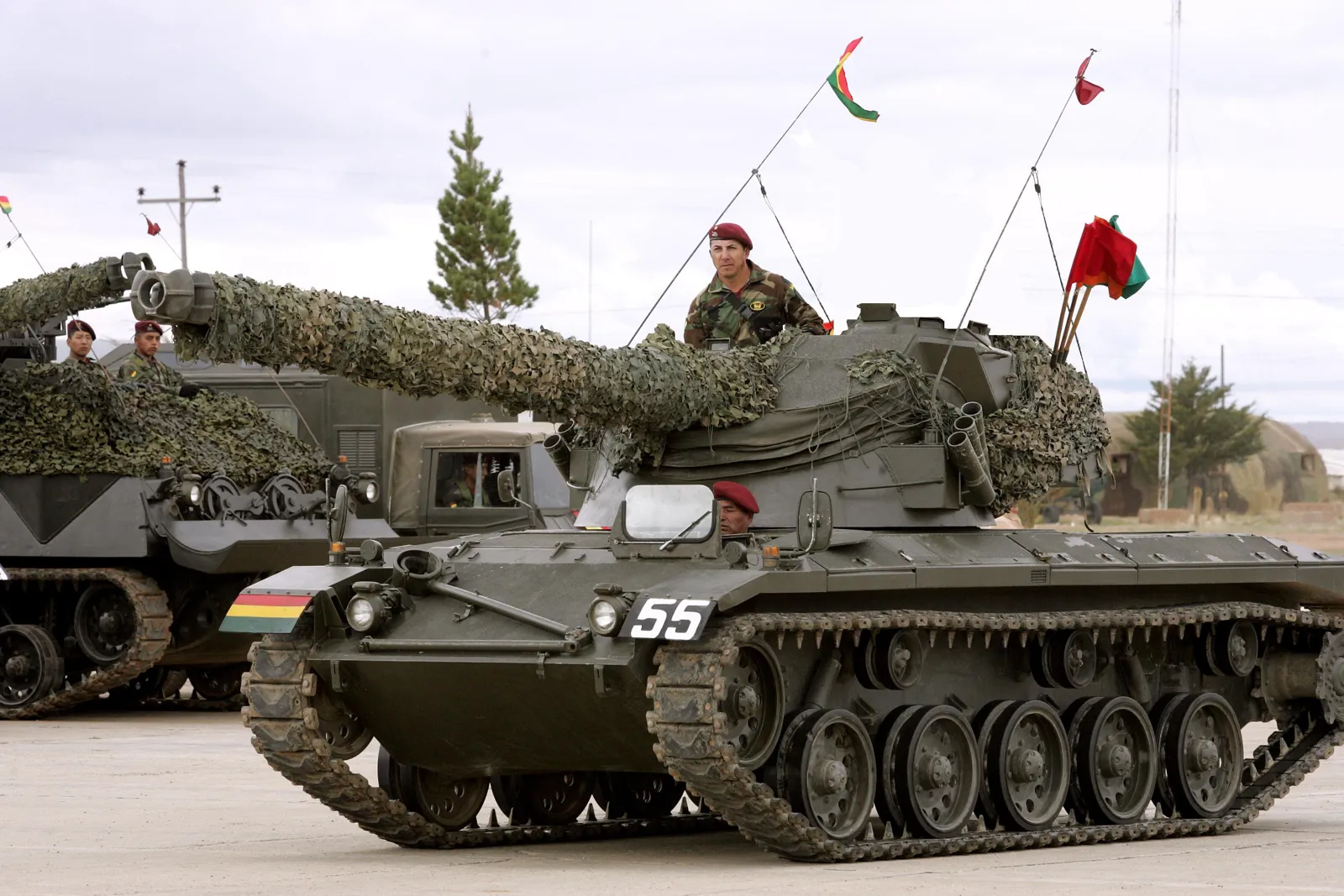
| Main battle tanks (SK-105 Kürassier) | 54; Austrian-built and, with its 105 mm gun and 17.7-tonne hull, effectively a tank destroyer. Global Firepower lists 30 as combat-ready |
| Armoured recovery vehicles | 2 Greifs (4K4FA-SB20) and 2-4 M578s, providing recovery support to the SK-105 fleet |
| Reconnaissance vehicles (EE-9 Cascavel) | 24; Brazilian-built 6×6 vehicles with a 90 mm gun, the heaviest direct-fire capability after the tank fleet |
| Armoured personnel carriers (M113) | ≈ 50 US-origin tracked vehicles, upgraded with local resources |
| Armoured personnel carriers (EE-11 Urutu) | 24; Brazilian-built 6×6 amphibious carriers from the same family as the Cascavel |
| Armoured vehicles (ZFB-05) | 41; Chinese-built light armoured vehicles, the newest armoured class in the inventory and prominent in internal security tasks |
| Armoured vehicles (MOWAG Roland and V-150 Commando) | 24 Rolands (with the military police, locally upgraded) and 15 V-150s; both date from the 1970s generation |
| Half-tracks (M3) | 24; Second World War vintage and the clearest indicator of the inventory’s average age |
| Total armoured vehicles | ≈ 764 in Global Firepower’s broadly defined 2026 count, which also covers tactical and logistic vehicles |
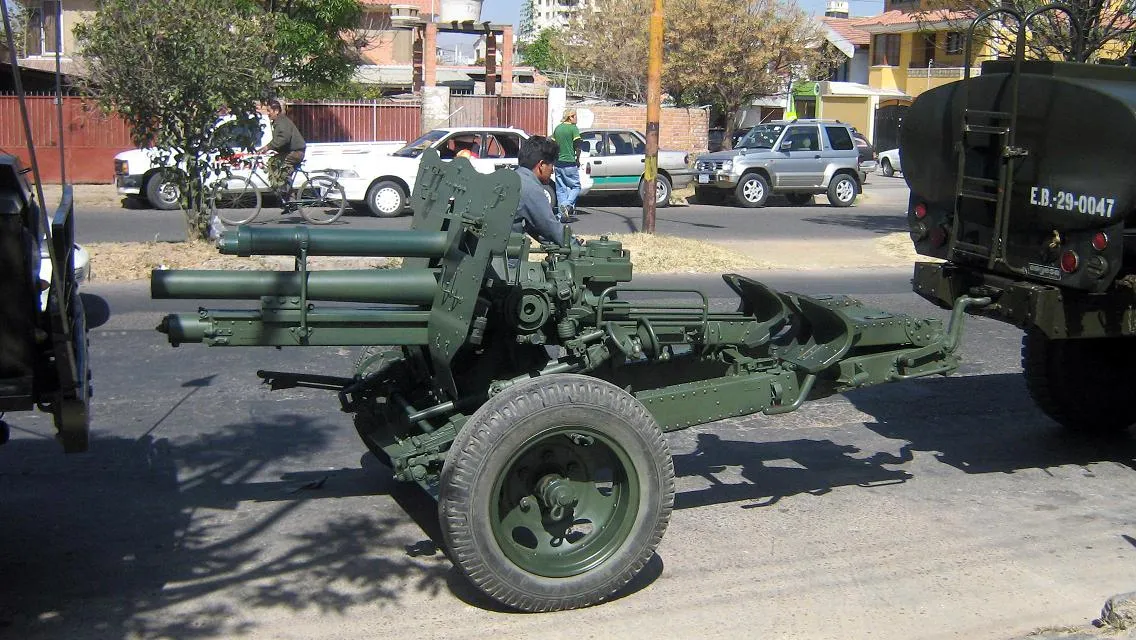
| Towed artillery | ≈ 58: six M101 105 mm, thirty-six M116 75 mm pack howitzers and six Bofors 75 mm. All towed and mostly of 1940s-1950s design |
| Self-propelled artillery | 0; Global Firepower records not a single self-propelled howitzer in the inventory |
| Rocket artillery (MLRS) | 0; the country operates no salvo rocket system at all |
| Mortars | A core of 250 M29 81 mm tubes plus M120 120 mm, M30 107 mm, M224 and Type 63-1 60 mm classes; the real indirect-fire power of the infantry battalions |
| Anti-tank missiles (HJ-8B Red Arrow) | 40; the wire-guided Chinese system is the army’s only guided anti-tank missile |
| Tactical vehicles | 40 locally produced Kojaks, 30 M988 HMMWVs and 50 HMMWVs in the reconnaissance role; heavy logistics rest largely on Chinese and Brazilian trucks |
Air Force Inventory
| Platform | Est. quantity |
|---|---|
| Total military aircraft | ≈ 67, of which Global Firepower lists 37 as serviceable. Fighters 0, attack aircraft 0, attack helicopters 0 |
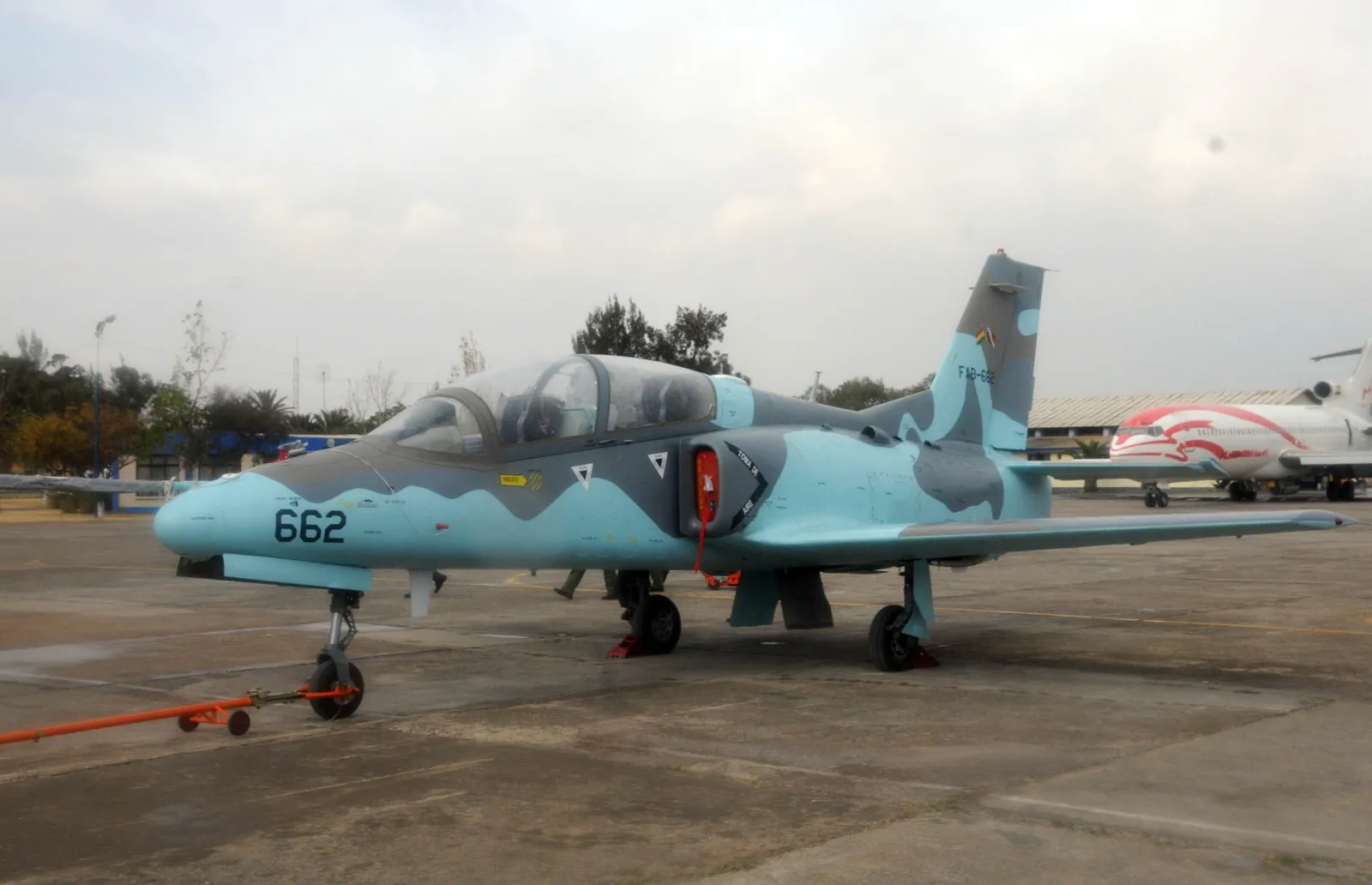
| Light attack and trainer jets (K-8 Karakorum) | 4; the Chinese-Pakistani joint design is the country’s only armable jet. Bolivia has had no fighters since the last T-33s were retired in 2017 |
| Trainers (Zlín Z 242L and Pilatus PC-7) | 8 Zlíns and 2 PC-7s; Global Firepower gives a total trainer count of 20 |
| Transport aircraft (C-130 Hercules) | 3 C-130B/Hs; a C-130H was written off in a runway excursion on 27 February 2026, cutting the fleet from four to three |
| Surveillance aircraft (Learjet 35) | 2, used for airspace monitoring and long-range liaison duties |
| Other transport and VIP aircraft | 5 Beechcraft King Airs, 2 Jetstream 31s, 1 Fokker F27, 1 Cessna 402, plus a Falcon 900 and a Falcon 50 in presidential service |
| Utility helicopters (UH-1H) | 11; the most numerous helicopter type and the backbone of internal security and disaster relief missions |
| Transport helicopters (H215M/AS332 Super Puma) | 6; the fleet’s heaviest lift capability and critical to high-altitude operations in the Andes |
| Light and search-and-rescue helicopters | 3 H145/EC145s, 2 H125M/AS350s, 1 SA316 Alouette III, 1 R66 and 6 R44s in the training role |
| Army aviation (Harbin Z-9) | 5 H425s; the Chinese licence-built derivative of the Eurocopter AS365, flown by the army’s 291st and 292nd aviation companies |
| Unmanned aerial vehicles (RemoEye-006) | 2; South Korean-built and for surveillance only. There is no armed UAV in the inventory, and UAV procurement for border surveillance is among the 2026 priorities |
Missile and Air-Defence Systems
| System | Type / Note |
|---|---|
| Ballistic missiles | None; there is no ballistic missile of any class in the inventory |
| Cruise missiles | None |
| Ground-based air-defence missiles | None; the country operates no fixed long-, medium- or short-range surface-to-air missile system |
| Man-portable air-defence missiles (HN-5) | ≈ 50; the Chinese derivative of the Soviet Strela-2 and the only air-defence missile layer the country possesses |
| Anti-aircraft guns (Type 65, 37 mm) | 16 twin-barrelled systems; the heavy end of low-altitude defence |
| Anti-aircraft guns (Oerlikon K20, 20 mm) | 80 twin systems; the most numerous air-defence element and an indication of how far the defence rests on gun barrels |
| Air-defence and traffic control network (SIDACTA) | A 13-radar network built under a EUR 196 million contract signed with France’s Thales on 23 August 2016, covering 3D and 2D primary radars plus secondary radars; it was completed in 2023 |
| Command and control centre (CIC) | Located in Cochabamba and inaugurated in September 2019; it runs detection of illicit flights and the interception protocols |
| Anti-tank missiles (HJ-8B) | 40; the only guided anti-tank system in the inventory |
| Anti-tank rockets and guns | 2,000 M72A3 LAWs, RPG-7s, Type 69-1s and 90 mm M67 and 105 mm M40A1 recoilless rifles |
Naval Power
| Class / Type | Est. quantity |
|---|---|
| Total craft | ≈ 173, most of them deployed on Lake Titicaca and the rivers of the Amazon and Paraná basins. Global Firepower counts landlocked countries as having zero naval assets |
| Personnel | ≈ 5,000-5,500, including seven marine infantry battalions, naval military police and the ‘Diablos Azules’ special operations element |
| Patrol boats (Capitán Bretel / Type 928 YC) | 6; Chinese-built and the most modern combat backbone of the fleet |
| Patrol boat (PR-51 Santa Cruz de la Sierra) | 1; of US origin and one of the navy’s largest single platforms |
| Lake-class patrol craft | 4, patrolling Lake Titicaca and the border with Peru |
| Fast riverine craft (Boston Whaler Piranha) | 38 patrol boats and 8 Mk.1 riverine assault craft; the principal tool of smuggling and narcotics patrols |
| Riverine hospital ships (PIASS) | 3; the 226-tonne vessels were built at Peru’s SIMA shipyard and carry health services to remote river communities |
| Auxiliary vessels | 2 hydrocarbon carriers, 2 tankers and 1 transport, plus 16 barges and 2 tugs acquired from South Korea |
| Training ship (Libertador Simón Bolívar) | 1; the navy’s symbolic flagship |
| Naval aviation (Cessna 340) | 1; a headquarters liaison aircraft and the navy’s only air asset |
| Frigates, corvettes and submarines | None; since the country lost its coastline in the War of the Pacific in 1879, the navy consists entirely of river and lake elements |
| Bases and administrative structure | Four naval areas and six naval districts; the main bases are Tiquina and Guaqui on Lake Titicaca, plus Guayaramerín, Riberalta, Puerto Suárez and Puerto Busch |
The Turkey Angle: Turkish Defence Industry
There is no Turkish-built platform in Bolivia’s inventory today, and no publicly announced military framework agreement or defence-industry cooperation agreement exists between the two countries. There is, however, one concrete and documented contact at which the defence heading was raised. On 9 April 2019 the then-President of Bolivia, Evo Morales, made an official visit to Ankara — the first at presidential level from Bolivia to Turkey. After the visit Morales said President Recep Tayyip Erdoğan had expressed a wish to cooperate on the transfer or sale of weapons to Bolivia, principally for the fight against smuggling, that payment facilities had been offered, and that the commander of the Bolivian Armed Forces had travelled to Turkey the previous week to discuss the offers. There is no open-source record of those talks turning into an actual procurement.
The documents signed during the same visit were economic in nature: an Agreement on Economic and Commercial Cooperation, which established a Joint Economic Commission, an Agreement on the Reciprocal Promotion and Protection of Investments, and an Agreement on Civil Aviation Cooperation. The joint declaration highlighted tourism, iron and steel, renewable energy and manufactured goods, and Turkey also expressed interest in taking part in Bolivia’s lithium industrialisation. Bilateral trade stood at roughly $130 million in 2019.
The diplomatic foundation dates to 1950, making 2025 the 75th anniversary of relations between the two countries. Turkey’s embassy in La Paz began operating in 2018, with Ambassador Serap Özcoşkun taking up her post on 14 February 2018; the current ambassador, Ertan Yalçın, was appointed on 29 June 2022 and presented his credentials on 26 September 2022. On 21 February 2024 the Turkish foreign minister met Bolivian Foreign Minister Celinda Sosa Lunda on the margins of the G20 meeting in Rio de Janeiro. Turkey’s defence-industry presence in the region also grew over this period: ASELSAN opened its Latin America regional office in Santiago in April 2024, and Turkey maintains military attachés in five countries in the region.
Bolivia’s stated procurement list and the export catalogue of the Turkish defence industry match almost line for line on paper: unmanned aerial vehicles for border surveillance, 4×4 tactical and armoured vehicles, riverine patrol boats, assault rifles and ammunition. Regional precedents show that overlap is not merely theoretical. In Chile, ASELSAN is running the Leopard 2A4CHL upgrade programme and HAVELSAN signed an agreement with the Chilean Navy on 27 March 2025 to fit its ADVENT combat management system to two frigates; in Peru, ASELSAN presented a package running from frigate and submarine modernisation to air defence at the SITDEF exhibition on 24-27 April 2025. On the Bolivian side, what exists today is an intention voiced in 2019, an established embassy and a functioning Joint Economic Commission.
That picture has to be read realistically. Bolivia is a country under foreign-currency pressure with a defence budget of around half a billion dollars; the obstacle to new platform purchases is financing, not a shortage of suppliers. That said, the government’s description of an expected $25 billion in carbon-bond revenue over two decades as a funding source for defence modernisation suggests the picture could change over the medium term. For the Turkish defence industry Bolivia is not a customer today; it is a mid-sized, low-budget potential market in which payment terms and technology transfer would be the decisive factors.
Frequently Asked Questions
How many tanks does Bolivia have? Global Firepower’s 2026 data puts Bolivia’s main battle tank count at 54, of which 30 are listed as combat-ready. All of them are Austrian-built SK-105 Kürassiers, and there is no other tank type in the inventory. With its 105 mm gun and 17.7-tonne hull, the SK-105 is technically in the tank destroyer class. On the armoured vehicle side there are 24 EE-9 Cascavel reconnaissance vehicles, roughly 50 M113s, 24 EE-11 Urutus, 41 ZFB-05s, 24 MOWAG Rolands, 15 V-150 Commandos and 24 Second World War-vintage M3 half-tracks; Global Firepower gives a total armoured vehicle figure of 764.
Which combat aircraft does the Bolivian Air Force operate? Bolivia has no fighter aircraft in its inventory. The country lost its fighter capability entirely when the last T-33s in service anywhere in the world were retired in 2017. Today the only armable jet is a fleet of four Chinese-Pakistani K-8 Karakorum light attack and training aircraft. The rest consists of 3 C-130 Hercules, 2 Learjet 35 surveillance aircraft, 5 Beechcraft King Airs, 2 Jetstream 31s, 8 Zlín Z 242Ls and 2 Pilatus PC-7 trainers. On the rotary side there are 11 UH-1Hs, 6 Super Pumas, 3 H145s, 2 H125Ms and, in army aviation, 5 Harbin Z-9s; there are no attack helicopters. In a 2017 evaluation of lead-in fighter trainers among the L-15, M-346, T-50 and Yak-130, the air force said it preferred the Yak-130, but no purchase followed.
Does Bolivia have an air-defence system? It has no ground-based surface-to-air missile system. The country’s only air-defence missile layer consists of roughly 50 HN-5 shoulder-launched systems, the Chinese derivative of the Soviet Strela-2. Low-altitude defence rests on 16 twin 37 mm Type 65 and 80 twin 20 mm Oerlikon K20 anti-aircraft guns. Yet the country’s largest defence investment falls in exactly this area: the 13-radar SIDACTA network, built under a EUR 196 million contract signed with France’s Thales on 23 August 2016, was completed in 2023. The integrated command and control centre in Cochabamba entered service in September 2019. The system detects illicit flights and runs interception protocols — but there is no fighter aircraft or missile in the inventory able to answer the target it detects.
Why does landlocked Bolivia have a navy? Bolivia lost its coastline to Chile in the War of the Pacific in 1879 and has had no sea access since. Even so, the Bolivian Navy (Armada Boliviana) operates with some 5,000 to 5,500 personnel and 173 craft. Its units are stationed on Lake Titicaca, on the border with Peru, and along the rivers of the Amazon and Paraná basins, organised into four naval areas and six naval districts. The backbone of the fleet consists of six Chinese-built Capitán Bretel-class patrol boats, 38 Boston Whaler Piranhas, 8 riverine assault craft and three riverine hospital ships built at Peru’s SIMA shipyard. The navy’s mission set centres on countering smuggling and narcotics and on carrying public services to remote river communities; it has no frigates, corvettes or submarines.
Is there defence cooperation between Bolivia and Turkey? There is no publicly announced military framework agreement or defence-industry cooperation agreement, and no Turkish-built platform in Bolivia’s inventory. The only concrete contact on record is the arms-supply discussion raised during Evo Morales’s visit of 9 April 2019: Morales said President Erdoğan had conveyed a wish to cooperate on the transfer or sale of weapons for the fight against smuggling, and that the commander of the Bolivian Armed Forces had travelled to Turkey to discuss the offers. Three agreements — on economic cooperation, investment and civil aviation — were signed during the same visit. Diplomatic relations date to 1950, Turkey’s embassy in La Paz opened in 2018 and bilateral trade stood at about $130 million in 2019.
Bottom Line
Bolivia’s inventory is one of the clearest South American cases of the gap between numbers and capability. On paper the country sustains a far from negligible structure: 54 tanks, 764 armoured vehicles and 173 craft. Within that structure, however, there is not one fighter aircraft, not one ground-based air-defence missile, not one self-propelled howitzer and not one rocket artillery system. The centre of gravity sits with Austrian, Brazilian and American platforms of the 1970s and 1980s, and the most visible renewal of the past twenty years has been 41 ZFB-05 armoured vehicles and six patrol boats from China. By contrast, the country’s single largest defence investment is not a weapon system at all but the EUR 196 million SIDACTA radar network — a choice that says plainly that the threat is defined less as conventional war than as illicit flights, narcotics and border smuggling. The problem is that nothing in the inventory can answer the target the network detects. The coup attempt of 2024 and the 53-day wave of protests in 2026 show how far the armed forces’ energy is turned inward. The Paz administration’s defence framework out to 2050, the military relationship with the United States restored after twenty years and the revenue expected from carbon bonds all open a door to modernisation over the medium term; but as long as the foreign-currency shortage persists, moving that list from paper to the field will take time.
Related Reading
Sources
- Global Firepower — Bolivia
- IISS — The Military Balance
- SIPRI — Arms Transfers Database
- Wikipedia — Armed Forces of Bolivia
- Wikipedia — Bolivian Army
- Wikipedia — Bolivian Air Force
- Wikipedia — Armada Boliviana
- Turkish MFA — Türkiye-Bolivia Political Relations
- Turkish Directorate of Communications — Türkiye-Bolivia Joint Declaration
- Urgentebo — Bolivia’s interest in buying arms from Turkey
- Infodefensa — Thales completes the SIDACTA radar installation
- Escudo Digital — Bolivia’s defence strategy to 2050