Europe’s Space Defence Pivot: MBDA Deutschland and ATMOS Study Orbital Strike as France Orders €1.5 Billion Spy Satellites

Two November announcements show how quickly European defence planning is moving into orbit. On November 18, German start-up ATMOS Space Cargo and MBDA Deutschland signed a cooperation agreement to study a Precision Orbital Deep Strike (PODS) concept that would deliver conventional payloads from orbit by re-entering the atmosphere on command. A week earlier, France ordered two military Earth-observation satellites from Airbus and Thales Alenia Space for more than €1.5 billion.
What PODS is meant to do
Under the agreement, ATMOS would lead the space transport element, drawing on its work on re-entry capsules, while MBDA Deutschland would be responsible for the warhead and guidance. The idea is a conventional weapon pre-positioned in orbit or launched on demand that could strike distant targets very quickly after a decision, approaching at speeds that are hard for air defences to intercept. The signing only opens a study phase. PODS does not exist as a weapon, and further development would need separate agreements, funding and political approval.
The War Zone described the project as part of a wider European interest in orbital strike. French outlet Meta-Defense argued that a German-led programme in this area could create friction with France, which is pursuing its own spaceplane concepts and has guarded its lead in strategic systems.
France’s IRIS order
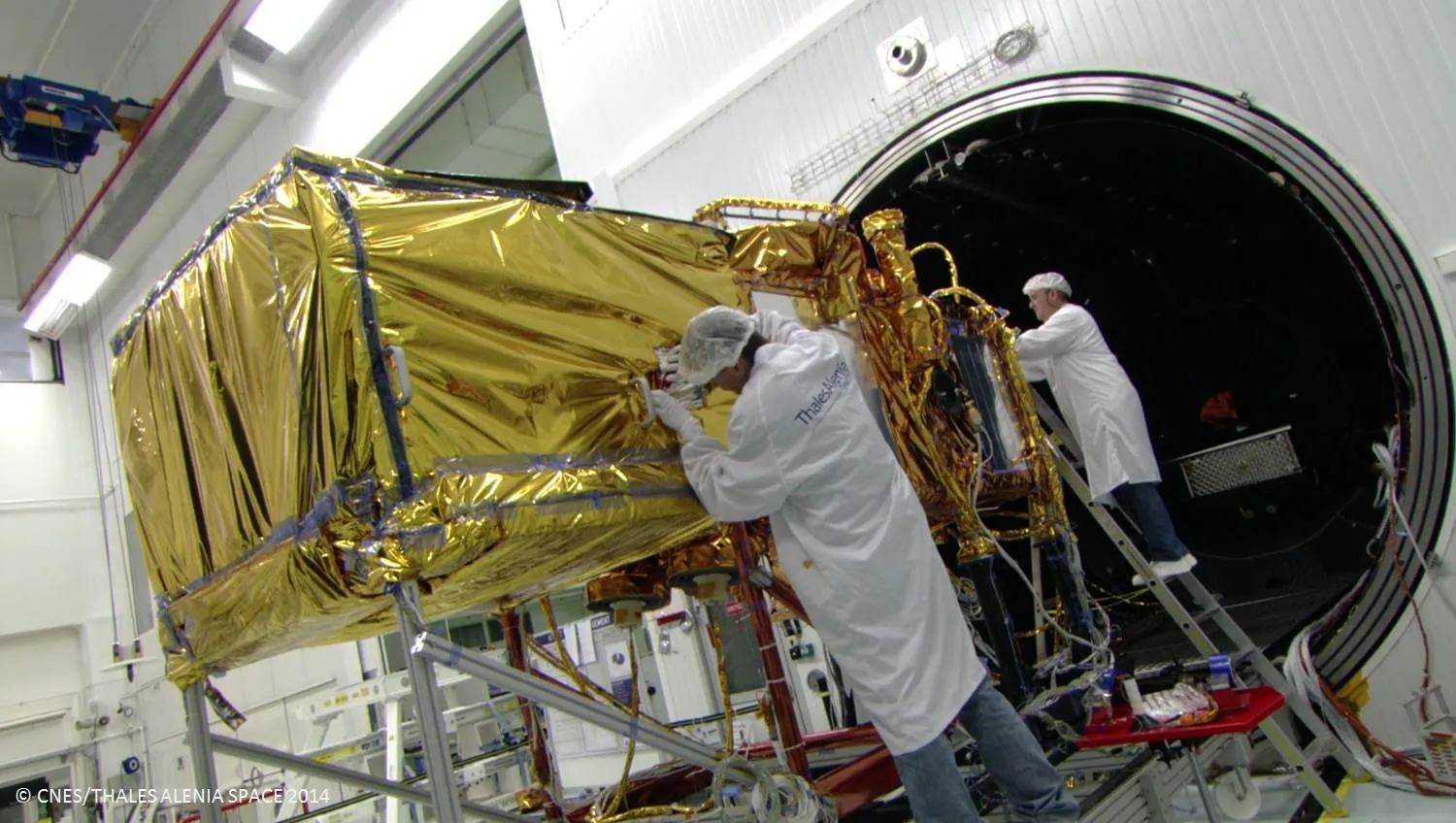
The French satellites, known as IRIS, will replace the three satellites of the current Composante Spatiale Optique (CSO) and maintain France’s space-based image intelligence beyond 2035, according to Defense News. The first IRIS satellite is intended to take over from CSO-1 and CSO-2. The order underlines Paris’s commitment to sovereign reconnaissance at a time when commercial imagery is widely available but cannot guarantee access in a crisis.
| Project | Partners | Stage |
|---|---|---|
| PODS orbital strike study | ATMOS Space Cargo, MBDA Deutschland | Cooperation agreement, 18 Nov 2026 |
| IRIS reconnaissance satellites | Airbus, Thales Alenia Space; French Defence Ministry | Two satellites ordered, over €1.5bn |
Legal and strategic questions
A conventional strike weapon in orbit is not banned by the Outer Space Treaty, which prohibits nuclear weapons and other weapons of mass destruction in orbit. It would nonetheless raise questions about stability. An adversary watching a re-entry vehicle may not be able to tell whether it carries a conventional or nuclear warhead, a concern raised in the past about US conventional prompt global strike concepts. The debate also comes as Western governments warn that Russia may be preparing to place a nuclear device in orbit, a development German media reported this month.
Analysis: Europe’s long-range gap
European militaries have long depended on the United States for deep strike and space-based intelligence. The war in Ukraine and doubts about US commitments have changed that calculation. Programmes such as the European Long-Range Strike Approach, France’s long-range land-strike effort with MBDA and Safran, and now studies into orbital strike all aim to give Europe its own means of holding distant targets at risk. Space reconnaissance like IRIS is the necessary companion: there is no point in long-range weapons without the ability to find targets. Whether PODS ever moves beyond a study will depend on cost, legal risk and whether Berlin and Paris can align their ambitions.
FAQ
Is PODS an existing weapon?
No. MBDA Deutschland and ATMOS have only agreed to study the concept.
What will IRIS replace?
France’s CSO military reconnaissance satellites.