Kuşkapanı vs ASIST, RAST and SAMAHE: How Turkey’s Helicopter Capture System Compares

Every navy that flies helicopters from small ships eventually buys the same kind of equipment: a system that locks the aircraft to the deck at touchdown and moves it into the hangar without people working under a turning rotor. The market is small, the suppliers are few, and the products are usually tailored to one ship and one helicopter. Kuşkapanı, the Helicopter Capture and Transfer System from Turkey’s Altınay Savunma Teknolojileri, is the newest entrant. This page sets it against the systems it will be measured against, from the Canadian Beartrap of the 1960s to Curtiss-Wright’s ASIST and France’s SAMAHE, and separates what is documented from what is a manufacturer claim.
Three jobs every deck handling system must do
Whatever the brand, a deck handling system has to secure the helicopter at the moment its wheels touch the deck, align it with the deck centreline, and traverse it into the hangar. For decades navies did all three by hand, with lashing chains and tow tractors, which meant putting sailors under the rotor disc on a pitching deck and narrowing the weather window for flying. Mechanising those steps became a product category in the 1960s and has evolved through roughly three generations since.
For Altınay the category is a logical extension of its core business. The company’s main competence is motion control: moving a heavy load precisely on an unstable base, which is the same problem it solves in radar pedestals, stabilised weapon mounts and servo drives. The basic description of how Kuşkapanı works phase by phase is in our main Kuşkapanı file; this page is about the comparison.
The established systems
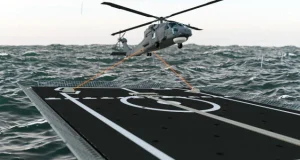
Beartrap, also known as HHRSD, was developed in Canada in the 1960s to let large anti-submarine helicopters operate from destroyers. A cable lowered from the hovering helicopter is connected on deck, a winch hauls the aircraft down, and a trap closes on a probe under the fuselage. RAST, used on US Navy ships that operated the SH-60B under the LAMPS III programme, refined that approach into a package of cable-assisted landing, a rapid securing device and rail traverse into the hangar. Both work well in heavy seas, but both need someone on deck to make the cable connection.
European navies largely went another way from the 1970s onward. In the harpoon and grid method a harpoon under the helicopter engages a steel grid set into the deck, holding the aircraft down with no cable at all; moving it to the hangar is a separate task done with a tractor or a dedicated trolley. France’s SAMAHE builds on that principle and adds a robotic deck trolley that handles the aircraft into the hangar. ASIST, developed by Curtiss-Wright’s Canadian business, removes the cable from the probe-based concept: an optically guided securing device travels across the deck to the helicopter’s probe and captures it after landing. Kuşkapanı belongs to this last, cable-free and crew-free generation.
Side-by-side comparison
| System | Origin / era | Capture method | Cable | Deck crew | Traverse |
|---|---|---|---|---|---|
| Beartrap (HHRSD) | Canada, 1960s | Cable haul-down and trap | Yes | Needed | Rail |
| RAST | Canada/USA, late 1970s–1980s | Cable-assisted landing, rapid securing device | Yes | Needed | Rail |
| Harpoon and grid | Europe, from 1970s | Harpoon locks into deck grid | No | Needed for lashing and towing | Tractor or separate system |
| SAMAHE | France, 2000s | Harpoon-grid plus robotic trolley | No | Reduced | Robotic trolley |
| ASIST | Canada (Curtiss-Wright), 2000s–2010s | Optically guided securing device | No | Not required | Rail |
| Kuşkapanı (HYTS) | Turkey (Altınay), integration 2026 | Image-processing probe tracking, lock within 3 s | No | Not required (one remote operator) | Rail with autonomous alignment |
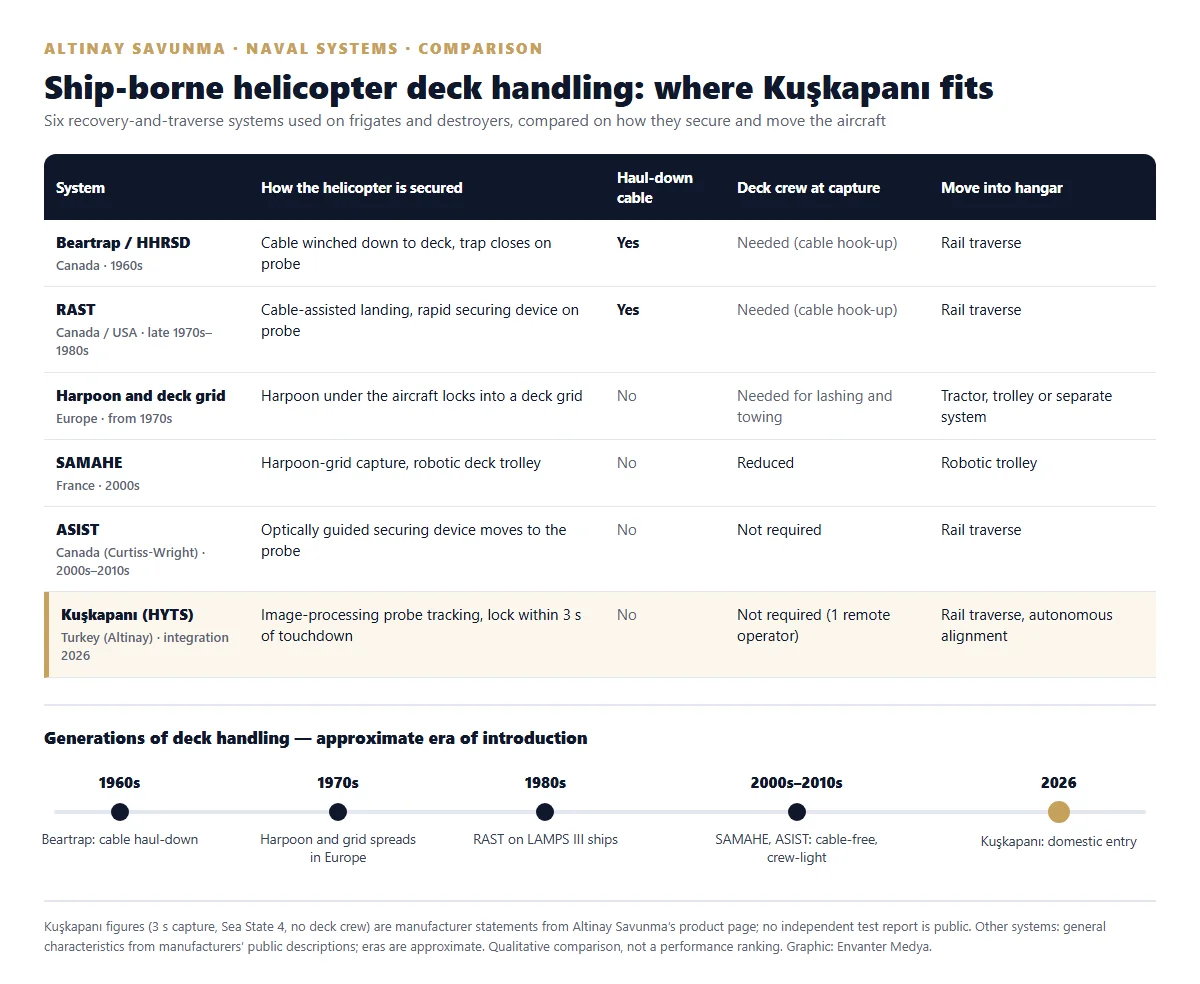
This is a map of approaches, not a ranking. Capture times, sea-state limits and maintenance figures for the foreign systems are published per installation and under different conditions, and no common test set exists in the public domain. The value of the comparison is in placing Kuşkapanı in the right technical generation.
Kuşkapanı’s technical profile
According to Altınay’s product page, Kuşkapanı combines image processing and position calculation, embedded software and control algorithms, and hydraulically and pneumatically driven mechanisms. The system computes the position of the landing probe while the helicopter is still airborne, locks the probe within three seconds of wheel contact, aligns the aircraft with the deck centreline autonomously and draws it along a rail into the hangar. The primary aircraft is the Sikorsky Sea Hawk SH-70 TN, and the stated operating limit is Sea State 4, roughly 1.25 to 2.5 metres of significant wave height, by day and by night.
| Item | Value | Note |
|---|---|---|
| Capture time | 3 seconds | From wheel contact to mechanical lock |
| Sea state limit | Sea State 4 | Day and night operation stated |
| Deck personnel | None required | Single operator at a remote console |
| Sensing | Image processing, position calculation | Probe tracked before touchdown |
| Drive | Hydraulic and pneumatic | With embedded software and control algorithms |
| Ship types | Frigate, patrol vessel, replenishment and combat support ship | Listed integration options |
Where it matches ASIST and where it differs
Kuşkapanı and ASIST share the essential architecture: no cable, and a mechanism that moves on the deck to capture a probe under the helicopter. Altınay points to two differences. The first is that the probe’s position is calculated by image processing while the aircraft is still in the air, so the mechanism is already in place at touchdown. The second is that nobody is on the flight deck during capture; a single operator works from a console. Against RAST and Beartrap, the obvious difference is the absence of the haul-down cable and the deck crew it requires. Against harpoon-and-grid installations, the difference is that traverse to the hangar is part of the same integrated system.
How much those differences matter in service will become clear after integration and acceptance trials on the İstif-class frigates. Until then the accurate description is a domestic system competing in the same class as ASIST.
Programme status and export outlook
Kuşkapanı is being developed for the İstif-class frigates of the MİLGEM programme, with STM as prime contractor, and Altınay has said shipboard integration began in 2026. The company is also developing a JP-5 helicopter fuel transfer system for the same ships, so the two are best read together as a helicopter deck package. For the TF-2000 air-defence destroyer, discussions with ASFAT have been reported; no selection has been announced. How the İstif class compares with its European peers is covered in our İstif versus FREMM comparison.
Navies flying the SH-60/S-70 family and navies buying Turkish-built hulls are the natural market. No export sale has been announced, so that is an assessment rather than customer information. Our files on Altınay’s international activity and the programmes it supports track what has actually been made public, and the company overview covers its wider product range.
| Kuşkapanı and its equivalents — Fact Box | |
|---|---|
| System | Kuşkapanı — Helicopter Capture and Transfer System (HYTS) |
| Manufacturer | Altınay Savunma Teknolojileri A.Ş. (BIST: ALTNY) |
| Class | Ship-borne helicopter capture, alignment and traverse |
| Generation | Cable-free, no deck crew (same class as ASIST) |
| Main foreign equivalents | ASIST, RAST, Beartrap, SAMAHE, harpoon-grid systems |
| Primary helicopter | Sikorsky Sea Hawk SH-70 TN |
| Capture time | 3 seconds (manufacturer figure) |
| Sea state | Up to Sea State 4 (manufacturer figure) |
| Lead platform | İstif-class frigate, STM prime contractor |
| Export | No announced sale |
Frequently Asked Questions
What are Kuşkapanı’s foreign equivalents?
The main systems doing the same job are Canada’s Beartrap and RAST, Curtiss-Wright’s ASIST, France’s SAMAHE and the harpoon-and-grid installations common in Europe. In technical generation, ASIST is the closest.
How does Kuşkapanı differ from ASIST?
Both are cable-free and capture a probe with a deck-mounted mechanism. Altınay’s stated differences are image-processing-based autonomous positioning and having no personnel on deck at capture. No published head-to-head test exists.
Why do RAST and Beartrap use a cable?
The cable lets the ship haul the helicopter down and control the landing in heavy seas. It works, but someone has to connect it on deck, and newer systems aim to remove that step.
How does SAMAHE work?
SAMAHE secures the aircraft through a harpoon engaging a deck grid and moves it into the hangar with a robotic trolley. It is used on French frigates.
Is the three-second capture time verified?
It is a manufacturer statement on Altınay’s product page. No independent test report is public; more data can be expected after acceptance trials on the İstif-class frigates.
Which ships will carry Kuşkapanı?
It is being developed for the MİLGEM programme’s İstif-class frigates, with shipboard integration stated to have begun in 2026. Discussions with ASFAT on TF-2000 have been reported without a selection.
Has Kuşkapanı been exported?
No export sale has been announced. S-70 family operators and buyers of Turkish-built ships are the logical market, but that is an assessment, not a customer list.
Why does Turkey want its own deck handling system?
Deck systems directly affect the readiness of helicopter-carrying ships and tie the navy to a supplier for spares and software. A domestic system reduces that dependency and can be tailored to Turkish ship and helicopter combinations.
Sources
- Altınay Savunma, official product page: Kuşkapanı — Helicopter Capture and Transfer System (altinaysavunma.com, accessed October 2026)
- Altınay Savunma, 2025 results statement: Kuşkapanı for MİLGEM frigates, integration in 2026 (March 2026)
- Hürriyet, interview with Hakan Altınay (August 2026); Altınay news page
- Curtiss-Wright, public product descriptions of ASIST and RAST
- Naval Group, public description of the SAMAHE helicopter handling system
- WMO sea state code
- Envanter Medya archive — Altınay product and programme coverage