Bayraktar KIZILELMA vs S-70 Okhotnik: Full Technical Comparison of Two Unmanned Combat Jets
Summary Not Found.
Two very different visions of the unmanned fighter are taking shape on opposite sides of the Black Sea. Baykar’s Bayraktar KIZILELMA is a compact, carrier-capable jet drone built around affordability and export reach, while Sukhoi’s S-70 Okhotnik is a heavyweight stealth flying wing tied to Russia’s sixth-generation airpower ambitions. This comparison weighs both on technology, maturity and program credibility from a NATO and export standpoint.
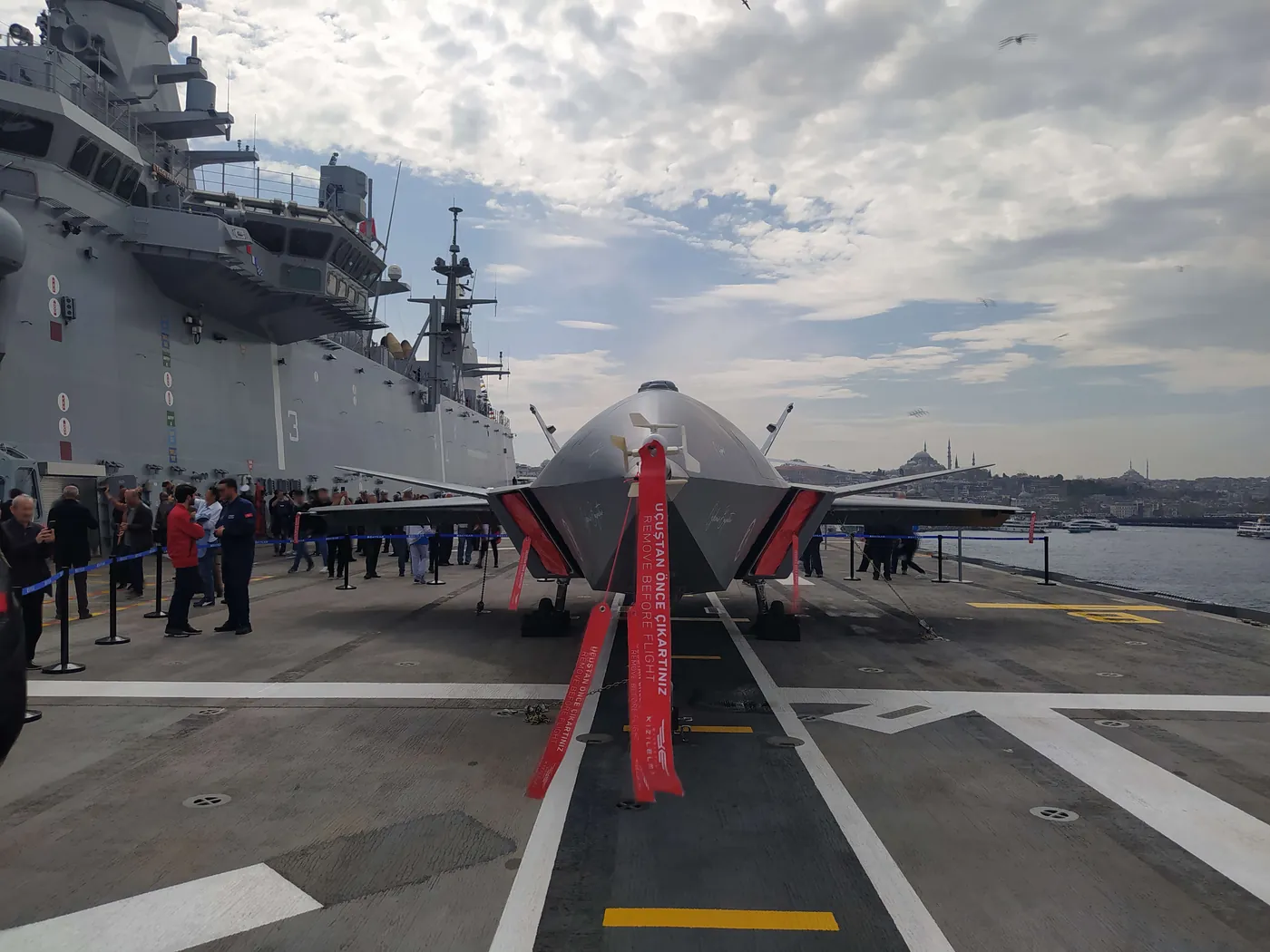
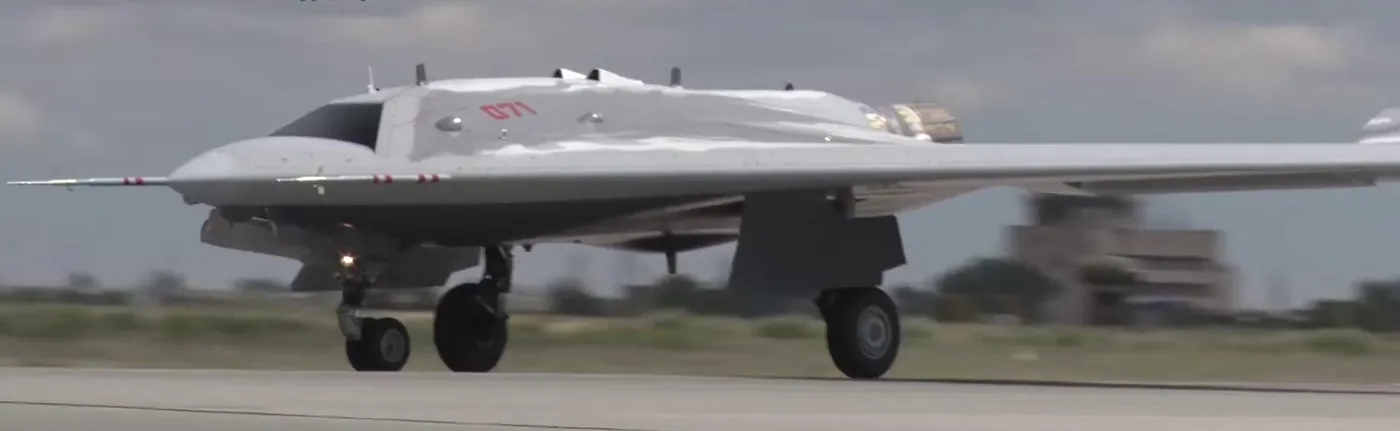
Bayraktar KIZILELMA — CC BY-SA 4.0S-70 Okhotnik — CC BY 4.0
The S-70 Okhotnik is in a heavier weight class and is credited with a payload approaching 2.8 tonnes, allowing it to carry stand-off missiles and guided bombs in an internal bay. On paper this gives the Russian flying wing a clear edge in raw striking mass, positioning it as a deep-strike companion to manned fighters such as the Su-57.
KIZILELMA carries roughly 1.5 tonnes across internal and external stations, but its weapons fit is broader and already integrated with Turkish-made effectors. In November 2025 it completed its first air-to-air test firing, a capability the Okhotnik has not publicly demonstrated. KIZILELMA trades absolute payload for a more diversified, validated weapons portfolio and a genuine air-combat ambition.
Sensors and Avionics
KIZILELMA is built around an indigenous AESA radar, the TOYGUN electro-optical targeting system and AI-assisted mission management with secure long-range datalinks. The design emphasizes manned-unmanned teaming, letting it act as a loyal wingman for KAAN and HURJET. The avionics architecture is new, modular and free of Western export controls.
The Okhotnik’s sensor suite remains opaque. It is intended to leverage Su-57 avionics and act as a sensor-and-shooter node in a networked formation, but the loss of a prototype over Ukraine in October 2024 raised hard questions about its datalink security and autonomous control reliability. In demonstrated, transparent capability, KIZILELMA currently presents the more credible avionics story.
Survivability and Stealth
Both aircraft pursue low observability through internal weapons carriage and shaping. The Okhotnik’s pure flying-wing planform is theoretically superior for all-aspect stealth, but independent analysis of the downed airframe suggested its real-world signature reduction may fall short of designer claims, partly due to the exposed engine nozzle on early prototypes.
KIZILELMA adopts a more conservative semi-stealth approach: reduced signature rather than full broadband stealth, prioritizing affordability and operational availability. Its survivability case rests on numbers, networking and attritability rather than a single exquisite platform. For a NATO-oriented buyer, KIZILELMA’s lower-risk, lower-cost survivability model may be more attractive than an unproven heavyweight.
Cost, Exportability and Alliance Relevance
This is where the two programs diverge most sharply. KIZILELMA is explicitly designed for export, with a competitive unit cost, carrier compatibility for TCG Anadolu-class ships, and freedom from ITAR-style restrictions. Baykar’s proven global sales network with TB2 and AKINCI gives the platform a ready customer pipeline among partner and NATO-adjacent nations.
The Okhotnik is effectively non-exportable: tied to Russian strategic programs, constrained by sanctions, and produced in very small numbers. Its combat debut ended in a friendly-fire shoot-down, undermining confidence. From a Defense News / Janes procurement lens, KIZILELMA is the far more relevant and acquirable system, while the Okhotnik remains a prestige demonstrator with limited reach beyond Russia.
Operating Nations
System
Operators
Bayraktar KIZILELMA
Turkiye (in development/testing); strong export interest among partner nations
S-70 Okhotnik
Russia (prototype/limited pre-series); no export customers
Verdict
On near-term credibility, exportability and a demonstrated air-to-air capability, the Bayraktar KIZILELMA edges ahead (67/100), offering an affordable, alliance-friendly unmanned fighter. The S-70 Okhotnik holds a raw payload and theoretical-stealth advantage but is set back by a troubled combat debut, sanctions and minimal production (50/100).
Frequently Asked Questions
Which is better, the Bayraktar KIZILELMA or the S-70 Okhotnik?
For an export-minded or NATO-adjacent operator, KIZILELMA is the stronger choice today: it is affordable, carrier-capable, free of Western export restrictions, and has already conducted an air-to-air test firing. The Okhotnik carries more payload and has a purer stealth shape, but is unproven, sanctioned and effectively non-exportable.
Has either drone been used in combat?
The S-70 Okhotnik suffered its first confirmed loss in October 2024 when a prototype was shot down by a Russian missile over Ukraine after losing control, its only notable combat-area appearance. KIZILELMA remains in flight testing but has cleared key milestones including air-to-air and precision-strike firings.
Is KIZILELMA a true fighter jet?
KIZILELMA is an unmanned combat aircraft (MIUS) designed for fighter-like roles, including air-to-air engagement and strike. It is not a full manned-fighter replacement but is intended to operate as a loyal wingman alongside KAAN and from short-deck carriers.
What engine does the Okhotnik use?
The S-70 Okhotnik is powered by a single large turbofan in the AL-31F/AL-41F class, the same family used on the Su-27 and Su-35 fighters, giving it far greater thrust and weight than the lighter KIZILELMA.
When will KIZILELMA enter service?
KIZILELMA is progressing through an intensive flight-test campaign that began with its December 2022 maiden flight, with serial production and frontline introduction expected later this decade as the indigenous TF6000 engine matures.