TRLG-230: Roketsan’s 230 mm Laser-Guided Artillery Rocket

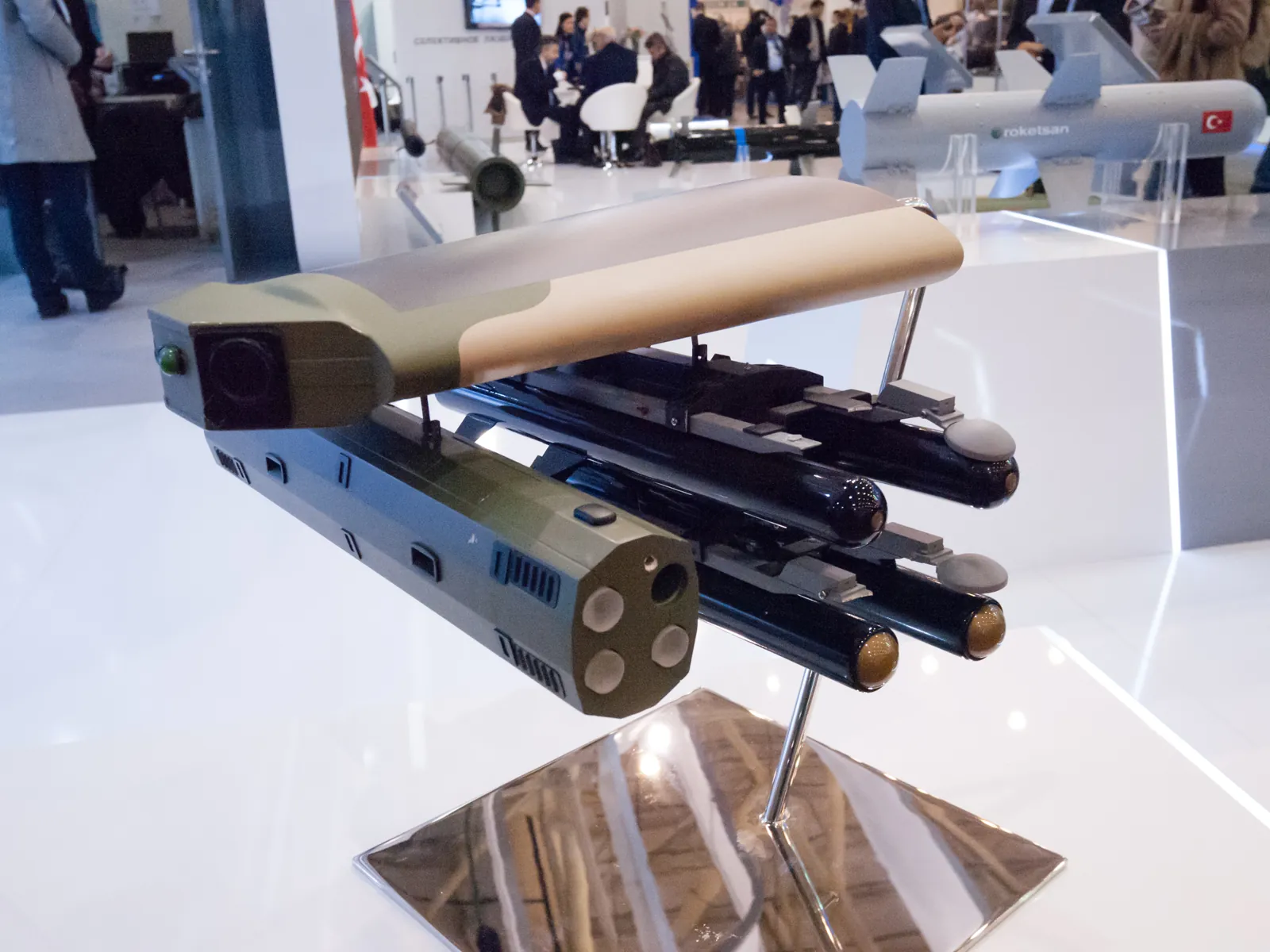
The TRLG-230 is a Turkish 230 mm laser-guided artillery rocket developed by Roketsan. It flies 20-70 km, weighs 210 kg, carries a 42 kg high-explosive warhead and achieves a CEP of 2 m or less using a terminal semi-active laser seeker cued by UAV designation, typically from a Bayraktar TB2. Unveiled in 2020, it was first imaged in Azerbaijan in early 2021, and its use in Ukraine was reported in 2022-23.
| TRLG-230 — At a Glance | |
|---|---|
| Category | Laser-guided artillery rocket (230 mm) |
| Developer | Roketsan (Türkiye) |
| Unveiled | 2020; first field imagery from Azerbaijan, Jan-Mar 2021 |
| Range | 20-70 km |
| Speed | Not officially disclosed |
| Weight | 210 kg (official; 215 kg in secondary sources) |
| Length / calibre | Not officially disclosed (~3.4 m per secondary sources) / 230 mm |
| Warhead | 42 kg HE with steel balls; effective radius ≥55 m |
| Accuracy | CEP ≤2 m (GPS/INS TRG-230 version: ≤10 m) |
| Guidance | GPS+GLONASS-aided INS + terminal semi-active laser seeker |
| Propulsion | Composite solid propellant |
| Platform | Roketsan MCL 6×6/8×8; air-launched derivative TRG-230-IHA (Akinci) |
| Users | Türkiye; Azerbaijan (2021+); Ukraine (reported, 2022-23) |
What is the TRLG-230?
The TRLG-230 is the laser-seeker variant of Roketsan’s TRG-230, a 230 mm guided artillery rocket. Where the baseline TRG-230 relies on GPS/INS guidance to strike fixed coordinates with a CEP of 10 m or better, the TRLG-230 adds a terminal semi-active laser seeker that tightens accuracy to 2 m or less and, crucially, allows the rocket to engage moving targets. Roketsan unveiled the system in 2020; the first field imagery emerged from Azerbaijan between January and March 2021.
The defining concept is the pairing of long-range rocket artillery with unmanned aerial vehicles. A UAV such as the Bayraktar TB2 locates the target and illuminates it with a laser designator; the truck-launched TRLG-230 then homes onto the reflected laser energy during its final approach. This closes a sensor-to-shooter loop in which the drone provides the eyes and the ground launcher provides a warhead far heavier than anything the UAV itself could carry. Few systems in the guided-rocket class offer this combination: the most common Western and Israeli counterparts use satellite/inertial guidance only.
With its 42 kg fragmentation-HE warhead and an effective radius of at least 55 m, the TRLG-230 is aimed at time-sensitive, high-value target sets: air-defence assets, radar vehicles, command posts and vehicles on the move. Its use in Azerbaijan is confirmed by open-source imagery, deliveries to Ukraine were reported in 2022-23, and Roketsan has since marketed the rocket with an explicit combat-proven emphasis.
Technical characteristics and how it works
The TRLG-230 flies a two-phase guidance profile. After launch it navigates on GPS+GLONASS-aided inertial navigation (INS) towards the target area. In the terminal phase the nose-mounted semi-active laser seeker takes over: a UAV or another designator illuminates the target, and the rocket steers onto the reflected laser spot for its final corrections. Because the seeker tracks the target rather than a pre-set coordinate, the rocket retains accuracy even if the target relocates after launch.
- Range: 20-70 km. The lower bound reflects safe-engagement and ballistic-profile requirements; the upper bound is the effective envelope of motor and guidance.
- Warhead: 42 kg HE with steel balls, point-detonation or proximity fuzing, effective radius of at least 55 m.
- Accuracy: CEP of 2 m or less, versus 10 m or less for the GPS/INS-only TRG-230.
- Propulsion: composite solid-propellant rocket motor. Speed has not been officially disclosed.
- Dimensions: 210 kg launch weight (official; some secondary sources cite 215 kg), 230 mm calibre; length not officially disclosed (roughly 3.4 m per secondary sources).
The family also includes an air-launched derivative, the TRG-230-IHA, developed for release from the Bayraktar Akinci UCAV with a targeted envelope of 20-150 km; a December 2022 test demonstrated 100 km and later trials 140 km. Those figures belong to the air-launched variant and should not be conflated with the 20-70 km envelope of the ground-launched TRLG-230.
Internationally, the TRLG-230 sits in the guided artillery rocket class. Its best-known counterparts are the US GMLRS and the Israeli EXTRA, with Iran’s smaller Fateh-family rockets often cited in the same range bracket. What sets the TRLG-230 apart is its terminal laser seeker: the standard versions of its rivals use satellite/inertial guidance only and cannot engage moving targets.
Platforms, users and exports
The standard launcher is Roketsan’s Multi-Calibre Launcher (MCL), integrated on 6×6 or 8×8 tactical trucks. The MCL fires 122 mm, 230 mm and 300 mm munitions from the same vehicle, so the TRLG-230 slots into an existing rocket-artillery architecture without requiring a dedicated fleet. In Azerbaijan the system has been imaged on KamAZ truck chassis.
The user picture, based on open sources, is as follows. Türkiye is the primary operator. Azerbaijan has fielded the system since early 2021, confirmed by open-source imagery. Use in Ukraine was reported in 2022-23, and Roketsan has promoted the rocket as combat-proven; however, no official contract details for Ukraine have been disclosed. The baseline GPS/INS TRG-230 is additionally reported in service in Bangladesh.
As with most defence exports, contract values, quantities and delivery schedules are rarely confirmed officially. User information marked as reported on this page rests on open-source imagery and reporting rather than government confirmation, and should be read with that caveat.
Place in Turkey’s defence industry: advantages and limitations
The TRLG-230 is one of the first series-production products to fuse Türkiye’s UAV ecosystem with its rocket-artillery firepower in a single kill chain. When the Bayraktar TB2’s reconnaissance and laser-designation capability is paired with the rocket’s 70 km reach, a warhead far heavier than any UAV-carried munition arrives on target with precision. This drone-eyes-plus-artillery-punch concept has been tested in the field, through Azerbaijani imagery and Ukrainian reporting, and is the core differentiator in Roketsan’s export pitch.
Three advantages stand out: moving-target engagement at CEP ≤2 m; a multi-calibre common launcher via the MCL; and the cost advantage of a rocket-based airframe over comparable guided missiles. The limitations are equally clear. Terminal laser homing requires the target to be continuously illuminated until impact, which means the designating UAV must survive over the target area — a constraint in dense air-defence environments. Dust, smoke and adverse weather degrade laser performance. And because parameters such as speed and length remain officially undisclosed, independent performance comparisons must work from limited data.
Within Roketsan’s TRG family, this positions the TRLG-230 as a niche but strategic product: the TRG-122 brings precision to the smaller 122 mm calibre, the TRG-300 KAPLAN reaches further with a heavier warhead, and the TRLG-230 stands as the family’s only ground-launched member able to strike targets on the move.
The TRLG-230’s range (20-70 km), weight (210 kg), warhead (42 kg HE, ≥55 m effective radius) and CEP ≤2 m accuracy are based on Roketsan’s official product data. Speed and length have not been officially disclosed; the ~3.4 m length and 215 kg weight found in secondary sources are unofficial. Use in Azerbaijan is confirmed by open-source imagery; use in Ukraine was reported in 2022-23 without officially disclosed contract details. The 100-140 km test figures belong to the separate air-launched TRG-230-IHA derivative.
Frequently Asked Questions
What is the range of the TRLG-230?
The TRLG-230 has a range of 20 to 70 km. The air-launched derivative TRG-230-IHA targets a 20-150 km envelope, with 100 km demonstrated in December 2022 and 140 km in later tests; those figures should not be confused with the ground-launched version.
What is the difference between the TRLG-230 and the TRG-230?
The TRG-230 uses GPS+GLONASS-aided INS to hit fixed coordinates with a CEP of 10 m or less. The TRLG-230 adds a terminal semi-active laser seeker, tightening accuracy to 2 m or less and enabling strikes on moving targets designated by UAV laser.
What platform launches the TRLG-230?
The standard launcher is Roketsan’s Multi-Calibre Launcher (MCL) on 6×6/8×8 tactical trucks. In Azerbaijan the system has been imaged mounted on KamAZ chassis.
Which countries use the TRLG-230?
Türkiye is the primary operator. Azerbaijan has fielded the system since 2021, confirmed by open-source imagery. Use in Ukraine was reported in 2022-23; no official contract details have been disclosed.
What are the TRLG-230’s closest counterparts?
The closest counterparts are the US GMLRS (M31) and the Israeli EXTRA. The TRLG-230’s distinguishing feature is its terminal laser seeker, which enables moving-target engagement — the standard versions of its rivals rely on satellite/inertial guidance only.
When was the TRLG-230 unveiled and fielded?
Roketsan unveiled the system in 2020. The first field imagery came from Azerbaijan between January and March 2021, and use in Ukraine was reported in 2022-23. Türkiye’s own service-entry date has not been officially detailed.
Sources
- Roketsan official product page — roketsan.com.tr
- Open-source defence reporting — Army Recognition, MilitaryLeak, Root Nation (TRLG-230 field imagery and integration reports)
- TRG-230 family data — Wikipedia and GlobalSecurity compilations
- Company and open-source records verified as of 23 July 2026