Germany Hands Israel Its Last Dolphin: What Sits Inside INS Drakon’s Oversized Sail?


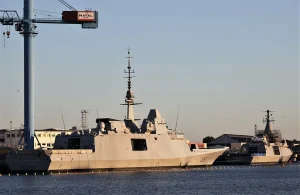
German shipbuilder TKMS has announced the delivery of INS Drakon, the third and final Dolphin AIP submarine built for the Israeli Navy. The boat has left the Kiel yard and is now in transit to Israel, closing a programme ordered back in 2012. What the defence community is actually discussing, though, is not the handover: Drakon is roughly five metres longer than its sisters and carries a sail of unusual size.
At a Glance
- What happened: On 1 September 2026 TKMS said INS Drakon had been delivered and had departed Kiel for Israel.
- Which boat: The third and last of the Dolphin AIP (Dolphin 2) class, Israel’s sixth submarine overall.
- Who built it: TKMS, formerly HDW, at Kiel in northern Germany.
- Price tag: Roughly EUR 650 million for the 2012 order.
- What is different: Sisters Tanin and Rahav measure 68.6 metres; Drakon is about 73-74 metres with a far larger sail.
- The debate: Analysts assess the enlarged sail houses vertical launch tubes. Israel confirms nothing.
- Next up: Three Dakar-class boats worth roughly EUR 3 billion, with deliveries expected early in the 2030s.
- Regional read: What changes in the Eastern Mediterranean is not tonnage but reach and persistence.
A farewell at Kiel, then a transit south
TKMS said on 1 September 2026 that INS Drakon had left its Kiel yard and begun the passage to Israel. The company described the boat as the third and final unit of the HDW Dolphin class fitted with air-independent propulsion, and said the Dolphin AIP programme had been completed with its departure. The send-off ceremony put the naval leadership of both countries on the same quayside.
Israeli Navy commander Vice Admiral Eyal Harel, German Navy chief Vice Admiral Jan Christian Kaack, Israeli defence procurement director Zeev Landau and Israel’s ambassador to Germany Ron Prosor all attended. That guest list alone signals how far this sits from a routine commercial handover. The submarine programme has long been the most visible, and the most contested, strand of German-Israeli defence cooperation.
TKMS chief executive Oliver Burkhard framed the moment around difficulty rather than capability. “With the departure of the INS Drakon, we are successfully concluding a challenging program that was characterized over many years by trust, technological expertise, and shared responsibility,” he said, adding that cooperation would continue with the Dakar class. The commercial subtext is not subtle: the yard wants credit for finishing a programme better known for its delays.
There is a corporate anniversary buried in this too. Kiel has been the Israeli Navy’s principal supplier for decades, building not only the Dolphin submarines but the Sa’ar 6 corvettes as well. Drakon’s departure closes one generation of that relationship; the Dakar class opens the next.
Fourteen years from order to handover
Drakon was ordered in 2012, after Tanin and Rahav had already entered the fleet, for roughly EUR 650 million. The plan at the time was straightforward: a repeat of an existing design, delivered in the early 2020s.
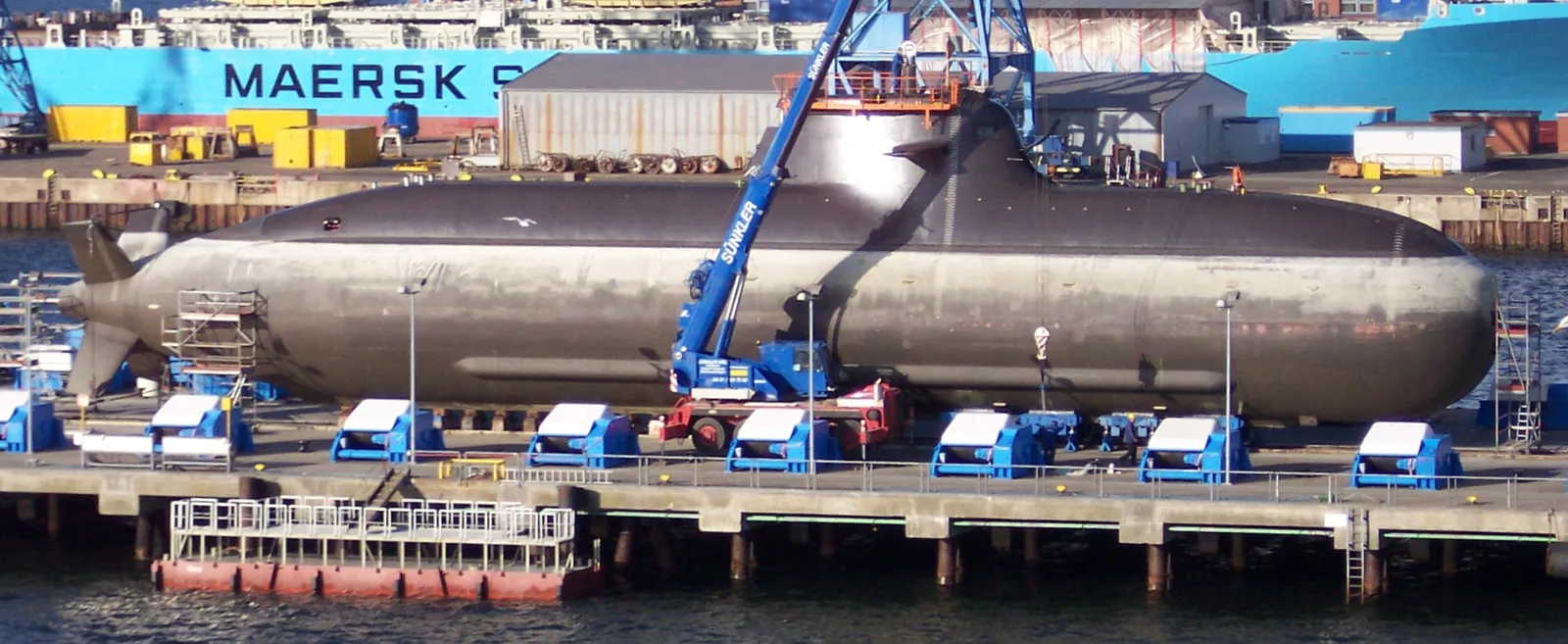
It did not work out that way. The boat was launched once in 2017, after which the design was reworked in what open sources describe as a reconceptualisation, which in practice meant a lengthened hull and a redesigned sail. Drakon was launched a second time in August 2023, was formally christened on 12 November 2024, and began sea trials during the summer of 2025. Fourteen years elapsed between contract and delivery.
The schedule is a reminder of something specific to submarines: they are the hardest military platform on which to freeze a design. Every metre added to the hull cascades into trim, acoustic signature, battery capacity and diving performance. Drakon’s delay looks far less like programme mismanagement than like a capability definition that changed midstream.
Five extra metres, and that sail
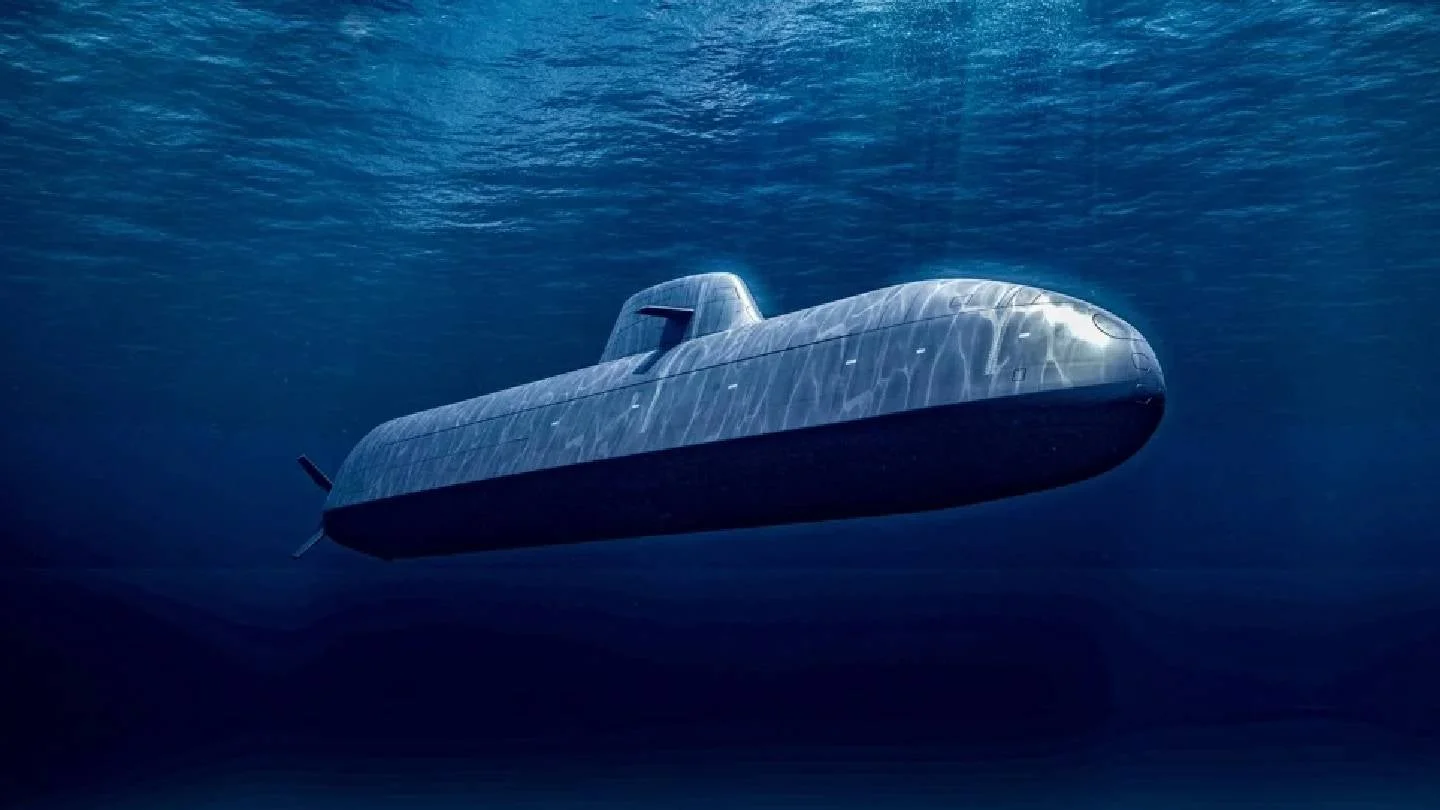
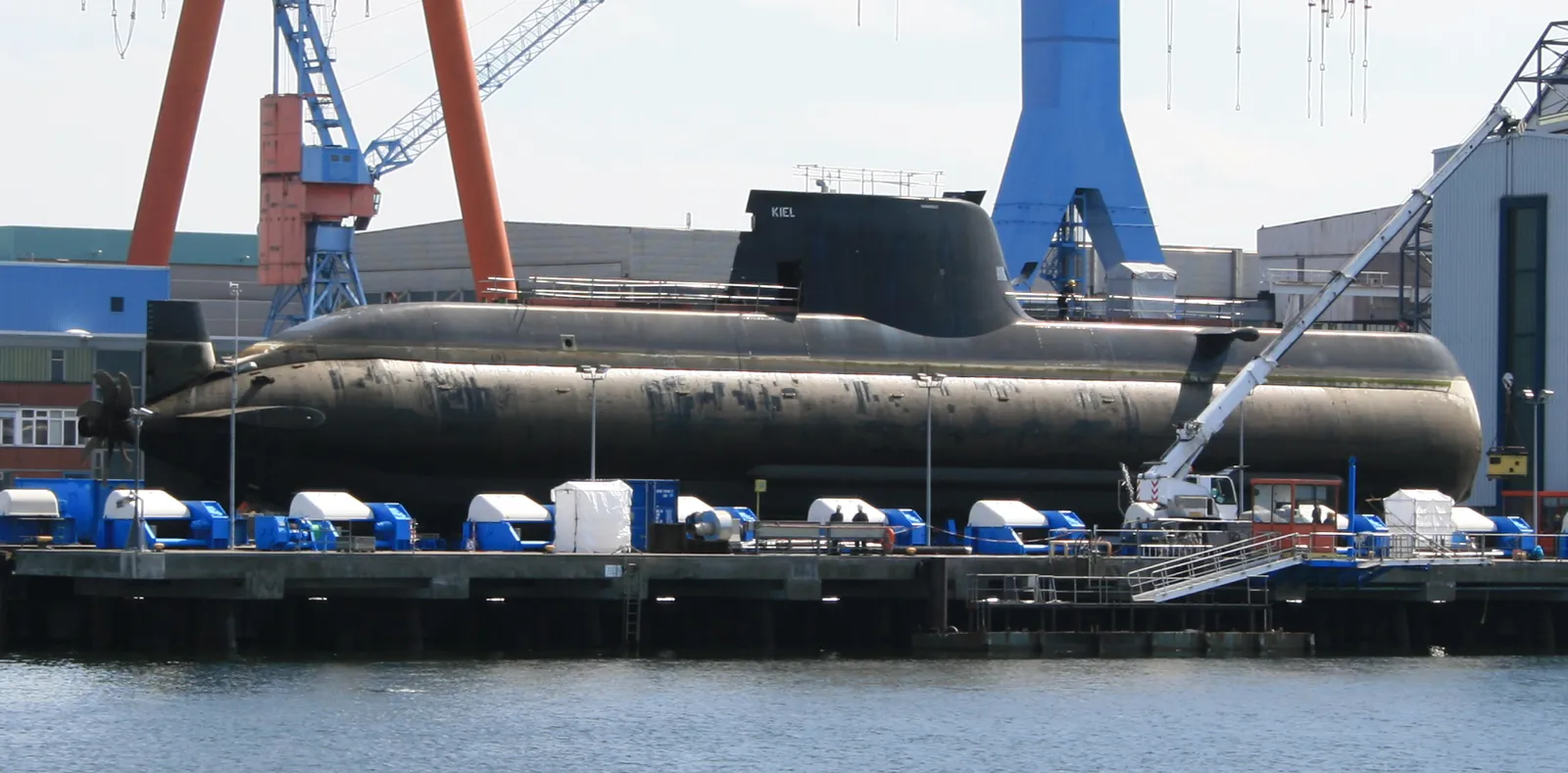
Tanin and Rahav are 68.6 metres long. Drakon comes in at roughly 73-74 metres. In submarine design that is not a rounding difference: it means an inserted hull section, new internal volume and, almost always, a new mission. But the hull is not what draws the eye. The sail does.
Drakon’s sail is markedly larger and taller than anything else in the class. Open-source analysts who track satellite and harbour imagery, most prominently naval analyst H I Sutton, have argued for years that the structure conceals vertical launch tubes. As Naval News reports, imagery analysis suggests those tubes may be sized for submarine-launched ballistic missiles.
A caveat matters here. Israel has never confirmed Drakon’s weapons fit, or any strategic capability in the class. These assessments rest on external shape, volume arithmetic and historical comparison. Even so, an innocent explanation is hard to construct. Internal volume is the most expensive commodity on a submarine, and no yard adds a structure that increases drag and acoustic signature without buying a serious capability in return.
Why the vertical-launch question matters
Israel’s existing Dolphins have long been assessed to carry cruise missiles through four enlarged 650 mm tubes, forming the sea leg of the country’s nuclear deterrent. That has never been acknowledged; Israel has maintained decades of deliberate ambiguity on nuclear weapons, neither confirming nor denying.
The difference between a cruise missile fired from a torpedo tube and a ballistic missile fired from a vertical tube is doctrinal, not technical trivia. A cruise missile flies low, slow and long, and can be tracked and shot down. A ballistic missile climbs, arcs and arrives in a fraction of the time, and intercepting it is a vastly harder problem. Adding vertical tubes converts a boat from a platform that carries weapons into the carrier of a second-strike capability.
Second strike is the load-bearing concept in deterrence theory. If every silo and airbase on land can be destroyed in a first attack, but one platform of unknown position remains under the sea, the attacker cannot obtain the result the attack was designed to produce. What makes a submarine strategic is not its range but the fact that it cannot be found. That is the real substance of the Drakon debate: not a new weapon, but which leg of a deterrence architecture is being reinforced.
Naval News assesses that combining the existing cruise-missile capability with a new ballistic system would give the Israeli Navy a more flexible and more survivable strategic option. Whether that assessment holds will only become measurable over years, through leaked imagery and observed test activity.
INS Drakon at a technical glance
| Item | INS Drakon (Dolphin AIP) |
|---|---|
| Class | Dolphin 2 / “Dolphin AIP”, diesel-electric with air-independent propulsion |
| Builder | TKMS (formerly HDW), Kiel, Germany |
| Ordered | 2012 |
| Approximate cost | EUR 650 million |
| Length | About 73-74 metres (sisters: 68.6 m) |
| Beam / draught | 6.8 m / 6.2 m |
| Displacement | 2,050 t surfaced / 2,400 t submerged |
| Crew | Up to 45 |
| Speed | More than 25 knots submerged |
| Test depth | At least 350 metres |
| Propulsion | Three diesels, single shaft, roughly 4,240 shp; PEM fuel-cell AIP |
| Torpedo tubes | Six 533 mm plus four enlarged 650 mm |
| Known weapons | DM2A4 Seehake wire-guided torpedo, IDAS anti-helicopter missile |
| Contested feature | Vertical launch tubes assessed to sit inside the enlarged sail (never officially confirmed) |
The Dolphin class: Germany’s most contested export line
The family dates to the early 1990s and the aftermath of the Gulf War, when Germany financed the first two boats for Israel largely as a grant and shared the cost of the third. Dolphin, Leviathan and Tekuma entered service in 1999 and 2000. That first batch was an enlarged derivative of the German Type 209 line, reworked to Israeli requirements, and its signature feature was the addition of four 650 mm tubes alongside the standard 533 mm battery.
The second batch, Dolphin 2 or Dolphin AIP, brought air-independent propulsion. PEM fuel cells stretch the time a diesel-electric boat can remain submerged from days to weeks without raising a snorkel, which is to say without approaching the surface. Compared with nuclear propulsion the endurance and speed are modest, but the acoustic signature is far quieter. INS Tanin arrived in 2014 and INS Rahav in 2016; Drakon closes the line.
Operational history remains largely classified. What appears in open literature clusters around long-range transits and passages toward the Red Sea. The deterrent value of such deployments lies not in striking a target but in demonstrating that the boat can reach one. In nuclear deterrence, the message routinely precedes the weapon.
The commercial side was contested throughout. The high proportion of German state subsidy attached to these exports has been a recurring political argument in Berlin, while procurement decisions around the class generated prolonged investigations in Israel. It is a textbook demonstration that arms exports are never purely an engineering matter.
Next in line: three Dakar-class boats worth about EUR 3 billion
As TKMS underlined, the end of the Dolphin AIP programme is not the end of the relationship. Israel signed for three Dakar-class submarines in early 2022, in a package worth roughly EUR 3 billion, with the German government reported to be covering a share of the cost, described in open sources as around a fifth. Construction of the first boat began several years ago.
The name commemorates the Israeli submarine lost with all hands in the Mediterranean in 1968, following the naval tradition of carrying lost ships’ names into new generations. Deliveries are expected from the early 2030s at roughly eighteen-month intervals, replacing the original Dolphin, Leviathan and Tekuma.
The Dakar programme may also explain why Drakon looks the way it does. A lengthened hull, an enlarged sail and increased internal volume are precisely the sort of solutions a yard would want to mature on an existing platform before they become standard on a new class. Read that way, Drakon is both the last boat of one programme and the first prototype of the next.
Berlin’s export argument, and the submarine exemption
The handover lands in the middle of two years of German back-and-forth over arms transfers to Israel. Berlin suspended approvals for military equipment that could be used in Gaza in August 2025, with Chancellor Friedrich Merz saying no such exports would be authorised until further notice. In November 2025 the government lifted the restriction, citing the ceasefire that had taken effect in October, and returned to case-by-case assessment.
Amnesty International and the European Center for Constitutional and Human Rights criticised the reversal sharply, with Amnesty calling the resumption reckless and unlawful. Germany is reported to have approved around EUR 485 million in arms exports to Israel since October 2023.
The submarine line occupies an unusual place in that argument. The August 2025 restriction was scoped to materiel usable in Gaza, and an ocean-going strategic submarine fell outside that definition, so the programme continued uninterrupted. The episode illustrates how export restrictions work in practice: political decisions tend to bite on visible, recognisable systems with near-term delivery schedules, while decade-long strategic programmes flow on beneath the argument.
How much does the Eastern Mediterranean actually change?
The Eastern Mediterranean is one of the most submarine-dense enclosed seas on earth. The fleets of Turkey, Greece, Israel, Egypt and Algeria overlap there with Russian, American, French and British units in a relatively confined body of water. Seabed topography, salinity layering and heavy commercial traffic combine to make it one of the hardest sonar environments anywhere.
What Drakon adds to that equation is not tonnage. A 2,400-tonne diesel-electric boat does not by itself shift the regional balance of forces. What shifts is the calculation problem created by moving a possible strategic capability out to sea: the existence of a platform whose position is unknown inserts permanent uncertainty into an adversary’s entire planning cycle. The arithmetic of deterrence runs on the cost of not knowing, not on counting launchers.
A second consequence follows. Underwater surveillance and anti-submarine warfare stop being a supporting function and become a primary line of investment. Fixed hydrophone arrays, unmanned underwater vehicles, hull and dipping sonars: this is where regional navies are most likely to concentrate spending over the coming decade.
The view from Ankara
Turkey operates one of the largest submarine fleets in the Eastern Mediterranean and, as it happens, buys from the same design house as Israel. Its Preveze and Gür boats descend from the German Type 209 line, while the Reis class now entering service is based on the Type 214TN, with one decisive difference: those boats are built at Gölcük Naval Shipyard. Turkey has moved past buying submarines and into building them with its own workforce.
The two programmes answer different questions. Israel’s Dolphin and Dakar line concentrates on closing a strategic gap with a handful of boats built abroad, which leaves the supply chain entirely external. Turkey’s line is built around numbers, continuity and indigenous content: each Reis-class boat carries a higher share of domestic systems, including ASELSAN sonar and electronic support suites, HAVELSAN combat management software, and Roketsan’s AKYA heavyweight and ORKA lightweight torpedoes, with ATMACA and the submarine-launched CAKIR available on the anti-ship side.
The next threshold is MILDEN, the national submarine programme. What separates MILDEN from everything before it is not licensed construction but design authority. Between building a submarine under licence and designing one from a blank sheet lies a barrier only a handful of states have crossed. Hull form, acoustic signature management, diving systems and combat system integration are where design competence becomes the one form of independence that does not require an export licence.
Comparing programmes of different scale and purpose directly would be misleading: Israel has chosen a small number of very expensive boats with a strategic mission, Turkey a broad fleet sustained by its own industry. But Drakon does underline a point that travels. Internal volume is a submarine’s scarcest resource, and what a navy decides to put in that volume today governs what it can do for the following thirty years. That is exactly where the weight of MILDEN’s design decisions sits.
Sources
- Naval News, “TKMS Delivers INS Drakon to Israel: Final Dolphin-class Submarine Features New Missile Capability”, 3 September 2026
- TKMS press release on the delivery of INS Drakon, 1 September 2026
- Defence Industry Europe, “TKMS delivers INS Drakon to Israeli Navy, completing Dolphin AIP programme”
- Naval Technology, “Israel receives final Dolphin-class submarine from Germany’s TKMS”
- Naval News archive, Israel orders three Dakar-class submarines, January 2022
- Al Jazeera and Euronews reporting on Germany lifting its arms export restrictions, November 2025
- Amnesty International and ECCHR statements on German arms transfers