The US Navy Wants Its Torpedoes Waiting on the Seabed: Inside Liberator


The US Navy is trying to remove the most expensive variable in undersea warfare: the submarine itself. In an analysis published on 26 August 2026, Naval News laid out Liberator, a programme that takes the Mk 48 ADCAP heavyweight torpedo off a hull and puts it directly on the ocean floor. Delivered by the Orca unmanned undersea vehicle weeks or months ahead of a crisis, the system is meant to wait in silence and then decide, on its own sensors, when the carrier or the submarine passing overhead is worth killing. The FY2027 line for the programme is $27 million. The number is small. The idea behind it is not.
At a Glance
- What: Liberator, a stationary seabed-emplaced launcher for torpedoes and other payloads.
- Who: US Navy; managed by Program Executive Office, Unmanned and Small Combatants (PEO USC).
- Primary payload: Mk 48 ADCAP heavyweight torpedo, 295 kg (650 lb) warhead; also Mk 54 LWTs and one-way attack UUVs.
- Delivery platform: the 10-metre multi-purpose payload module of Boeing’s Orca XLUUV.
- Money: $27 million requested for FY2027; on the Orca side, $135.8 million in FY2027 and $1.13 billion across the FYDP for 16 vehicles.
- Schedule: full-scale test asset in FY2026; competitive OTA prototype awards in Q3/Q4 FY2026; end-to-end at-sea demonstration late in FY2027.
- Where: the geography named out loud is the Taiwan and Luzon Straits.
- Why it travels: narrow straits and shallow enclosed seas are where a stationary undersea effector pays for itself — which is a description of Turkiye’s neighbourhood.
Not a Submarine, Not Quite a Mine: What Liberator Actually Is
In conventional undersea warfare, a torpedo has an address. It lives inside a submarine or a surface ship, and something expensive and crewed has to carry it into range. Liberator cuts that chain in half. According to a 26 August 2026 analysis by Naval News reporter Carter Johnston, the programme separates the weapon from its carrier and puts it on the seabed instead.
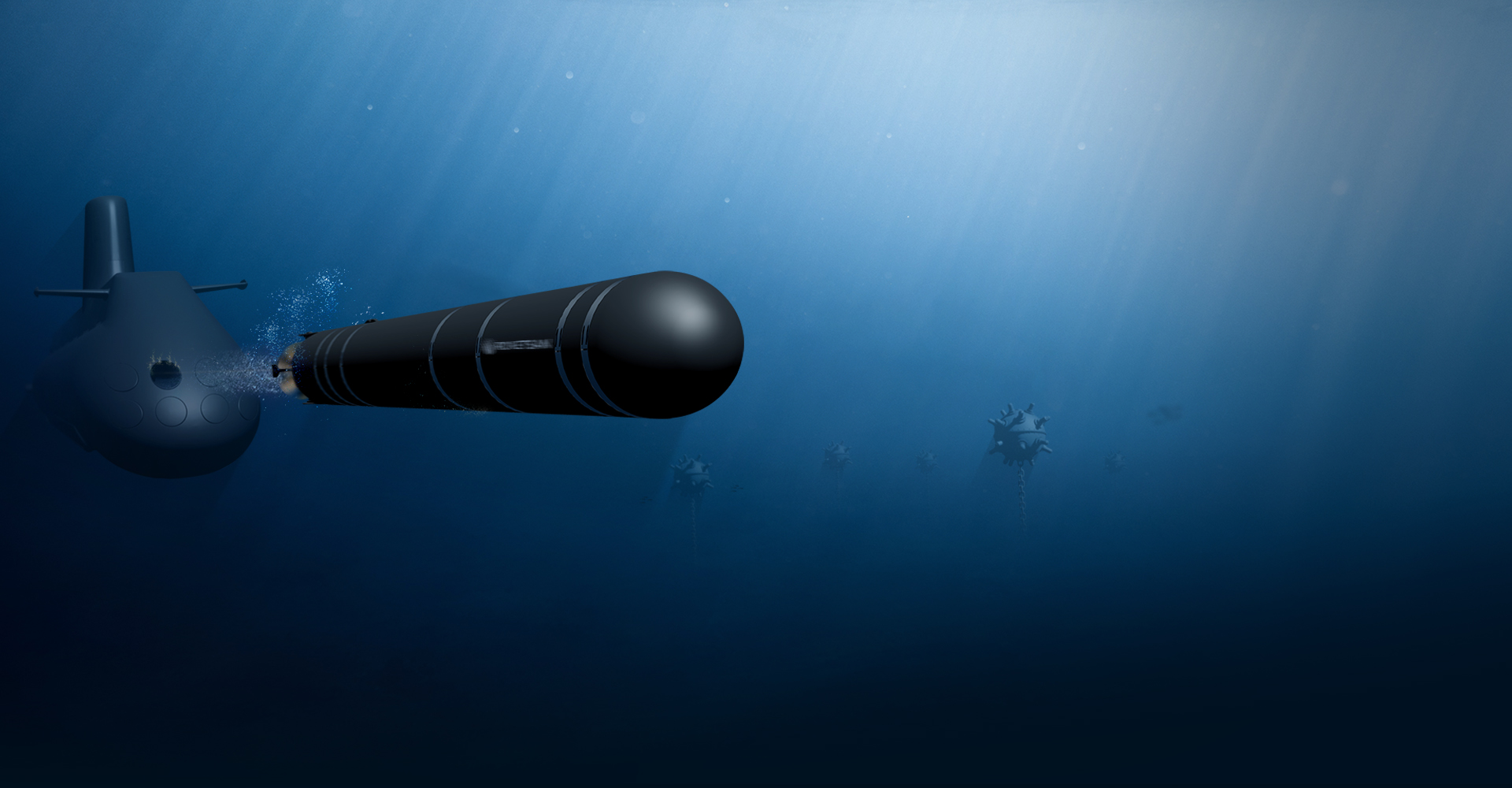
The Navy’s own budget language is dry enough to be easy to miss. Liberator is described as “an alternative delivery system for torpedoes or similar devices” and as “a stationary system placed on the seabed to launch various payloads.” That is neither a mine nor an unmanned vehicle. It is something in between: a magazine that sits on the ocean floor, listens, decides and fires.
The cleanest way to understand it is to ask who does the driving. If you want a torpedo waiting in a strait that an adversary carrier group has to transit, someone has to take it there. Today the answer is a nuclear attack submarine, which then has to stay, stay hidden, and stay fed. Liberator’s answer is that nobody has to — the torpedo has been there for months.
That changes the cost structure of presence more than it changes the lethality of any single shot. A Virginia-class boat in one theatre is a Virginia-class boat absent from every other theatre. A canister on the seabed has no opportunity cost at all once it has been laid.
How the Programme Surfaced: Buried in 5,000 Pages of Budget Justification
Liberator’s route into public view is a small case study in how American defence programmes become visible. It appeared quietly in 2025, with the first traces sitting inside roughly 5,000 pages of research and development budget documents published in June 2025. Naval News says it was first to cover the programme and its objectives, in July 2025. Navy officials declined to comment on specifics at the time.
Then, in October 2025, came an industry day. PEO USC delivered a three-and-a-half-hour brief on Liberator to industry. In defence acquisition, a 3.5-hour industry brief is not the sound of a concept being explored. It is the sound of a requirement being handed over.
Through 2026 more detail dropped into the documents. Money has been committed to the design and fabrication of a full-scale test asset, and the Navy is expected to award a competitive Other Transaction Authority contract to several competitors for prototypes. OTA is the fast lane around traditional acquisition rules, and it is the Pentagon’s instrument of choice for unmanned systems.
The Schedule Runs Through Late FY2027
The timeline in the documents is tight. FY2026 covers design and fabrication of the full-scale test asset. Competitive OTA prototype awards to multiple vendors are expected in the third and fourth quarters of that fiscal year. FY2027 brings production contracts, a finalised maintenance and operational test plan, and initial training for fleet sailors. Late in FY2027, an at-sea demonstration is meant to test end-to-end capabilities.
“End-to-end” is the operative phrase. Launching a heavyweight torpedo out of a container on the seafloor is hard engineering, but it is engineering. The real examination is whether the system recognises the right target at the right moment after months of silence — whether the whole chain works. That demonstration is the programme’s genuine milestone.
There is a second programme riding on the same schedule. Hunter, described as a lethality enhancement payload for Boeing’s Orca XLUUV, has been explicitly tied to Liberator: “the acquisition strategy for Hunter program will be developed by Q1FY28 in alignment with the Liberator program timeline.” If Liberator slips, Hunter slips with it.
Why the Mk 48 ADCAP Choice Gives Away the Target List
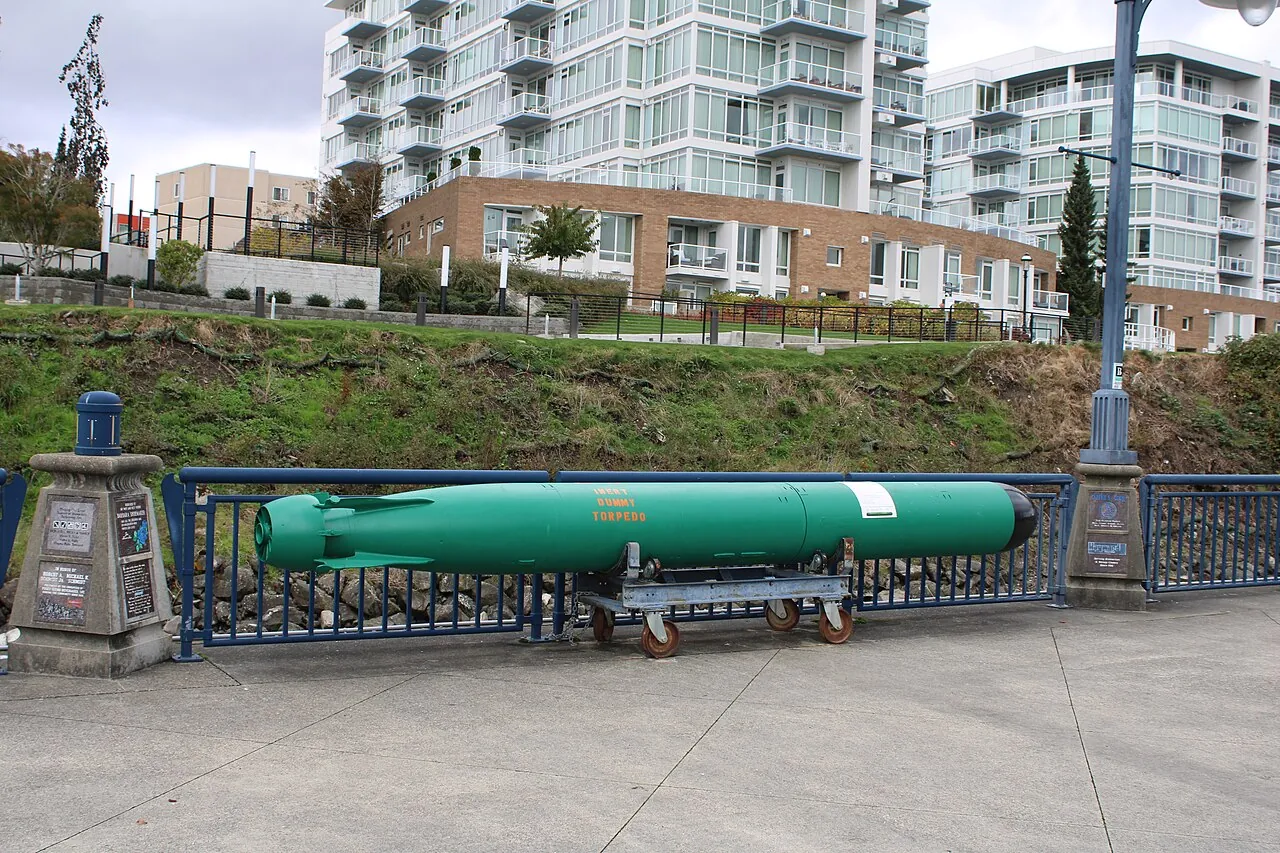
Building the system around the Mk 48 ADCAP rather than a lightweight torpedo tells you what the Navy expects to shoot at. The ADCAP warhead weighs 295 kg (650 lb). For comparison, the Mk 54 lightweight torpedo carried by the Hammerhead encapsulated effector the Navy is already buying has a 44 kg (100 lb) warhead.
A factor of roughly seven is not a technical footnote; it is a doctrinal choice. A 44 kg warhead is enough to end a submarine’s day. A 295 kg warhead puts surface tonnage on the table — carriers, amphibious assault ships, replenishment vessels. Naval News lists exactly those categories among the high-value targets Liberator is intended to hold at risk.
Publicly available estimates put Mk 48 ADCAP range in excess of 12 to 21 nautical miles, which turns each emplaced canister into a threat circle tens of miles wide. Other payloads under consideration include Mk 54 lightweight torpedoes, the Mk 54 Compact Rapid Attack Weapon, and one-way attack undersea vehicles developed by the Defense Innovation Unit. Liberator is being designed as a magazine for a family of effects, not a housing for one weapon.
The Orca Connection: Designed Around a 10-Metre Payload Module
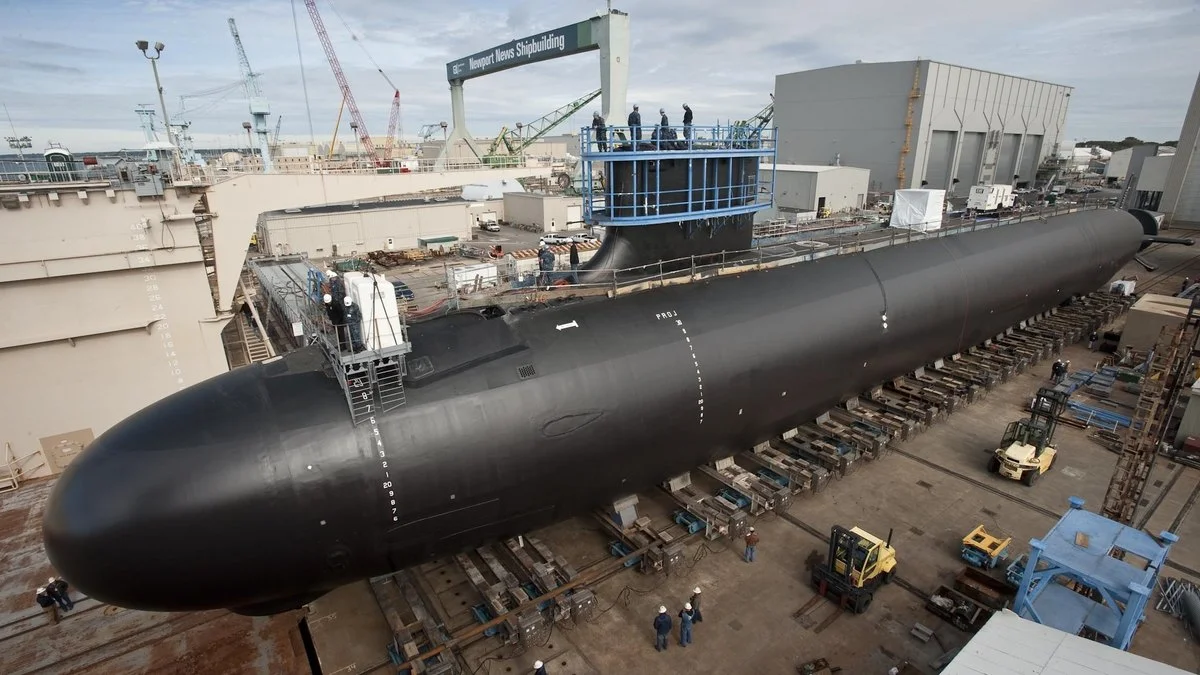
Liberator’s dimensions are dictated by its ride. The system is being designed around the 10-metre multi-purpose payload module of the Orca XLUUV. Earlier renderings showed at least twelve heavyweight torpedo tube launchers mounted together.
Boeing’s Orca is among the largest operational unmanned undersea vehicles anywhere and sits at the centre of US Navy undersea autonomy plans. The FY2027 budget carries $135.8 million for XLUUV procurement, covering two vehicles, against a projected $1.13 billion across the Future Years Defense Program and a total of 16 vehicles through FY2031.
Set against those figures, Liberator’s $27 million FY2027 line looks modest. But in defence budgets the size of a line rarely reflects the size of an idea. Twenty-seven million dollars is what a prototype-and-demonstration phase costs; the real bill arrives with a production decision. A related effort, the Combat Autonomous Maritime Platform (CAMP), is moving alongside it in support of Orca development.
Liberator at a Glance: The Technical Record
| Item | What is known |
|---|---|
| Programme | Liberator |
| Type | Stationary seabed-emplaced multi-payload launcher |
| Managing office | PEO Unmanned and Small Combatants (PEO USC) |
| Primary payload | Mk 48 ADCAP heavyweight torpedo |
| Warhead | 295 kg (650 lb) |
| Weapon range | In excess of 12-21 nautical miles (public estimate) |
| Alternative payloads | Mk 54 LWT, Mk 54 Compact Rapid Attack Weapon, one-way attack UUVs (DIU) |
| Delivery platform | Boeing Orca XLUUV, 10 m multi-purpose payload module |
| Depicted capacity | At least 12 heavyweight torpedo tubes |
| FY2027 request | $27 million |
| Prototype contracting | Q3/Q4 FY2026, competitive OTA, multiple vendors |
| At-sea demonstration | Late FY2027, end-to-end capability |
| Linked programme | Hunter (acquisition strategy by Q1 FY2028) |
| Named geography | Taiwan and Luzon Straits |
The Cold War Lineage: From Mk 60 CAPTOR to Hammerhead
None of this is new. A torpedo that waits on the bottom and chooses its own target is a revival of a concept the US Navy fielded four decades ago. The Mk 60 CAPTOR — enCAPsulated TORpedo — entered service in 1979 and stayed in the inventory until 2001.
Its logic still holds. CAPTOR used Reliable Acoustic Path propagation to passively distinguish hostile submarine signatures from surface vessels and friendly submarines, then launched the Mk 46 torpedo inside it once a target was confirmed. It could be laid by aircraft, submarine or surface ship, sat at depths down to 1,000 feet, and stayed operational for weeks to months. The air- and ship-laid variant measured 3.68 m and 1,077 kg; the submarine-laid version 3.35 m and 935 kg.
The nearer relative is Hammerhead. Built by General Dynamics Mission Systems, this moored encapsulated effector houses a Mk 54 lightweight torpedo modified for underwater launch and releases it once its sensors confirm a hostile contact. GDMS took an initial $92.9 million contract in 2022, a $20.7 million option in 2024, and in 2026 a $229.65 million modification for 188 additional units, with most work in Taunton, Massachusetts, and completion expected by October 2028.
Liberator differs in scale and in ambition. Hammerhead is a moored anti-submarine system; Liberator sits on the bottom, throws a far heavier weapon and brings surface targets into scope. Two weight classes of the same family is the right way to read them.
The Hard Part Is Not Firing. It Is Deciding.
Putting a torpedo on the seabed is an engineering problem. Firing it at the right moment is a doctrine problem. Since CAPTOR, the genuine difficulty in this family has never changed: discrimination.
The system is underwater and cannot ask anyone. Whatever passes overhead — a hostile submarine, a friendly one, a neutral merchant, a fishing boat — has to be classified by onboard sensors. However good the acoustic signature library, if that call is made without a human in the loop then the error margin translates directly into political consequence. A 295 kg warhead delivered to the wrong hull is not a malfunction; it is an international incident.
Which means Liberator’s most critical subsystem is not the torpedo but the sensor-and-decision chain, and probably some form of communications. Undersea communication is a domain where transmitting is itself a way of being found: stay quiet and you cannot be authorised, ask for authorisation and you may be located. The public documents do not say how that trade has been resolved.
Power, Corrosion and Biofouling: The Cost of Waiting
Keeping a weapon alive on the seabed for months may be harder than firing it. Seawater is patient with nothing left in it, and three unglamorous problems decide whether the concept works.
The first is energy: keeping sensors listening, a processor running and launch power available for months demands a serious power budget. The second is corrosion and biofouling — anything resting on the bottom is colonised within weeks, degrading both acoustic performance and the reliability of the launch mechanism. The third is recoverability: how the weapon is safed or retrieved when a crisis passes is a legal question as much as a technical one.
CAPTOR solved these to a “weeks to months” standard with 1970s technology. Modern battery chemistry, low-power processing and coatings should stretch that considerably. But no endurance claim means anything until it is demonstrated in water, which is precisely what the late-FY2027 event is for.
A Legal Grey Zone: Mine or Weapon System?
How Liberator is classified matters nearly as much as how it performs. Naval mine use is governed by Hague Convention VIII of 1907 and subsequent customary law, which imposes obligations such as rendering anchored automatic contact mines harmless once they break free, and notifying mined areas.
Whether a seabed-emplaced system that selects targets with its own sensors and fires a torpedo fits neatly inside that framework is contested. The United States has historically preferred to call such systems “encapsulated effectors” or weapon systems rather than mines — the phrasing in Hammerhead’s formal designation is not an accident. Naming determines obligation.
This is not an academic argument. Transit regimes through international straits, neutral commercial shipping and post-conflict clearance responsibility will all come under pressure as these systems proliferate.
Why Taiwan and Luzon
Naval News names two pieces of water for the deployment concept: the Taiwan Strait and the Luzon Strait. The choice explains why encapsulated undersea weapons are back.
The value of an emplaced effector is inversely proportional to how much sea room the target has. Waiting in open ocean is statistically pointless; waiting in a strait a target must transit is close to optimal. The system uses geography itself as a sensor, collapsing a search problem into a waiting problem.
The second reason is access. These waters are assumed to be heavily contested in a crisis, making prolonged submarine presence progressively riskier. Liberator’s logic is to place the weapon before the crisis and withdraw the platform. In Naval News’s framing, the systems “could covertly be deployed from Orcas or other platforms to the seafloor of contested or denied waters some time in advance” to wait for high-value targets.
Read From Ankara: Enclosed Seas and Narrow Straits
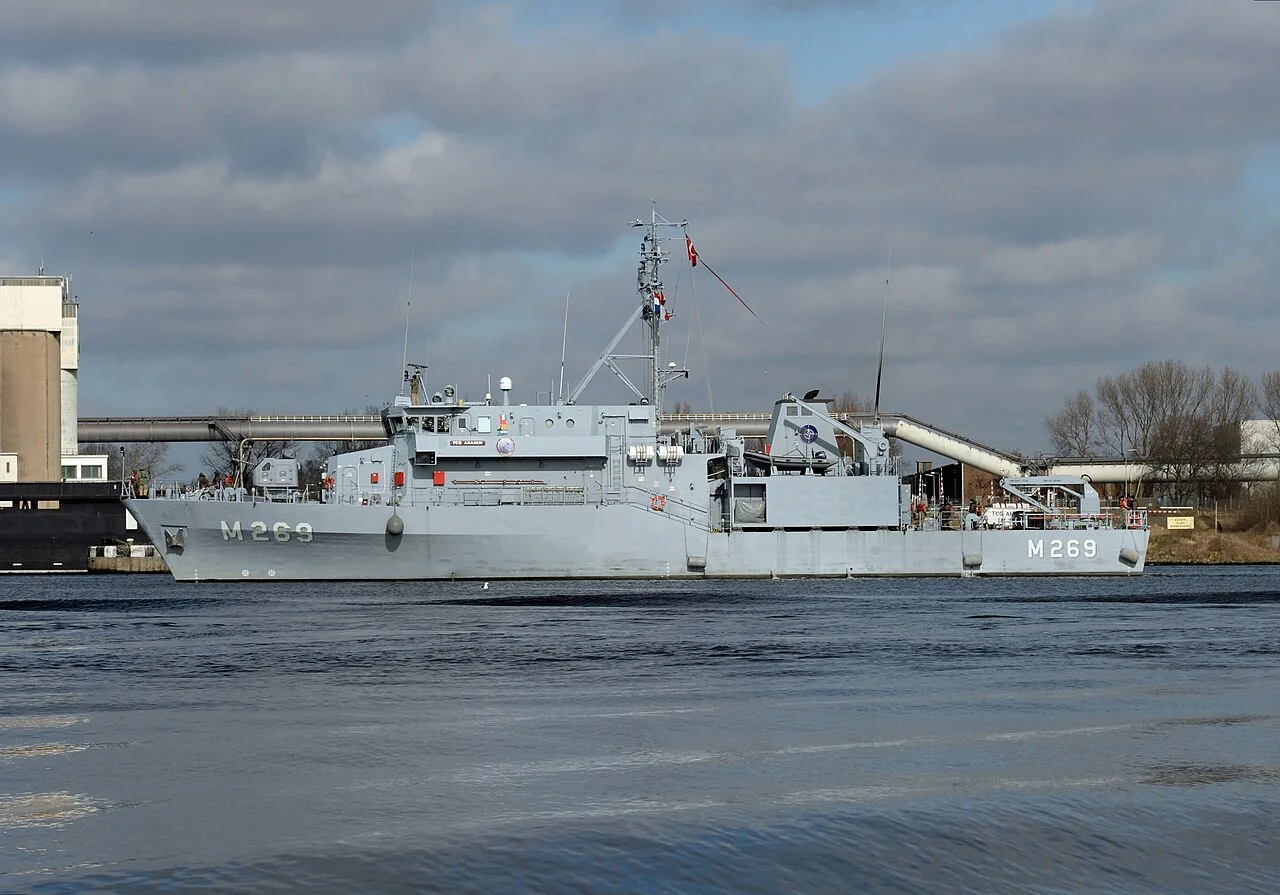
The framing behind Liberator is immediately familiar in Turkiye. The environment in which an encapsulated undersea weapon performs best — narrow passages, shallow enclosed seas, water where the target has no alternative route — is a literal description of Turkiye’s maritime neighbourhood. The Dardanelles and the Bosphorus, the constricted channels between Aegean islands, and the closed geometry of the Black Sea are the textbook cases for stationary undersea effects. The most famous moment in Turkish naval history was written with exactly this logic: in 1915 the minelayer Nusret laid a line that stopped an offensive without defeating a fleet.
Most of the building blocks already exist. ROKETSAN’s AKYA is a fully indigenous heavyweight torpedo with high speed, long range, an active/passive sonar seeker and external guidance over fibre-optic cable; its integration into the MUREN PREVEZE combat management system gave Turkish submarines a national torpedo capability. ORKA, the indigenous lightweight torpedo launchable from surface ships and aircraft, occupies roughly the weight class that the Mk 54 fills on Liberator’s alternative payload list.
The carrier side has moved fast too. STM’s autonomous undersea vehicle family reached the large class with TENGIZ, unveiled at SAHA 2026 with a stated mission depth beyond 400 metres and endurance exceeding 20 days. On the sensing side, ASELSAN’s FERSAH hull-mounted sonar, DUFAS low-frequency towed active sonar and MATES mine detection system, together with the HIZIR torpedo countermeasures suite, add up to a national undersea acoustic base.
What is missing in Turkiye, then, is not a product but a definition. There is a national heavyweight torpedo, a large-class autonomous undersea vehicle, and an accumulated body of undersea acoustics and decision support. What Liberator does is combine those into a new concept: decouple the weapon from the platform and entrust it to geography. The transferable lesson is not the $27 million budget line but the fact that stationary undersea effects in enclosed seas are being taken seriously again — natural ground for a navy with a deep mine warfare tradition. The scales are not comparable, and should not be compared: the American problem is trans-oceanic access in the Pacific, the Turkish one is narrow water off its own coast. Different requirements, same physics.
Four Things to Take Away
First, the innovation is in the timing, not the weapon. Nothing about the Mk 48 is new. What is new is placing it relative to the target months in advance. Emplacing a weapon before a crisis is a fundamentally different military problem from fighting for access during one.
Second, large UUVs have become carriers. Designing a weapon system around Orca’s 10-metre payload module marks the point at which XLUUVs stop being ISR platforms and become magazines. That threshold will pull their legal and operational status along with it.
Third, stationary is cheap. The cost of holding a submarine in a theatre and the cost of leaving a canister there are not in the same universe. As budgets tighten and hull counts stay flat, any idea that makes presence cheaper will get a hearing.
Fourth, the verdict comes late in FY2027. Endurance, discrimination, the full kill chain — every claim on paper gets measured at that demonstration. Until then, Liberator remains a well-argued idea.
Sources
- Naval News — “Liberator: Understanding the U.S. Navy’s New Seabed Carrier Killer”, Carter Johnston, 26 August 2026
- Naval News — initial Liberator coverage, July 2025, and the October 2025 industry day announcement
- US Navy FY2025-FY2027 research, development, test and evaluation budget justification documents
- Congressional Research Service — Navy Large Unmanned Surface and Undersea Vehicles
- USNI News — U.S. Navy to Increase Hammerhead Anti-Submarine Mine Order, 17 March 2026
- Boeing — Orca XLUUV product page
- ROKETSAN — AKYA and ORKA torpedo product pages
- TUBITAK BILGEM — AKYA torpedo integration with MUREN PREVEZE
- ASELSAN — naval combat and mission system solutions
- STM — TENGIZ autonomous undersea vehicle press release