TUSAŞ and ROKETSAN Sign HÜRSAT-2 Satellite Contract

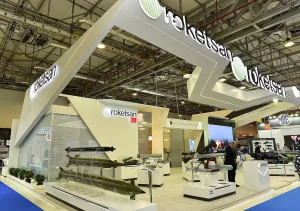
Turkish Aerospace Industries (TUSAŞ) and missile maker ROKETSAN have signed a second project contract for HÜRSAT, Türkiye’s first satellite family designed from the outset for series production. The agreement was signed on 5 October at the 77th International Astronautical Congress (IAC 2026) in Antalya, with Türkiye’s Presidency of Defence Industries (SSB) observing.
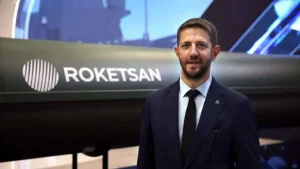
The signing took place at the TUSAŞ pavilion, with TUSAŞ General Manager Mehmet Demiroğlu and ROKETSAN General Manager Murat İkinci attending. SSB confirmed the deal in its weekly activity bulletin, stating that the HÜRSAT-2 project contract was signed between the two companies under the agency’s observation.
A shift from one-off satellites to a shared architecture
What distinguishes HÜRSAT from earlier Turkish satellite efforts is the move away from single, bespoke designs toward a common architecture that can be reconfigured for different missions. Spacecraft in the family will range between 200 and 650 kilograms, built on a shared bus rather than redesigned from scratch for each payload.
The goal is to cut both development time and unit cost by reusing the same production line for multiple satellites. Concept work points to two main variants: HÜRSAT EO, carrying electro-optical imaging, and HÜRSAT SAR, carrying synthetic-aperture radar. The first configuration being prepared is a roughly 200-kilogram Earth-observation satellite.
Built for formation flying in low orbit
The strategic value of HÜRSAT lies less in any single satellite than in the plan to operate several of them together in low Earth orbit (LEO). As more satellites from the family enter service, specific regions can be revisited more frequently, data can reach end users faster, and different customer requirements can be served sequentially by the same production line.
That approach mirrors a broader international trend away from reliance on a handful of large, expensive satellites and toward constellations of smaller, cheaper platforms — a model already pursued by several space-faring nations seeking more resilient and more frequent coverage.
A domestic launch ambition
Demiroğlu said the contract also covers plans for TUSAŞ and ROKETSAN to carry out the family’s first launch together. “We will both build our satellite and launch it domestically,” he said, describing it as a first for Türkiye in combining satellite manufacturing and launch capability under one national effort.
Under the stated schedule, the first HÜRSAT satellite is targeted for launch in mid-2027, with HÜRSAT-2 expected to fly aboard ROKETSAN’s ŞİMŞEK-1 rocket sometime in 2028–2029. SSB and the companies describe these as planning targets, subject to how design and testing progress.
Why it matters
Türkiye’s defence and intelligence community has long leaned in part on imagery leased from foreign satellite operators. A family of series-produced, lower-cost satellites would reduce that dependence while adding the flexibility to increase observation frequency during a crisis or when operational demand spikes.
The HÜRSAT-2 contract also extends the long-standing industrial partnership between TUSAŞ and ROKETSAN — rooted in missiles and precision munitions — into space platforms, with SSB’s presence at the signing underlining the programme’s standing as a state-backed priority. Neither the contract value nor the number of satellites covered has been disclosed; further technical and commercial detail is expected from the companies in future announcements.
Sources
- Presidency of Defence Industries (SSB), weekly bulletin “What Happened in Turkish Defence Industry This Week?”, 12 October 2026 — https://www.ssb.gov.tr/haber/turk-savunma-sanayiinde-bu-hafta-neler-oldu-2026-10-12 — used to confirm the contract and the parties involved.