Indra Unveils Drizzle: A 400 km/h Interceptor Drone Family Against Mass Drone Attacks

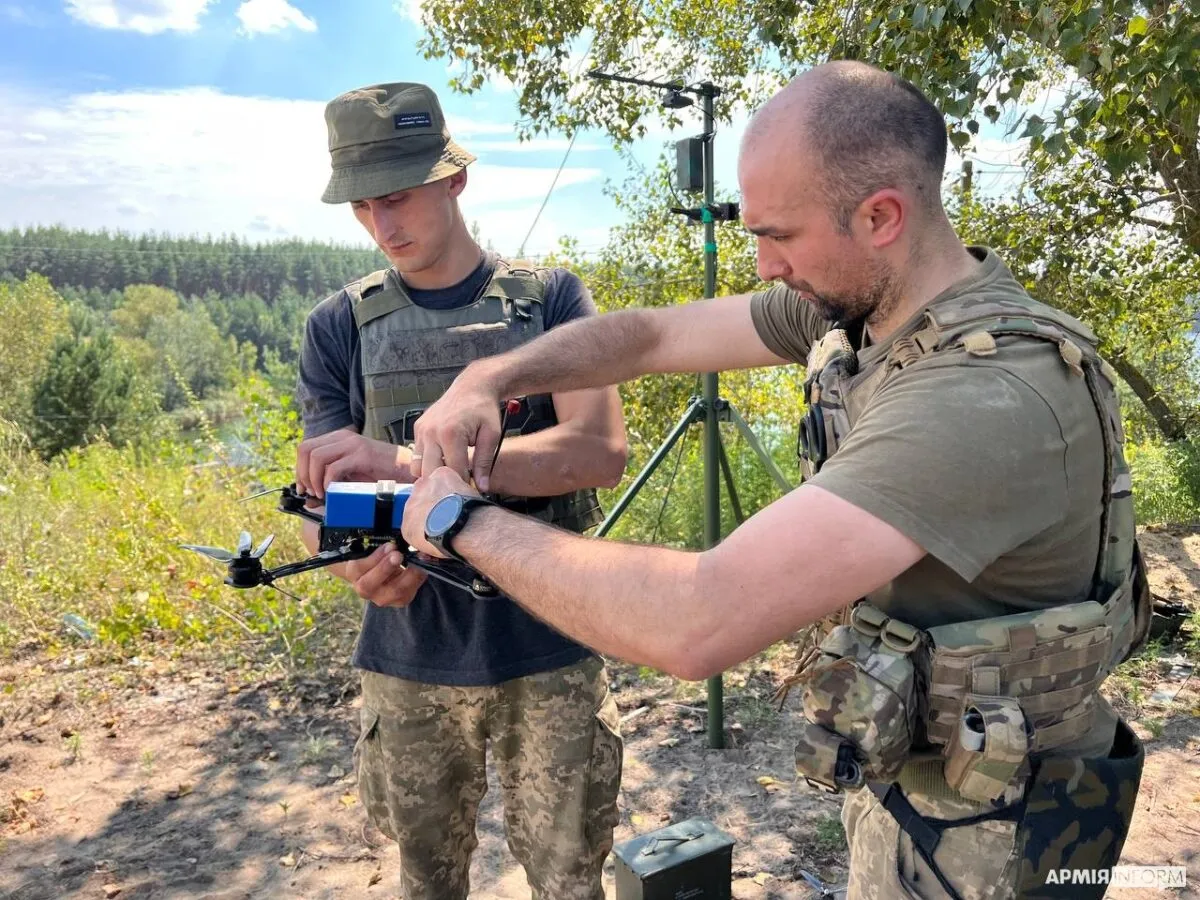
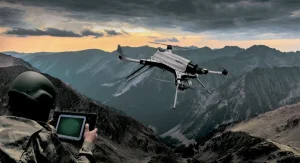
Image: An FPV-based interceptor drone being prepared on the Ukrainian front (representative image — ArmyInform, the Ukrainian Ministry of Defence news agency). No official product imagery of Indra Drizzle has been released.
MADRID, 17 September 2026 — Spanish defence and technology group Indra has unveiled a new family of interceptor drones built to counter mass drone attacks. Named Drizzle, the system was presented publicly at UNVEX, Spain’s unmanned systems trade fair. The company says the effectors exceed 400 km/h and reach roughly 80 kilometres on their own, protecting infrastructure sites, convoys and deployed units.
How the system works
Drizzle departs from conventional air defence missile logic. The system is built around a low-cost, expendable effector that is itself an air vehicle. It uses electro-optical and infrared sensors to find its target, with image processing and target discrimination carried out onboard in real time during flight. Indra plans to add radar in later phases.
The primary use case is a hard-kill counter-drone solution — one that physically destroys the target. Beyond that, the effectors can be integrated onto land vehicles and helicopters in an onboard self-protection role.
The mothership concept: a carrier at 30,000 feet
Drizzle’s most notable configuration is the mothership architecture. Here an expendable carrier drone holds several interceptors internally. The carrier flies roughly 80 kilometres at 30,000 feet, then releases its effectors, which add a further 50 kilometres of coverage — producing an effective radius of about 130 kilometres.
The intent is to push the defence out to where the threat originates. In classic short-range air defence the defended point is fixed and the threat must travel all the way to it. The mothership concept moves the intercept ring forward, aiming to break up a drone swarm long before it reaches the target.
The fair detail says something about programme maturity: UNVEX ran on 16-17 September 2026 in San Javier, in Spain’s Murcia region. Indra also displayed a Drizzle variant adapted to be launched from a modified rifle. That version points to a use case pushed down to squad level — an interceptor a single soldier can carry becomes a separate layer in convoy and patrol protection.
The company added that several motherships can operate as a swarm, producing a “shower” of interceptors able to saturate an adversary’s defences. Effectors that have completed their intercept task can then be used as attack vectors.
The cost equation
One question has sat at the centre of the counter-drone debate for years: is it sustainable to expend a $2 million missile to bring down a $2,000 drone? Operations in Ukraine and the Red Sea showed that this asymmetry exhausts the defending side economically.
Indra positions Drizzle as an answer to that equation. The company says the approach aims to give allied armed forces a cost-effective means of countering large numbers of low-cost drones, with the argument resting on economies of scale bringing unit cost down in serial production. No firm unit price was disclosed.
A crowding European field
The interceptor drone segment has become one of the busiest corners of the European defence industry over the past two years. FPV-based interceptors were used at scale against Shahed-class targets on the Ukrainian front, and that operational data accelerated the move by Western European manufacturers into similar systems. Numerous start-ups in Germany, Poland and the UK are developing products in the same segment.
Indra’s advantage lies in its existing radar and command-and-control estate. The company supplies sensors and C4I systems across a significant share of Spain’s air defence network. Drizzle’s ability to plug into an existing sensor architecture may matter more to institutional buyers than raw effector performance.
Read from Ankara
Türkiye built an early and broad counter-drone portfolio. ASELSAN’s KORKUT serves the mission with a 35 mm air defence gun, while GÜRZ combines gun, missile and laser on a single platform. The GÖKBERK laser weapon offers a low-cost kill option at close range, and Roketsan’s SUNGUR provides the shoulder- and vehicle-launched short-range missile layer.
The link not yet widely fielded in that picture is precisely the category Drizzle represents: an expendable, forward-deployed interceptor air vehicle. Electronic warfare and gun-based solutions are effective for point defence, but their range depth is limited against swarms approaching from multiple axes.
That makes the architecture Indra has shown both a competitor and a signal for the Turkish industry. In export markets in particular — the Gulf, North Africa and Central Asia — counter-drone packages are now tendered as layered solutions rather than single systems. A bid that cannot fill the outermost layer can lose to a rival arriving with the complete stack.
Serial production timing, interested customers and verified test results have not been published. How far the performance claims made at launch hold up under operational conditions will determine the product’s real value.
Sources
- Indra corporate presentation, UNVEX 2026, Spain, 17 September 2026
- Defence Industry Europe, “Indra launches Drizzle interceptor drones to counter mass attacks”, 17 September 2026