What is the B-21 Raider? Northrop Grumman’s Next-Generation Stealth Bomber, Explained

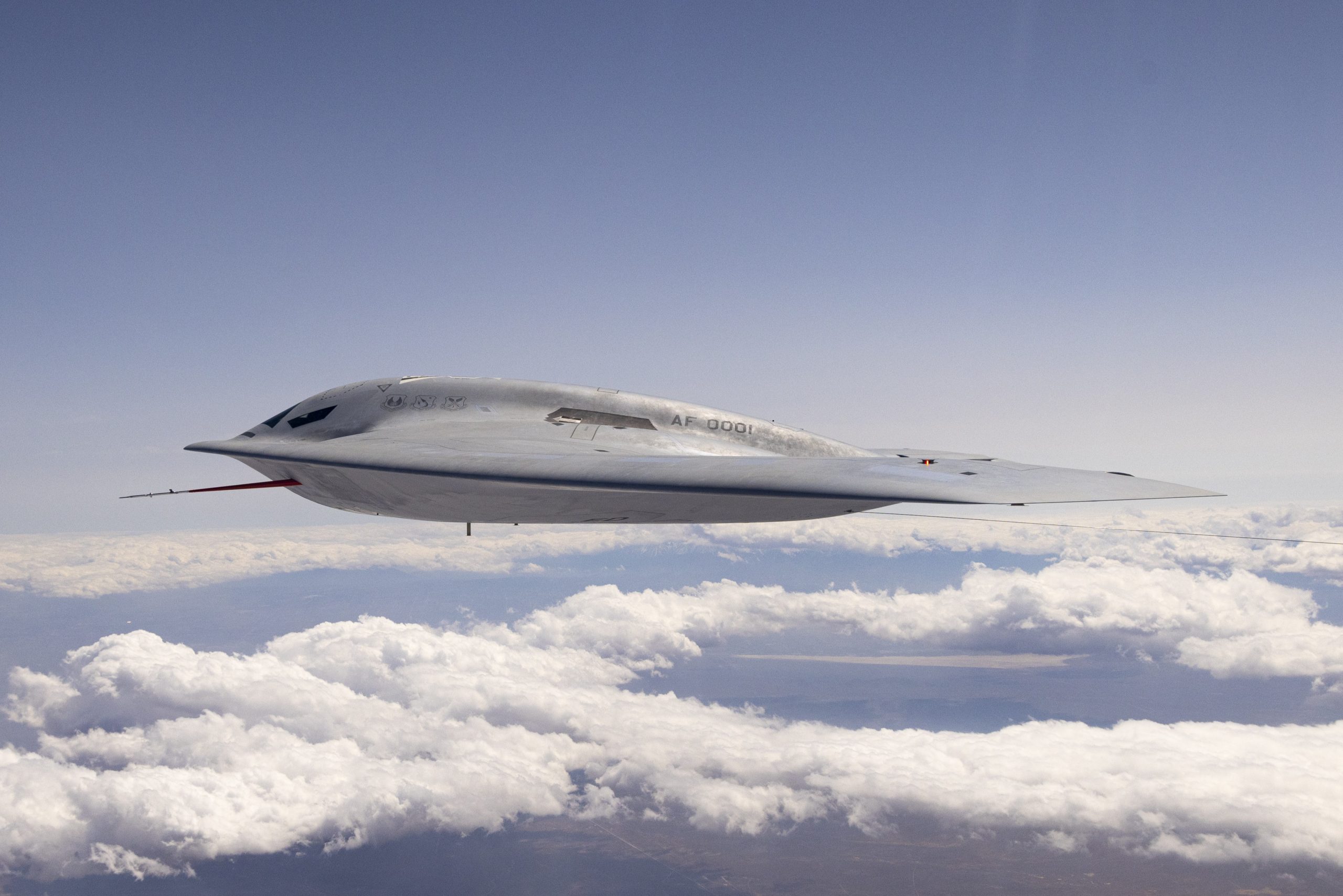
The B-21 Raider is the U.S. Air Force’s first new bomber program in 35 years and the first publicly funded sixth-generation military aircraft of any class. Built by Northrop Grumman under the Long Range Strike Bomber (LRS-B) contract awarded in October 2015, the B-21 is intended to replace both the B-1B Lancer and the B-2A Spirit across the U.S. Air Force’s strategic strike fleet. First publicly revealed at Northrop’s Palmdale, California Site 4 facility on 2 December 2022 and first flown on 10 November 2023, the B-21 is the first U.S. military aircraft in 30 years designed from inception around open-architecture sustainment, allowing rapid integration of future weapons, sensors and software without extensive airframe modification.
Key facts at a glance
| Attribute | Value |
|---|---|
| Type | Long-range stealth strategic bomber |
| Manufacturer | Northrop Grumman Aeronautics Systems |
| First flight | 10 November 2023 |
| Service entry | ~2027 (initial operational capability) |
| Crew | 2 (with optional unmanned configuration) |
| Engines | 2× Pratt & Whitney F135-derived (classified specifics) |
| Length | Estimated 17 m |
| Wingspan | Estimated 41 m |
| MTOW | Estimated 80–100 tonnes (classified) |
| Payload | Estimated ~13,600 kg (about half of B-2’s 18,144 kg) |
| Combat radius | Unrefueled estimated 9,200+ km |
| Service ceiling | Classified |
| Weapons | Nuclear (B61-12, LRSO) + conventional (JASSM-ER, AGM-86, GBU-57 MOP, future hypersonic) |
| Planned procurement | 100+ aircraft (USAF stated minimum) |
| Unit cost target | ~ USD 692 million in 2010 dollars (~ USD 800 million in 2024 dollars) |
| Bases (planned) | Ellsworth AFB (lead), Whiteman AFB, Dyess AFB |
Origins: the LRS-B program
The B-21 program traces to the U.S. Air Force’s late-2000s recognition that the 21-aircraft B-2 Spirit fleet — supplemented by Cold War-era B-1B and B-52H bombers — could not absorb the air-defense modernization underway in China and Russia. After the cancellation of the Next-Generation Bomber program in 2009 due to cost, the Pentagon launched Long Range Strike Bomber (LRS-B) in 2011 with explicit cost discipline: a per-unit production cap of USD 550 million in 2010 dollars, achievable only with mature-technology reuse and an open-architecture design. Northrop Grumman beat a Boeing-Lockheed Martin team for the prime contract on 27 October 2015. Initial development funding totaled USD 21.4 billion through Engineering and Manufacturing Development.
The 2 December 2022 unveiling
On 2 December 2022, the Air Force and Northrop Grumman publicly unveiled the first B-21 — designated AF-1, named “Cerberus” — at the Site 4 production facility in Palmdale, California. The reveal showed a flying-wing planform visually similar to the B-2 but smaller, with several differentiating features:
- Single-piece flush canopy with no faceted glass panels, suggesting integrated transparency conformal to the airframe contour.
- Single-row low-mounted air intakes recessed into the upper wing surface, reducing radar return from the engine compressor face.
- Simplified two-piece elevon trailing edge replacing the B-2’s more complex multi-segment configuration.
- Cleaner overall body lines — fewer access panels visible, suggesting larger composite sub-assemblies.
What we know about capability
Air Force officials have publicly confirmed several capabilities:
- Dual-capable: nuclear and conventional missions.
- Open architecture: the avionics, mission systems and software are explicitly designed for rapid third-party integration without source-code re-certification — a direct response to the B-2’s notoriously slow upgrade cycle.
- Optionally manned: Air Force officials have suggested but not confirmed that the B-21 can fly with no crew.
- Multi-role: ISR (intelligence, surveillance, reconnaissance) is an explicit collateral mission, suggesting wide-area sensors.
- Network warfare: explicit integration with the new Advanced Battle Management System (ABMS) and Joint All-Domain Command and Control (JADC2).
Weapons
| Weapon | Class | Role |
|---|---|---|
| B61-12 | Variable-yield gravity bomb | Strategic nuclear |
| AGM-181 LRSO | Air-launched cruise missile (under development) | Strategic nuclear standoff |
| AGM-158B JASSM-ER / -XR | Stealth cruise missile | Conventional stand-off |
| GBU-57 Massive Ordnance Penetrator | 13,600 kg deep-penetrating bomb | Hardened underground targets |
| HACM | Air-launched hypersonic | Time-sensitive strategic targets |
| Future networked munitions | — | To be defined; open-architecture integration |
The schedule
- 27 October 2015 — Northrop Grumman wins LRS-B prime contract.
- 2 December 2022 — First B-21 publicly unveiled at Palmdale.
- 10 November 2023 — First flight.
- 2024 — Flight test program with second aircraft joins.
- ~2027 — Initial Operational Capability projected.
- ~2032 — B-2A Spirit fleet retirement begins as B-21 deliveries scale.
- ~2035 — B-1B Lancer fleet retirement complete.
- ~2050 — Planned operational lifespan terminus.
Procurement plan and cost
The U.S. Air Force has stated a minimum requirement of 100 B-21 aircraft; informal Air Force planning documents have referred to potential procurement of 150–200 over the program’s life. Cost per aircraft is contractually capped at approximately USD 692 million in 2010 dollars — equivalent to about USD 800 million in 2024 — significantly below the B-2’s adjusted USD 2.0 billion. The program is funded under Major Defense Acquisition Program rules with classified annual budget; FY2025 funding is publicly estimated at USD 5.3 billion.
B-21 vs. its peers
| B-21 Raider | B-2A Spirit | B-1B Lancer | Tu-160M (Russia) | |
|---|---|---|---|---|
| Generation | 6 (announced) | 5 (stealth) | 4 (variable-geometry) | 4 (modernized) |
| Configuration | Flying wing | Flying wing | Variable-geometry swept wing | Variable-geometry swept wing |
| Payload | ~13,600 kg (estimated) | 18,144 kg | 34,019 kg | 40,000 kg |
| Combat radius | ~9,200 km | ~11,100 km | 5,500 km | ~7,300 km |
| Cost per aircraft | ~ USD 800M | ~ USD 2.0B (FY2010 dollars adjusted) | ~ USD 280M | ~ USD 270M |
| Planned procurement | 100+ | 21 (all delivered) | 100 (45 in service) | 50 (modernized + new) |
Why the B-21 matters
The B-21 is the U.S. Air Force’s most important program of the 2020s and 2030s. It restores the long-range stealth strike capacity that the 21-aircraft B-2 fleet could no longer sustain, brings down per-aircraft cost by nearly a factor of three, and introduces the open-architecture model that the Air Force intends to apply to all future major aircraft programs. With first flight completed and IOC projected for 2027, the B-21 will define U.S. strategic airpower through the 2050s.