F-22 Pilot Controls YFQ-44A Fury Fighter Drone From the Cockpit for the First Time

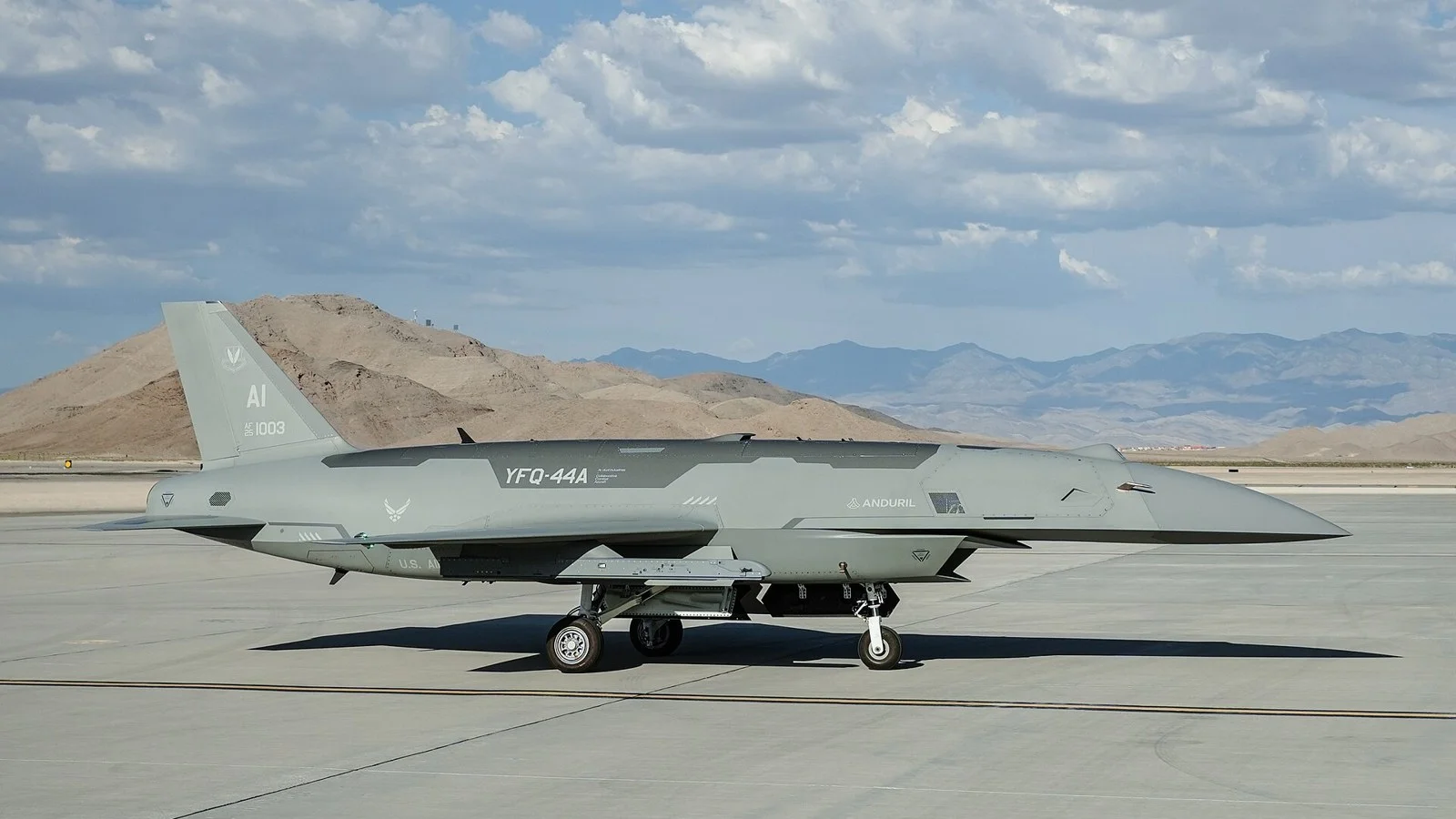
The U.S. Air Force and Anduril Industries have confirmed that an F-22 Raptor pilot controlled a pre-production YFQ-44A Fury drone from the cockpit for the first time, sending it high-level tactical instructions that the drone’s onboard autonomy software carried out in real time through maneuvers and simulated combat tasks. The test took place earlier in October 2026, and both the Air Force and Anduril announced it on October 16. Anduril confirmed it was a first for both an F-22 and a pre-production YFQ-44A.
Takeoff at Edwards, rendezvous in the air
Both aircraft took off from Edwards Air Force Base, California, and joined up in flight. According to Anduril, the Raptor pilot sent an updated mission plan to the Fury over a tactical data link, then commanded it through operationally relevant maneuvers from the F-22 cockpit. The test involved the 412th Test Wing, the 422nd Test and Evaluation Squadron, the 309th Software Engineering Group, the Nellis-based Experimental Operations Unit (EOU), the F-22 System Program Office, and the CCA Software Autonomy and Teaming Branch.
Two contenders for Increment 1
The YFQ-44A is Anduril’s entrant in the Air Force’s Collaborative Combat Aircraft (CCA) programme’s first increment, alongside General Atomics’ FQ-42A Vengeance. The Air Force is targeting at least 500 Increment 1 CCAs by 2032, with a follow-on Increment 2 planned that could bring different designs. The first CCAs are expected to enter operational service toward the end of this decade.
Earlier milestones for the Fury include formation flying with F-35s last month — though those F-35s were not yet commanding the drone — and a live AIM-120 AMRAAM missile firing earlier this year.
F-22 control architecture still undisclosed
The Air Force has not released details of how the F-22 was configured for this test. Past budget documents mention adding tablets, cables, and related equipment to the Raptor for drone control, and a single Raptor is expected eventually to manage multiple CCAs at once. Lockheed Martin, the F-22’s prime contractor, is working with the Air Force on control architectures and user interfaces for both the F-22 and the F-35. The interfaces disclosed so far are mainly tablet-style devices, seen as a starting point, with acknowledged concerns about pilot workload, particularly in single-seat fighters.
Officials weigh in
Air Force Secretary Troy Meink said “this achievement demonstrates what is possible when we are aligned with industry on a shared imperative.” Air Force Chief of Staff Gen. Ken Wilsbach said “this flight shows the power of crewed-uncrewed teaming and the advantage it provides our warfighters.” Anduril’s Vice President of Autonomous Airpower, Mark Shushnar, called the Air Force’s CCA programme “the fastest moving, most mature CCA programme anywhere in the world.”
A pivotal step for crewed-uncrewed teaming
The milestone is seen as a key step toward F-22s serving as the Air Force’s first aerial controllers for CCAs. The Air Force’s first large-force exercise involving CCAs, Emerald Flag, is planned for December 2026. Lt. Col. Lyndon “OTTO” Bartlett, the EOU’s Director of Operations, said at the AFA conference in September that Emerald Flag will be the first genuine large-force integration exercise for these uncrewed systems.
Major open questions include how CCAs will be deployed, launched, recovered, and logistically supported, along with the policies and procedures needed to govern them. Building pilot trust in autonomous wingmen is considered critical. The Marine Corps and Navy face the same set of issues in their own CCA efforts and are coordinating closely with the Air Force.
An earlier rehearsal: F-22 and the MQ-20 Avenger
In November 2025, General Atomics staged a similar demonstration in which an F-22 controlled an MQ-20 Avenger surrogate aircraft during a mock combat mission. Whether the F-22 will go on to control General Atomics’ own FQ-42A next remains unclear.
Why the F-22, and why now
Testing the F-22 in this role is not incidental. The Raptor remains the Air Force’s most capable air-superiority platform, but production ended in 2011 and the fleet stayed relatively small. A role as an airborne controller for CCAs gives the F-22 a way to extend its operational relevance through sensing and command-and-control capacity, effectively giving the platform a second mission set as the F-35 fleet continues to grow.
Timing matters too: the CCA programme sits at the center of the Air Force’s push to generate numerical superiority affordably in an environment of increasingly dense adversary air defenses. The head-to-head between Anduril and General Atomics will largely determine Increment 1’s cost and delivery schedule, and the success of this F-22 test could also shape design decisions for Increment 2.
Sources
The War Zone, Joseph Trevithick, “F-22 Pilot Controls FQ-44 Fighter Drone From The Cockpit For The First Time” (October 16, 2026) — used to verify test details, unit information, official statements, and quotes.