ÇAKIR cruise missile: ROKETSAN’s multi-platform missile

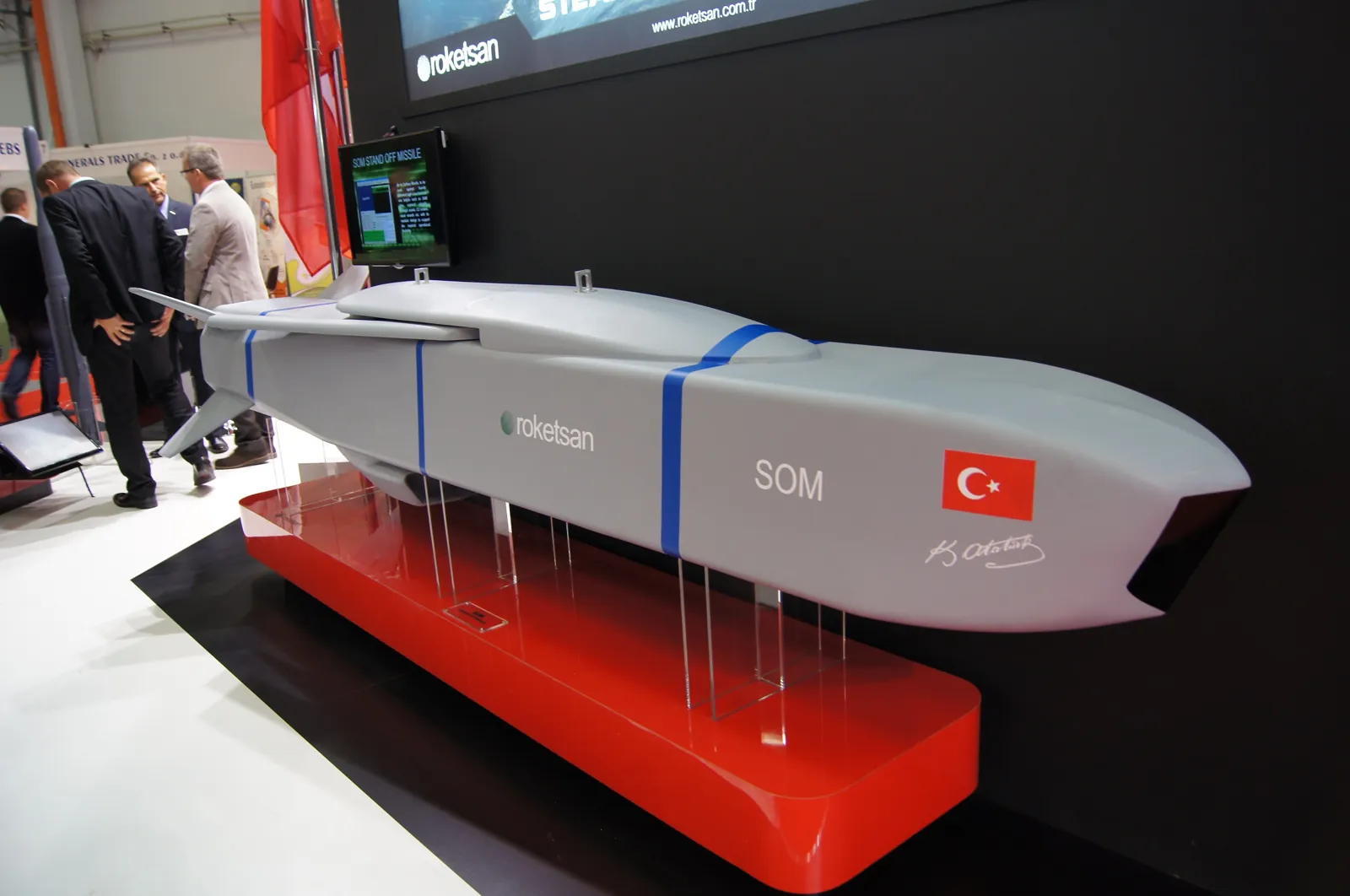
ÇAKIR is a multi-platform compact cruise missile family developed by ROKETSAN. It is designed to be launched from land, sea and air platforms. First unveiled on 31 March 2022, ÇAKIR entered series production on 9 July 2024. Its range is stated as 150+ km for the surface version and, according to some sources, 175+ km for the air-launched version, at a subsonic speed of Mach 0.75-0.85.
| ÇAKIR — Key Data | |
|---|---|
| Category | Multi-platform compact cruise missile |
| Developer | ROKETSAN |
| Unveiled | 31 March 2022 |
| Series production | 9 July 2024 |
| Range | 150+ km (surface), 175+ km (air, source dependent) |
| Speed | Mach 0.75-0.85 (subsonic) |
| Weight | ~275 kg (air) / ~350 kg (surface, with booster) |
| Length / diameter | 3.3 m (air) / 3.8 m (surface); diameter ~275 mm |
| Warhead | ~70 kg (fragmentation / semi-armour-piercing / thermobaric option) |
| Guidance | INS + GPS + IIR/RF (configuration dependent) |
| Propulsion | Kale KTJ-1750 turbojet + solid-fuel booster |
| Operator | Turkish Armed Forces (entering service) |
What is ÇAKIR?
ÇAKIR is a compact cruise missile family developed by ROKETSAN. Its defining feature is that it is multi-platform: the same missile family is designed to be fired from ground vehicles, naval platforms and aerial platforms. This approach aims to let a single munition be shared across different services while reducing the logistics burden of maintaining separate weapons.
The missile was first shown to the public on 31 March 2022. ROKETSAN announced on 9 July 2024 that ÇAKIR had entered series production. Now entering the Turkish Armed Forces inventory, the system stands out for its low weight and compact dimensions compared with larger, heavier cruise missiles in its class. This makes it easier to integrate onto small naval platforms and unmanned aerial vehicles.
ÇAKIR has been presented in several configurations for different missions. In open sources these are referred to by abbreviations such as CR, AS, LIR and SW, pointing to land-attack, anti-ship and different seeker variants. Some technical details have not been officially disclosed.
Technical features and how it works
ÇAKIR is a subsonic cruise missile, with a speed given as roughly Mach 0.75-0.85. Its range is stated as 150+ km in the surface (land/sea) version and, in some sources, 175+ km in the air-launched version; this difference relates to the initial energy the launch platform imparts to the missile.
At the heart of the propulsion system is the indigenous Kale KTJ-1750 turbojet engine. The surface-launched version uses a separate solid-fuel boost motor to accelerate the missile off the launcher; once the booster has done its job and separates, the turbojet carries the missile to the target. The air-launched version needs no booster because the aircraft already provides speed and altitude, which is why the air version is shorter (about 3.3 m) and lighter (~275 kg), while the surface version is longer (about 3.8 m) and heavier (~350 kg) with its booster.
The guidance architecture is based on INS + GPS; in the terminal phase, an imaging infrared (IIR) or radio-frequency (RF) seeker is engaged depending on configuration. This flexibility allows the missile to be directed against both fixed land targets and moving naval targets. The ~70 kg warhead can be configured as fragmentation, semi-armour-piercing or thermobaric. Certain figures (exact CEP, precise range brackets) have not been officially disclosed.
ÇAKIR is compared with compact, multi-platform cruise missiles in its class. The table below summarises the main foreign systems mentioned alongside ÇAKIR in open sources. This comparison reflects general class similarity and does not imply exact performance parity.
Platforms, operators and exports
ÇAKIR’s most distinctive feature is its multi-platform design. The missile is developed to be launched from ground vehicles, naval platforms (frigates, corvettes, fast attack craft and smaller boats) and aerial platforms. ROKETSAN has stated that integration of ÇAKIR onto indigenous unmanned aerial vehicles such as the Bayraktar Akıncı is planned; the status of that integration is being announced in stages.
The first operator is the Turkish Armed Forces, with ÇAKIR entering the inventory. Its export status has not been officially disclosed; to date the missile has mainly featured in the promotional stage at international defence exhibitions. For this reason, any confirmed export contract awaits official announcements.
Place in Türkiye’s defence industry
ÇAKIR is positioned as a system that complements ATMACA in ROKETSAN’s cruise missile family. While ATMACA is a larger, heavier and longer-range anti-ship cruise missile, ÇAKIR offers a more compact, multi-platform solution. This allows smaller naval platforms, land batteries and unmanned aerial vehicles to gain a cruise missile capability as well.
The system’s main advantages are its low weight, the ability for a single missile to be shared across different services, an indigenous turbojet engine (Kale KTJ-1750) and modular guidance/warhead options. On the other hand, because the system is only now entering service and public data on combat use is limited, some performance figures cannot yet be independently verified. Precise numbers for range, CEP and seeker performance have in part not been officially disclosed.
Some ÇAKIR figures differ between sources (for example, range is given as 150+ km on the surface and 175+ km from the air), and some technical details such as warhead specifics and CEP have not been officially disclosed. Export status has likewise not been officially announced. The values in this article are limited to official ROKETSAN information and open sources.
Frequently Asked Questions
What is the range of ÇAKIR?
It is stated as 150+ km in the surface (land/sea) version and, according to some sources, 175+ km in the air-launched version. The exact range varies by configuration and full brackets have not been officially disclosed.
Who operates ÇAKIR?
The first operator is the Turkish Armed Forces. The system is now entering the inventory; its export status has not been officially disclosed.
Which platforms launch ÇAKIR?
ÇAKIR is a multi-platform cruise missile that can be launched from ground vehicles, naval platforms and aerial platforms. Integration onto unmanned aerial vehicles such as the Bayraktar Akıncı is planned.
What is comparable to ÇAKIR?
In open sources ÇAKIR is placed in the same class as compact cruise/anti-ship missiles such as Italy’s MBDA Marte family and Norway’s JSM. Its larger indigenous counterpart is ATMACA.
Has ÇAKIR been exported?
No confirmed export contract for ÇAKIR has been officially disclosed. To date the missile has featured in the promotional stage at international defence exhibitions.
When did ÇAKIR enter service?
ÇAKIR was first unveiled on 31 March 2022; its move into series production was announced on 9 July 2024. It is now entering the Turkish Armed Forces inventory.
Sources
- ROKETSAN official — roketsan.com.tr
- ROKETSAN series production announcement (9 July 2024)
- Presidency of Defence Industries and open-source defence publications
- Anadolu Agency and Daily Sabah reporting (2022-2024)