AKYA Torpedo: Turkey’s National Heavyweight Torpedo Explained

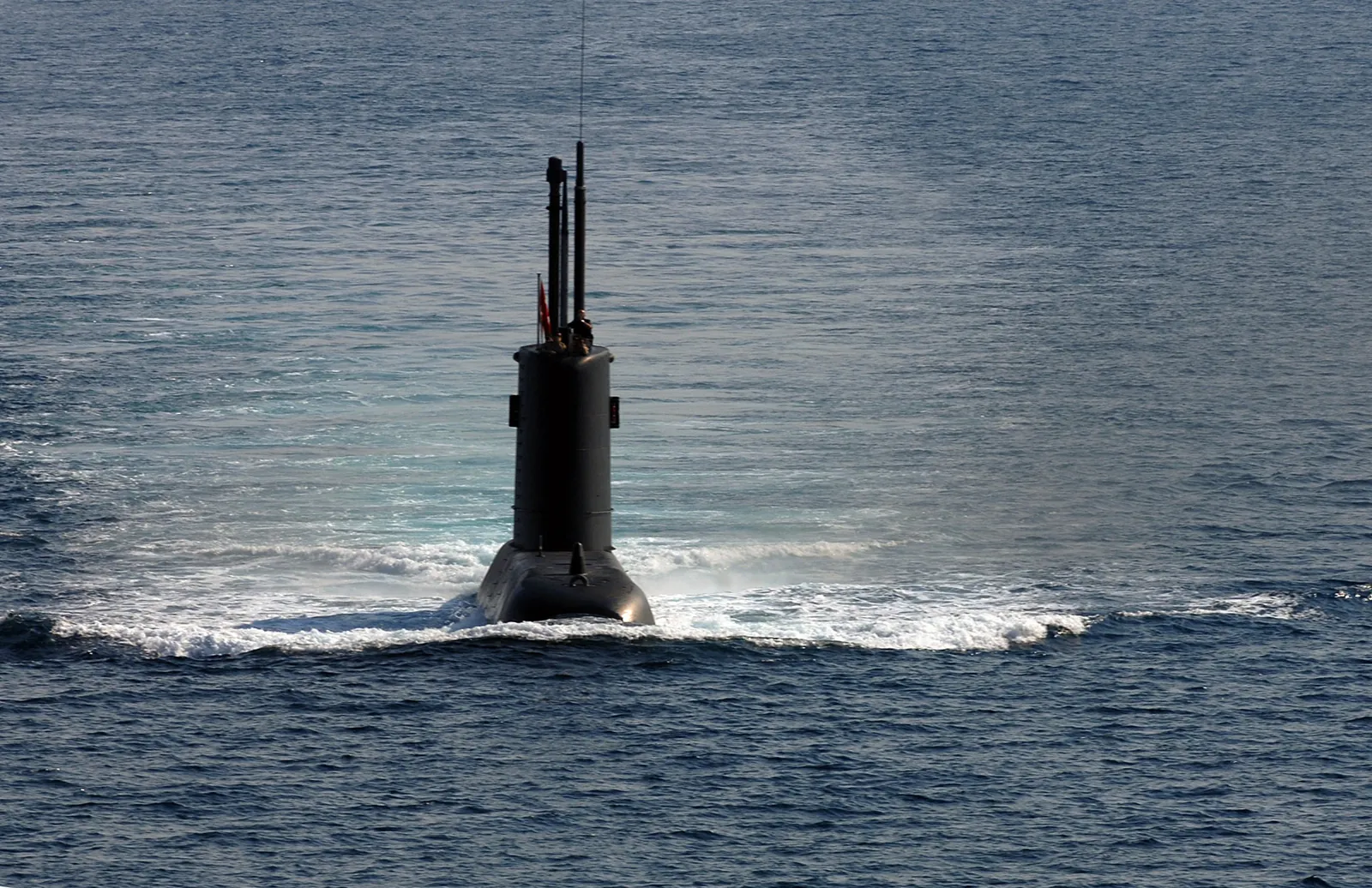
AKYA is Turkey’s first national heavyweight torpedo, developed by ROKETSAN. A 533 mm, ~1,200 kg weapon, it reaches a range of over 50 km at 45 knots and engages both submarines and surface ships. First deliveries to the Turkish Navy took place in May 2024, arming the Preveze, Gür and Reis-class submarine fleet.
| AKYA — At a Glance | |
|---|---|
| Category | Heavyweight torpedo (submarine-launched) |
| Developer | ROKETSAN (prime contractor) |
| Programme start | 2009 (Turkish Navy ArMerKom) |
| First delivery | May 2024 (Turkish Naval Forces) |
| Range | 50+ km |
| Speed | 45 knots (~83 km/h) |
| Weight | ~1,200 kg |
| Length / diameter | ~7 m / 533 mm |
| Warhead | ~350-380 kg insensitive, proximity fuze |
| Guidance | Fibre-optic wire + active/passive sonar seeker + wake homing |
| Propulsion | Brushless DC electric motor, counter-rotating propellers |
| Platforms | Preveze, Gür and Reis-class (Type 214TN) submarines |
| Operator | Turkish Naval Forces |
What is the AKYA torpedo?
AKYA is Turkey’s first indigenously developed heavyweight torpedo, built with ROKETSAN as prime contractor. Launched from submarines through standard 533 mm tubes, it is a dual-purpose weapon: it can hunt enemy submarines in anti-submarine warfare (ASW) and strike surface combatants in anti-surface warfare (ASuW).
The programme was initiated in 2009 by the Turkish Navy’s Research Centre Command (ArMerKom). Serial production began in 2021, a live firing test was completed on 27 December 2023, and first deliveries to the Turkish Naval Forces followed in May 2024. In June 2026 the weapon passed another milestone when a Turkish submarine fired an AKYA for the first time through the national MÜREN combat management system, sinking a target ship in a SINKEX exercise.
Heavyweight torpedoes are a submarine’s primary strike weapon, and only a handful of nations can design and build them. With AKYA, Turkey joined a small club that includes the United States, Germany, France and the United Kingdom, sharply reducing its dependence on imported torpedoes for the core armament of its submarine fleet.
How does AKYA work? Technical characteristics
AKYA is roughly 7 metres long, 533 mm in diameter and weighs about 1,200 kg — the standard envelope of a NATO heavyweight torpedo. It achieves a range of more than 50 km and a top speed of 45 knots (about 83 km/h). Its maximum operating depth has not been officially disclosed.
The guidance architecture is layered. After launch, the torpedo stays connected to the submarine through a fibre-optic wire that spools out behind it. This wire guidance lets the crew steer the weapon using the submarine’s own sonar picture, update the target mid-run or abort the attack. In the terminal phase, an onboard active/passive sonar seeker detects and locks onto the target independently. Against surface ships, AKYA can also use wake homing — following the turbulent wake a vessel leaves behind — a technique that is notoriously difficult to defeat with acoustic decoys. Resistance to acoustic countermeasures was a core design requirement.
The warhead weighs approximately 350-380 kg, uses insensitive explosives for handling safety and is fitted with a proximity fuze, allowing it to detonate under or near the hull for maximum destructive effect. Propulsion comes from a brushless DC electric motor driving counter-rotating propellers, fed by a high-energy battery — a combination that delivers long range while keeping the acoustic signature low.
AKYA competes in the 533 mm heavyweight torpedo class, a field mastered by only a few industrial nations. The systems below are the principal Western benchmarks against which the Turkish weapon is measured — including the German torpedo it is set to replace in Turkish service.
Platforms, operators and exports
AKYA’s launch platforms are the Turkish Navy’s submarines: the Preveze class, the Gür class and the new-generation Reis class (Type 214TN). Fired from standard 533 mm torpedo tubes, the weapon is planned to replace the fleet’s legacy stocks of German DM2A4 and American Mk 37 torpedoes.
The June 2026 SINKEX marked a significant integration milestone: an AKYA was fired for the first time through the indigenous MÜREN combat management system and sank a real target vessel. The test demonstrated that not only the torpedo but the entire fire-control chain aboard Turkish submarines is becoming a national capability.
The sole known operator is the Turkish Naval Forces. No export contract has been officially disclosed; heavyweight torpedoes are strategic munitions, and any sale would typically move through slow, government-to-government channels.
Place in Turkey’s defence industry: strengths and limits
For Turkey’s defence sector, AKYA carries weight well beyond its 1.2 tonnes. Heavyweight torpedo design is among the hardest disciplines in naval engineering, demanding mastery of sonar seekers, underwater propulsion, high-energy batteries and fibre-optic data links in a single sealed weapon. Fielding AKYA put ROKETSAN — and Turkey — into a very short list of producers. Together with the AKATA submarine-launched cruise missile, it forms one of the two pillars of Ankara’s push to arm its submarines entirely with national weapons, a strategy that will extend to the future MİLDEN indigenous submarine.
Strengths: dual-purpose engagement of submarines and surface ships; post-launch control and retargeting through the wire; a wake-homing terminal mode that is hard to spoof; a quiet electric propulsion train; and supply security that no imported torpedo can offer.
Limits: AKYA is a young weapon. Rivals such as the Mk 48 ADCAP draw on decades of operational data and continuous upgrade cycles that the Turkish torpedo has yet to accumulate. Key parameters such as maximum diving depth remain undisclosed, which complicates direct comparison, and the system has no export track record so far.
AKYA’s range (50+ km), speed (45 knots), weight (~1,200 kg), length (~7 m) and warhead (~350-380 kg) figures are based on ROKETSAN catalogue data and open sources. Maximum operating depth and any export contracts have not been officially disclosed; this article avoids quoting unconfirmed figures for those items.
Frequently Asked Questions
What is the range of the AKYA torpedo?
AKYA has a range of more than 50 km and reaches a top speed of 45 knots (about 83 km/h) on electric propulsion.
Who operates the AKYA torpedo?
The only known operator is the Turkish Naval Forces. First deliveries took place in May 2024 and the weapon is being integrated across the submarine fleet.
Which platforms launch AKYA?
AKYA is fired from the 533 mm torpedo tubes of Turkey’s Preveze, Gür and Reis-class (Type 214TN) submarines. It is planned to replace legacy DM2A4 and Mk 37 torpedo stocks.
What are AKYA’s closest rivals?
Its principal counterparts are the American Mk 48 ADCAP, the German DM2A4 SeaHake, the French F21 Artemis and the British Spearfish heavyweight torpedoes.
Has AKYA been exported?
No export contract has been officially disclosed. The Turkish Naval Forces remain the sole known operator.
When did AKYA enter service?
Serial production was approved in 2021, a live firing test was completed on 27 December 2023, and the first torpedoes were delivered to the Turkish Navy in May 2024.
Sources
- ROKETSAN official product page — roketsan.com.tr
- Naval News — Turkish Navy achieves first AKYA firing from MÜREN CMS, SINKEX (June 2026)
- Janes — ROKETSAN delivers AKYA torpedo to Turkish submarines (May 2024)
- Wikipedia — Roketsan Akya and open-source defence publications