ROKETSAN ALPAGUT: The Turkish Loitering Munition That Waits an Hour Above Its Target, Explained

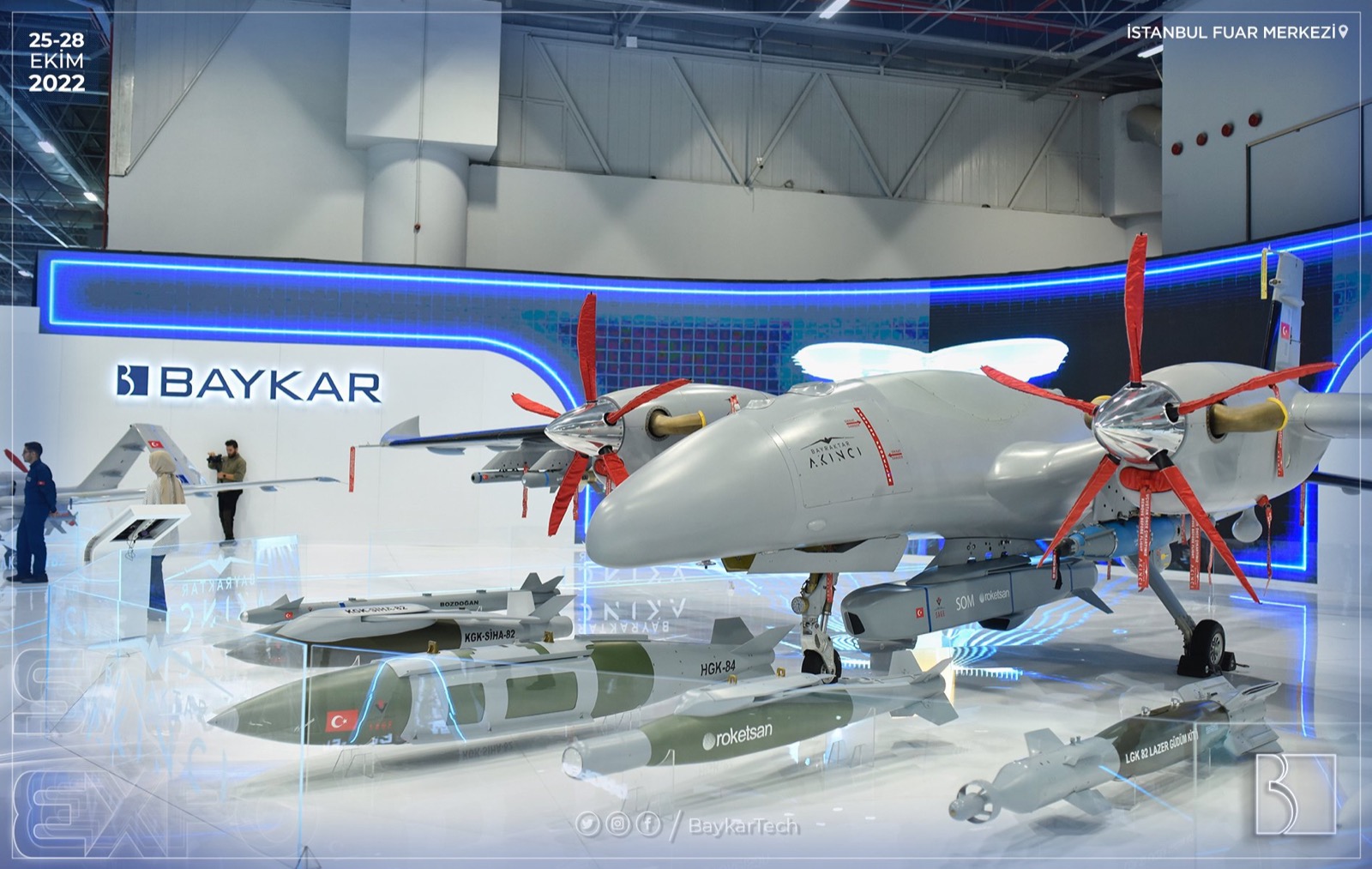
Image: ROKETSAN ALPAGUT loitering munition on display. Photo by Utayre, Wikimedia Commons, CC BY-SA 4.0.
Picture a tank hidden in a forest. The traditional way to deal with it was to send an aircraft to drop a bomb on the patch of trees where it was last seen. If the tank moved before the bomb fell — and it usually did — the strike missed. The newer answer to the same problem is a small winged drone that flies to the area, circles overhead for more than an hour, watches the target with a camera, and dives only when the human operator pushes the button. In the international defence vocabulary this class of weapon is called a “loitering munition.” ROKETSAN’s Turkish version is named after a Turkic warrior caste: ALPAGUT.
ALPAGUT looks like a small fixed-wing drone. It is fired from a launch tube, its wings snap open, and it cruises out to the target area. There it loiters for upwards of an hour — silent, on station, ready. The operator sees the camera feed; when the operator confirms the target, ALPAGUT dives and detonates its eleven-kilogram warhead. Unlike old-fashioned missiles, which could not be recalled once fired, ALPAGUT can be aborted in flight — if civilians are spotted near the aim point, or a better target emerges, the operator just keeps it circling.
Entry into Turkish Armed Forces service is expected this year. The wider point is that ALPAGUT puts Turkey into the most-talked-about weapon category of the post-2022 era. The Ukraine war proved, in public, that loitering munitions are now central to land warfare — American Switchblades hunting Russian tanks, Russian Lancets killing Ukrainian howitzers, Iranian Shahed-136s saturating cities. Every serious military read the same lessons. ROKETSAN built Turkey’s response.
At a Glance
Translated to everyday terms: 60 km is roughly Istanbul to Sapanca. ALPAGUT flies that far, circles its target for more than an hour like a slow propeller-driven bird of prey, and only dives when the operator decides. The eleven-kilogram warhead is enough to disable a tank, a self-propelled gun or a small building.
What ALPAGUT Actually Does
The Multi-Platform Trick
The strongest feature of ALPAGUT is not any single number on its data sheet — it is the fact that almost any Turkish military platform can launch it. From the air: Bayraktar AKINCI and TB3 drones, TUSAŞ ANKA and AKSUNGUR, T-129 ATAK and T-929 ATAK-2 attack helicopters, and even GÖKBEY utility helicopters and HÜRKUŞ light attack aircraft. From the ground: unmanned ground vehicles and dedicated launch trucks. From the sea: MİLGEM Ada-class corvettes and the new generation of unmanned surface vessels.
One weapon, every domain. It is the kind of integration the Turkish defence industry has been pushing toward for a decade — a single munition the entire armed forces can shoot.
Specifications
| Specification | Value |
|---|---|
| Range | 60+ km |
| Loiter Time | More than 60 minutes overhead |
| Total Weight | 45 kg |
| Length | 2.3 m |
| Warhead | 11 kg — fragmentation, armour-piercing or thermobaric |
| Seeker | Dual-mode EO/IR camera head |
| Mode | Fire-and-forget; abort and retarget possible |
| Operation | Single or coordinated swarm |
How ALPAGUT Compares Internationally
| System | Country | Class |
|---|---|---|
| ALPAGUT | ROKETSAN — Türkiye | Tactical loitering, multi-platform |
| Switchblade 600 | AeroVironment — USA | Anti-armour loitering |
| Lancet-3 | ZALA Aero — Russia | Tactical loitering |
| HAROP | IAI — Israel | Anti-radiation loitering |
Why It Matters for Turkey
ALPAGUT is not just a new weapon. It is the visible sign of a doctrine shift. The Turkish military increasingly plans around large numbers of inexpensive, smart loitering munitions, instead of small numbers of very expensive missiles. On the borders, at sea, in dense combat areas — ALPAGUT can wait overhead in numbers that would be unaffordable with traditional precision missiles.
The second point is supply security. ALPAGUT is fully domestic — engine, airframe, software, warhead designed and built in Turkey. That means no foreign export licence sits between the Turkish Armed Forces and a fresh batch in a crisis. And the same property makes ALPAGUT an attractive export to NATO and Gulf customers looking for an alternative to American or Israeli loitering munitions whose end-use restrictions can be tightened at any time.
Place in the Turkish Loitering-Munition Family
- STM KARGU-2 — palm-sized, helicopter-style kamikaze drone.
- STM ALPAGU — small fixed-wing kamikaze, carried in a backpack.
- Baykar Kemankeş / K2 — Baykar’s new-generation small strike drones.
- ROKETSAN ALPAGUT — this article — medium-class, multi-platform.
- ROKETSAN İHA-230 — the bigger sibling with longer range.
Summary
| Name | ROKETSAN ALPAGUT |
|---|---|
| Builder | ROKETSAN |
| Class | Loitering munition / kamikaze drone |
| Range / Loiter | 60+ km — more than 60 minutes overhead |
| Warhead | 11 kg in three interchangeable types |
| Launchers | Air, land and sea — AKINCI, ANKA, TB3, ATAK, GÖKBEY, MİLGEM and more |
| International peers | Switchblade 600 (USA), Lancet (Russia), HAROP (Israel) |
Sources: