





World’s Largest Electro-Optical System Manufacturers: An $11 Billion Market and ASELSAN’s Fifth Place (2026)

Electro-optical systems are the defense industry’s least visible and most decisive layer: in modern war the sensor that sees the target arrives before the weapon that hits it. The same technology family runs from a night vision monocular to a fighter’s targeting pod, from a tank gunner’s sight to a warship’s deck camera — a market that reached roughly $11 billion in 2025, with North America alone taking 38 percent of it. And Türkiye enters this table higher than in any other sector of this series: ASELSAN, which counted electro-optics among the segments driving its 2025 revenue of 180.4 billion Turkish lira, brought a $40 million thermal camera (FLIR) production facility online and exported its GÖZ-MOBİL thermal camera in high volumes to NATO member states in Europe. Following our unmanned ground vehicle file, Envanter Medya compares the world’s electro-optical system builders across market weight, segment coverage, critical-component independence and exports.
Editorial note: This ranking is an editorial research product compiled by Envanter Medya from publicly available data; it is not an official international ranking. Electro-optics is not reported as a separate line in company accounts; this file relies on verifiable contract, product and export data. Sources are listed at the end.
The research at a glance
“Largest” by which measure?
Electro-optics (EO/IR) is the hardest sector in this series to measure: no major defense company reports a line called “electro-optical revenue.” The systems sell embedded inside other platforms — a targeting pod as part of an aircraft contract, a gunner’s sight as part of a tank contract. So this file uses four yardsticks: segment coverage (land, air, naval, space, handheld), critical-component independence (does the company make its own infrared detectors?), verified programs and contracts and export footprint.
The sector’s real bottleneck is the detector: the heart of an electro-optical system is the focal plane array (FPA) that converts infrared light into an electrical signal. Very few countries can build one; everyone else is a system integrator. This file scores critical-component independence as a separate criterion, because the sector’s true hierarchy is set by detector production, not optical design.
By market weight: American dominance, European balance
The military electro-optical and infrared systems market reached roughly $11.1 billion in 2025, with North America the largest region at a 38.2 percent share. Behind that share stand five American primes: RTX, Lockheed Martin, Northrop Grumman, L3Harris and Teledyne FLIR — the last working the civil-military boundary as the sector’s most widespread thermal camera brand. Leonardo’s US subsidiary Leonardo DRS won a five-year, $94 million contract to produce advanced infrared weapon sights for US Army snipers — an indication of how large even a single sub-segment can be. In Europe, Thales, Safran and Hensoldt hold the balance, alongside Israel’s Elbit Systems.
By segment coverage: who is where?
Five segments: land platform (tank/AFV gunner-commander sights), air platform (targeting pods, nose turrets), naval (deck EO, IRST), space (satellite imaging sensors) and handheld (night vision, thermal binoculars). Counted from public product lines (T label). The Turkish company is marked separately.
Verified products and programs
| Company | Country | Key products | Verified indicator | Data type |
|---|---|---|---|---|
| RTX | USA | ATFLIR, MTS turrets, space sensors | Among the world’s largest defense companies per SIPRI; products across all five segments; infrared detector production in-house | R/T |
| Lockheed Martin | USA | Sniper ATP, EOTS (F-35), space EO | The F-35’s embedded electro-optical targeting system and the Sniper pod; widespread across NATO | R |
| Elbit Systems | Israel | Litening pod, night vision, land EO | The Litening targeting pod serves most NATO states; a broad line from handheld to airborne | R/T |
| Thales | France | Talios pod, Sophie thermal, naval EO | The Rafale’s Talios targeting pod; the Sophie family has a wide export base | R |
| ASELSAN 🇹🇷 | Türkiye | ASELPOD, ASELFLIR, GÖZ-MOBİL, DORUK, CATS | 2025 revenue of 180.4 billion TL, with electro-optics among the driving segments; $40M FLIR/thermal camera facility online; GÖZ-MOBİL exported in high volumes to NATO members in Europe; ASELPOD targeting pod exported; $1.45B in export contracts in nine months | R |
| Leonardo / Leonardo DRS | Italy-USA | Infrared weapon sights, land EO | Five-year, $94M contract for advanced infrared weapon sights for US Army snipers | R |
| Teledyne FLIR | USA | Thermal cameras and detectors | The sector’s most widespread thermal camera brand; as a detector maker, supplier to many integrators | R/T |
| Safran | France | Optronics, JIM thermal family | Long-established land and air optronics builder; prime supplier to French programs | R/T |
| Hensoldt | Germany | Sensors and optronics | EO supplier to German platforms; integrated radar-optronics portfolio | R/T |
| Chinese builders | China | Land/air EO systems | Production and export data not disclosed | D |
Data types: R = official/company statement, T = credible industry reporting, D = insufficient data. Because no company reports electro-optical revenue separately, the revenue criterion is assessed here only indirectly and at low weight, via group defense revenue.
The Envanter Medya Composite Index: EM-GDPI (adapted)
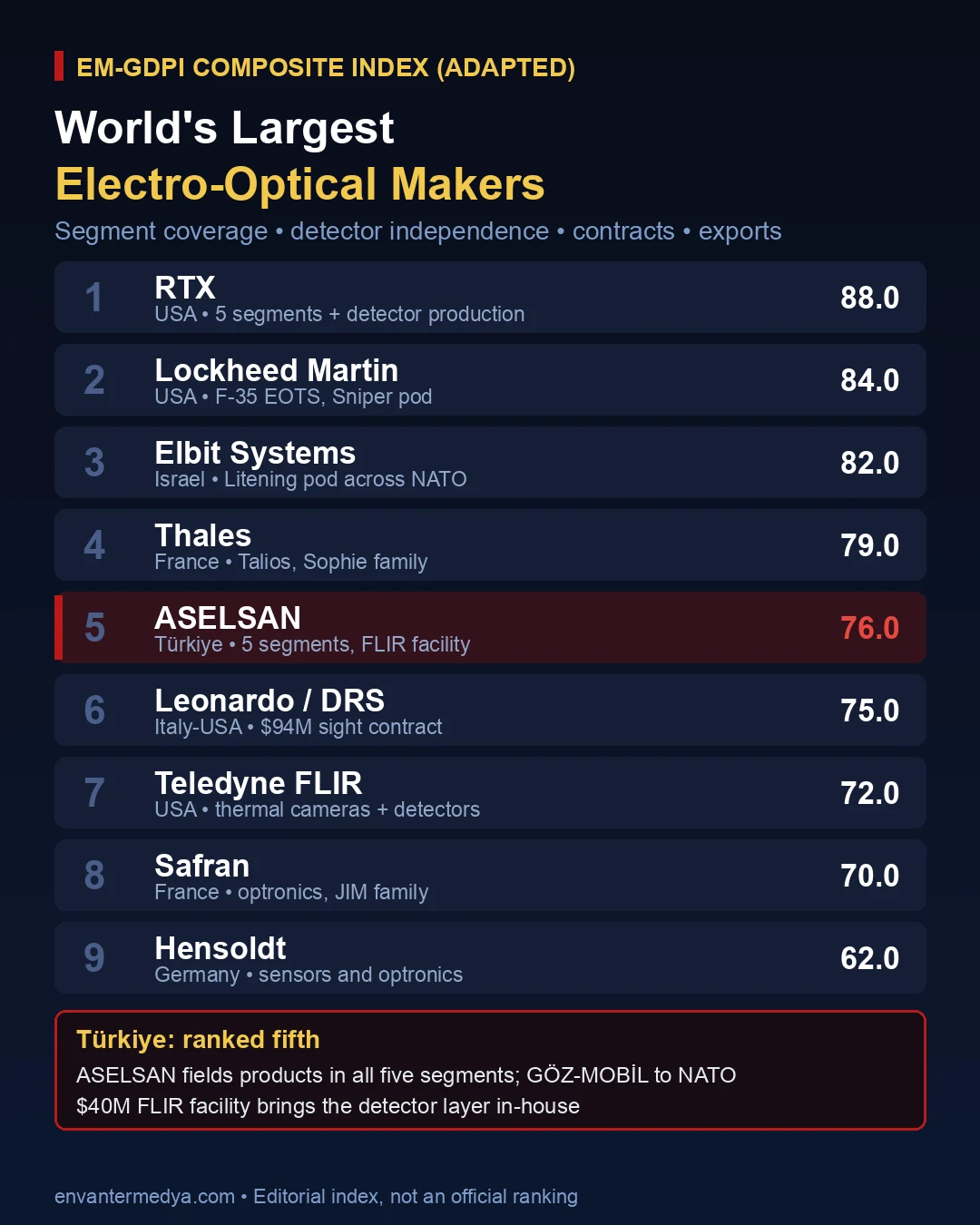
The series’ nine-criterion index was adapted for this sector: because electro-optical revenue cannot be separated, the revenue criterion’s weight was reduced and a critical-component independence criterion (infrared detector production) was added. Chinese builders were not scored for lack of data — no data, no score.
An editorial, adapted index — not an official ranking. The revenue criterion’s weight was reduced and critical-component independence added. Chinese builders were not scored. The Turkish company is marked separately.
What the index says: RTX leads on presence across all five segments and on vertical integration from detector to system. Lockheed Martin ranks on the F-35’s embedded EO system, Elbit on the Litening pod’s NATO-wide footprint. ASELSAN’s fifth place at 76 points is among the Turkish defense industry’s highest placements in this series — and no accident: the company fields products in all five segments, has a verified export record and, most critically, is bringing detector and thermal camera production in-house with a $40 million investment. The only thing capping its score is scale: RTX’s defense revenue is many times ASELSAN’s total turnover.
Where does Türkiye stand?
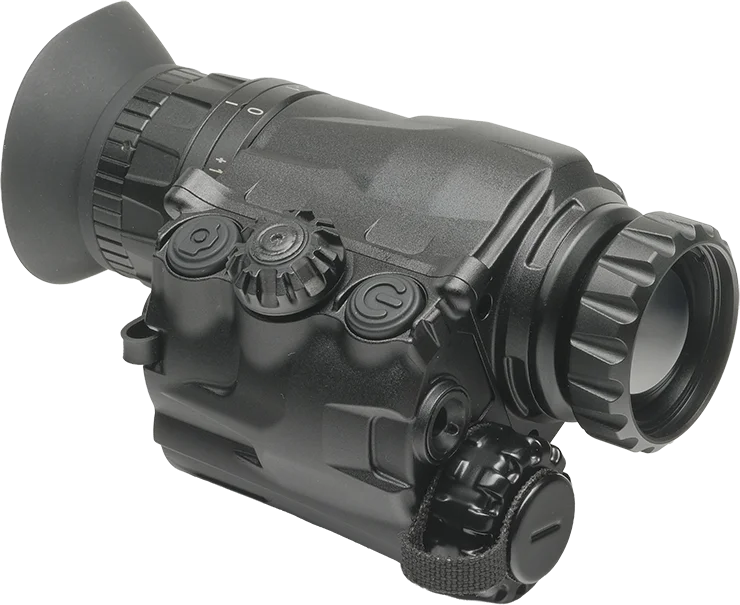
Electro-optics is one of the most mature areas of Turkish defense industry, and ASELSAN sits at its center. The company’s 2025 revenue reached 180.4 billion Turkish lira, and electro-optics was formally listed among the segments that drove it. The product line covers all five segments: the DORUK and GÖZ families in handheld, gunner-commander sights on land platforms, the ASELPOD targeting pod and ASELFLIR turrets in the air, and deck EO systems at sea. The export record is concrete: the GÖZ-MOBİL thermal camera was exported in high volumes to NATO member states in Europe for border security needs, and ASELPOD proved a Turkish targeting pod could be exported. The company signed $1.45 billion in direct and indirect export contracts in the first nine months of the year. The most strategic step, though, is infrastructural: a new FLIR production facility brought online with a $40 million investment aims to produce thermal cameras and advanced optical systems in Türkiye.
Where is Türkiye behind?
Let the data speak: the gap is in scale and in the lowest layer. RTX’s and Lockheed Martin’s defense revenues are many times ASELSAN’s total turnover — meaning larger R&D budgets and more programs running at once. More critical is the infrared detector (FPA) layer: the sector’s true hierarchy is set by detector production, and the United States and France hold decades of accumulated capability there. ASELSAN’s $40 million FLIR facility targets exactly that gap, but the investment will take time to mature. In space, Turkish EO sensors remain at İMECE scale, while RTX’s and Thales’s satellite imaging sensor experience runs far deeper. Against that, three data points support optimism: the number of builders fielding products in all five segments barely exceeds a handful worldwide and ASELSAN is one of them; exports reach NATO members; and detector production is no longer a goal but a facility already online.
How this research was prepared
Data year: Market data 2025 (industry reports); company and contract data from official announcements, January 2024 – August 2026. Scope: Ten groups building military electro-optical/infrared systems; radar and electronic warfare are covered in a separate file. Missing data: No company reports electro-optical revenue separately; because market share estimates vary by source, no company-level share is published here. Chinese builder data is not public. EM-GDPI (adapted): The revenue criterion’s weight was reduced and critical-component independence added.
| Company | Data reliability | Note |
|---|---|---|
| ASELSAN, Leonardo DRS | A | Official financial and contract announcements current |
| RTX, Lockheed, Elbit, Thales, Teledyne FLIR, Safran, Hensoldt | B | Product and program data public; no EO revenue breakdown |
| Chinese builders | D | No reliable current data; excluded from the index |
Frequently asked questions
Which company is the world’s largest electro-optical system manufacturer?
RTX leads on segment coverage and vertical integration; Lockheed Martin on the F-35’s embedded system and Elbit on the Litening pod’s NATO footprint. RTX tops Envanter Medya’s adapted index, with ASELSAN fifth.
How big is the military electro-optical market?
Roughly $11.1 billion in 2025, with North America the largest region at 38.2 percent. Different research houses publish higher figures depending on scope definitions.
How strong is ASELSAN in electro-optics?
It is one of the few builders fielding products in all five segments (land, air, naval, space, handheld). Its 2025 revenue was 180.4 billion Turkish lira, with electro-optics among the driving segments, and it signed $1.45 billion in export contracts over nine months.
What will ASELSAN’s new thermal camera facility do?
The FLIR production facility, brought online with a $40 million investment, will build thermal cameras, night vision devices and advanced optical systems — targeting domestic capability in the infrared detector layer, the sector’s most critical component.
What is GÖZ-MOBİL?
ASELSAN’s thermal camera system, in service with Türkiye’s Gendarmerie and exported in high volumes to NATO member states in Europe for border security needs.
What is a targeting pod?
An electro-optical system carried under a fighter that images the target and marks it with a laser. Examples: Lockheed Martin’s Sniper, Elbit’s Litening, Thales’s Talios and Türkiye’s ASELPOD.
What is the sector’s most critical component?
The focal plane array (FPA) that converts infrared light into an electrical signal. Very few countries can produce one; everyone else is a system integrator. It is scored as a separate criterion here.
What was Leonardo DRS’s US Army contract?
A five-year, $94 million contract to produce advanced infrared weapon sights for US Army snipers — a marker of how large even one sub-segment can be.
Has ASELPOD been exported?
Yes; ASELSAN’s targeting pod is among the few Turkish aviation subsystems with an export record.
Why is Teledyne FLIR positioned differently?
The company makes both end products (thermal cameras) and detectors — meaning it supplies many system integrators as well as competing with them, a distinctive position on the civil-military boundary.
What about China’s electro-optical production?
Production and export data are not disclosed; this research does not assess unverifiable data.
What is the difference between electro-optics and radar?
Radar senses with radio waves; electro-optics with light and heat emission. Radar gives long range in all weather; electro-optics is passive (it emits nothing) and offers higher identification resolution. See our radar manufacturers file and the Defense Atlas.
Sources and methodology notes
This study is an editorial research product prepared by Envanter Medya by cross-checking publicly available official company data, contract announcements, industry market reports and institutional sources. Principal sources:
- IMARC Group — 2025 military EO/IR market size ($11.1 billion)
- Fortune Business Insights — regional market shares (North America 38.2%) and leading builders
- Anadolu Agency — ASELSAN’s 2025 revenue (180.4 billion TL) and driving segments
- Anadolu Agency — the $40 million FLIR production facility investment
- ASELSAN official publication — the handheld electro-optical product family and GÖZ-MOBİL exports
- Grand View Research — Leonardo DRS’s US Army infrared weapon sight contract ($94 million)
Last updated: August 25, 2026. This is a living research page, updated as contract and export announcements arrive. The next file in the series examines the world’s largest small arms manufacturers. For the full series, see the 2026 Global Defense Industry Report.