South Korea’s KF-21 Boramae Joins Air Force Service

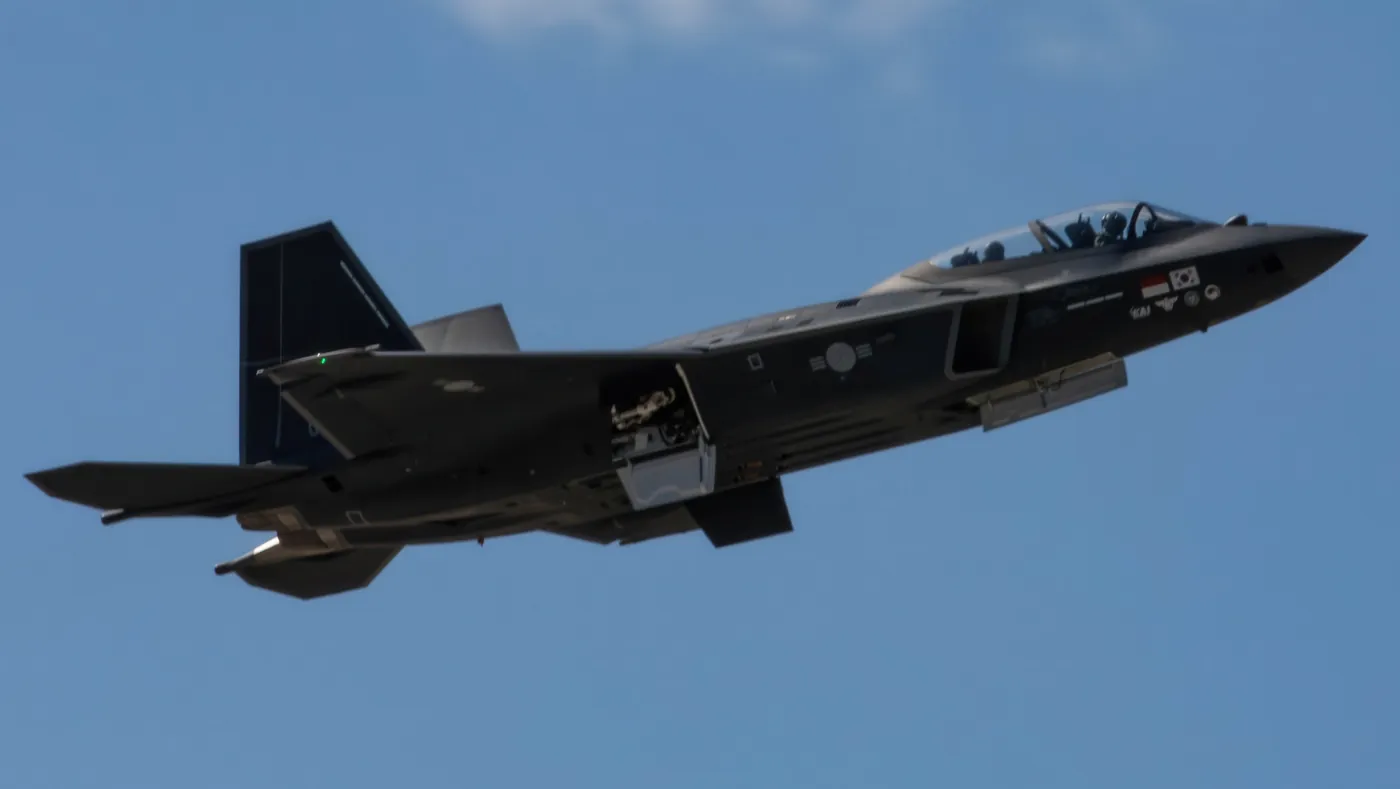
South Korea’s indigenous KF-21 Boramae fighter formally entered Air Force service on 22 September at Yecheon Air Base. The first serial-production aircraft, delivered by Korea Aerospace Industries (KAI), joined the 156th Fighter Squadron, reactivated after a 14-year gap specifically to operate the new type.
A handover ceremony at Yecheon
The first serial KF-21 Boramae, tail number 001, was formally inducted into the Republic of Korea Air Force at a ceremony held at Yecheon Air Base on 22 September. Major Han Jae-seok signed the delivery-acceptance document. The aircraft flew in formation with FA-50, TA-50 and T-50 trainers already in service — a formation that visibly tied South Korea’s own aircraft family together across classes and reinforced the program’s message of continuity. Air Force Chief of Staff Son Seok-rak received the program’s completion report in person at a hangar on the base.
A squadron reactivated for the occasion
The 156th Fighter Squadron, which now operates the KF-21, was reactivated on 1 June 2026 after standing down 14 years earlier — brought back specifically to fly the new domestic platform. Reactivating a squadron rather than simply assigning aircraft to an existing unit signals that this induction is being treated as the start of an institutional capability, not a one-off delivery. Standing up a unit with its own lineage and history to fly a new type is typically read as a sign that the air force expects the platform to serve as a long-term backbone rather than a supplementary asset.
Twenty-five years from concept to cockpit
The KF-21 Boramae program traces back to design work that began in 2001, with the main development phase starting in 2015. That puts the span from initial concept to service entry at roughly 25 years, and the development-to-delivery phase at about a decade. The length of that timeline reflects the engineering and industrial complexity of building a 4.5-generation fighter with partial low-observable characteristics that push toward fifth-generation capability. Along the way, engine integration, the localization of avionics systems and weapons certification each went through years-long test cycles of their own before converging into a single production standard.
Why the milestone matters
For any fighter program, the meaningful threshold is not the first prototype flight but the moment a production aircraft joins an operational squadron. Clearing that threshold gives KAI and South Korea’s Defense Acquisition Program Administration (DAPA) concrete evidence that the KF-21 has moved from test and evaluation into operational service. Attention now shifts to expanding fleet numbers and building the operational track record that will matter for any future export prospects — for a fighter aircraft, what ultimately shapes export interest is less the specification sheet than the flight hours and reliability record it accumulates once it is flying real missions for a real air force.
A parallel with Turkey’s KAAN
KF-21’s entry into service invites a natural comparison with KAAN, the Turkish fighter developed by Turkish Aerospace. Both programs occupy similar ground: domestically developed fighters positioned between the 4.5 and fifth generations. South Korea has now put its first serial KF-21 into an operational squadron; Turkey’s KAAN is on its own track, with first serial-production deliveries to the Turkish Air Force targeted from 2028. Both countries are pursuing broadly similar industrial strategies aimed at equipping their air forces with domestically built platforms and reducing reliance on imported fighters — one has just marked its induction ceremony, the other is approaching its own first-delivery milestone, and the shared motivation behind both programs leaves open room for future technical cooperation between the two industries.
What comes next
The agenda ahead for the KF-21 program centers on accelerating the production line and standing up or reactivating further squadrons along the same model used for the 156th. The Republic of Korea Air Force plans to bring additional units into service at other bases over the coming years, which means the KF-21’s share of the overall fighter inventory will grow in stages rather than all at once. The next milestone that matters for program managers is completing operational certification across the full range of air-to-air and air-to-surface munitions the aircraft is meant to carry, alongside building up fleet-wide flight hours — the kind of data that will underpin both domestic sustainment decisions and any future export discussions.
Sources
- DefenseMirror, “KF-21 Boramae inducted into ROKAF service,” 24 September 2026
- Defense Acquisition Program Administration (DAPA) — official statements
- Republic of Korea Air Force (ROKAF) — Yecheon Air Base ceremony announcement