What Is Rafael Advanced Defense Systems? Israel’s State Arms Maker
- 11 Oct 2026 10:30
- Updated: 11 Oct 2026

Rafael Advanced Defense Systems is one of Israel’s three largest defence companies and is wholly owned by the Israeli state. It began in 1948 as a weapons research laboratory inside the Ministry of Defense, took the name RAFAEL in 1958 and became a government company in 2002. Its headquarters are in Haifa. Rafael is best known for Iron Dome, David’s Sling, the Spike missile family, SPICE bomb kits, Litening pods and the Trophy active protection system. Many of these systems have been used by the Israeli military in Gaza, where the UN has documented mass civilian casualties and the International Court of Justice is hearing a genocide case.
Overview and History
Rafael traces its origin to the science corps and weapons laboratories set up inside Israel’s Ministry of Defense in 1948. In 1958 the organisation became RAFAEL, a Hebrew acronym for the Armament Development Authority, and for decades it operated as a government agency rather than a company. Its earliest widely known product was the Shafrir air-to-air missile of the 1960s. The Shafrir line evolved into the Python series; the Python-5 in production today is the latest member of that lineage.
During the Cold War the authority broadened its work into electro-optics, rocket motors and naval missiles. The 1980s produced the Popeye air-to-ground missile and the Litening targeting pod. The 1990s brought the first versions of the Spike anti-tank missile and the Trophy active protection system. In this period Rafael began to shift from a laboratory serving the Israeli military toward a producer with export ambitions.
In 2002 the Israeli government converted the authority into Rafael Advanced Defense Systems Ltd., a state-owned limited company. Incorporation made it easier to sign commercial contracts, form joint ventures and open subsidiaries abroad. The entry into service of Iron Dome in 2011 raised the company’s international profile. In 2024 Rafael reported sales of roughly US$4.8 billion and a record order backlog, growth that coincided with the war in Gaza and accelerated Israeli procurement.
Structure and Ownership
Rafael is 100 percent owned by the State of Israel, with its shares administered through the Government Companies Authority and its board appointed by the government. Together with Israel Aerospace Industries (IAI), which has the same status, it forms the state-owned core of the Israeli arms industry; the third major player, Elbit Systems, is privately held. Rafael is not listed on any stock exchange and publishes only summary financial results.
According to the company’s public organisation, Rafael operates three main divisions: Air and Missile Defense Systems, Land and Naval Systems, and Air Superiority and C4I Systems. These are supported by production units for rocket motors and energetic materials. Its main sites lie along the coast north of Haifa, with further facilities near Yokneam and Beersheba. The workforce exceeds 8,000 according to company statements.
Abroad, the company operates Rafael USA in Washington and Rafael Systems Global Sustainment, the Varley Rafael Australia joint venture, EuroSpike GmbH in Germany with Diehl Defence and Rheinmetall, and Kalyani Rafael Advanced Systems in India with Bharat Forge. In the United States it formed Raytheon Rafael Area Protection Systems with RTX to build Iron Dome components locally. In Israel it holds stakes in the electro-optics maker Controp and in the drone manufacturer Aeronautics.
| Division / entity | Area | Note |
|---|---|---|
| Air and Missile Defense Systems | Iron Dome, David’s Sling, SPYDER, Iron Beam, C-Dome | Core division |
| Land and Naval Systems | Spike, Trophy, Samson, Typhoon, naval missiles | Core division |
| Air Superiority and C4I | Python-5, Derby, SPICE, Litening, BNET radios | Core division |
| EuroSpike GmbH (Germany) | Spike production and European marketing | Joint venture with Diehl Defence and Rheinmetall |
| Kalyani Rafael Advanced Systems (India) | Local production of Spike and other systems | Joint venture with Bharat Forge |
| Raytheon Rafael Area Protection Systems (US) | US production of Iron Dome components | Joint venture with RTX |
| Controp Precision Technologies | Electro-optical surveillance systems | Shareholding |
Products and Systems
The centrepiece of Rafael’s air defence portfolio is Iron Dome, designed against short-range rockets and artillery. Rafael builds the Tamir interceptor, while the ELM-2084 radar comes from IAI’s Elta subsidiary. At medium and long range sits David’s Sling, developed with Raytheon. The SPYDER surface-to-air system, which fires Python-5 and Derby missiles, is aimed at export customers. The 100 kW-class laser system Iron Beam was reported to have been delivered to the Israeli military and declared operational in late 2025.
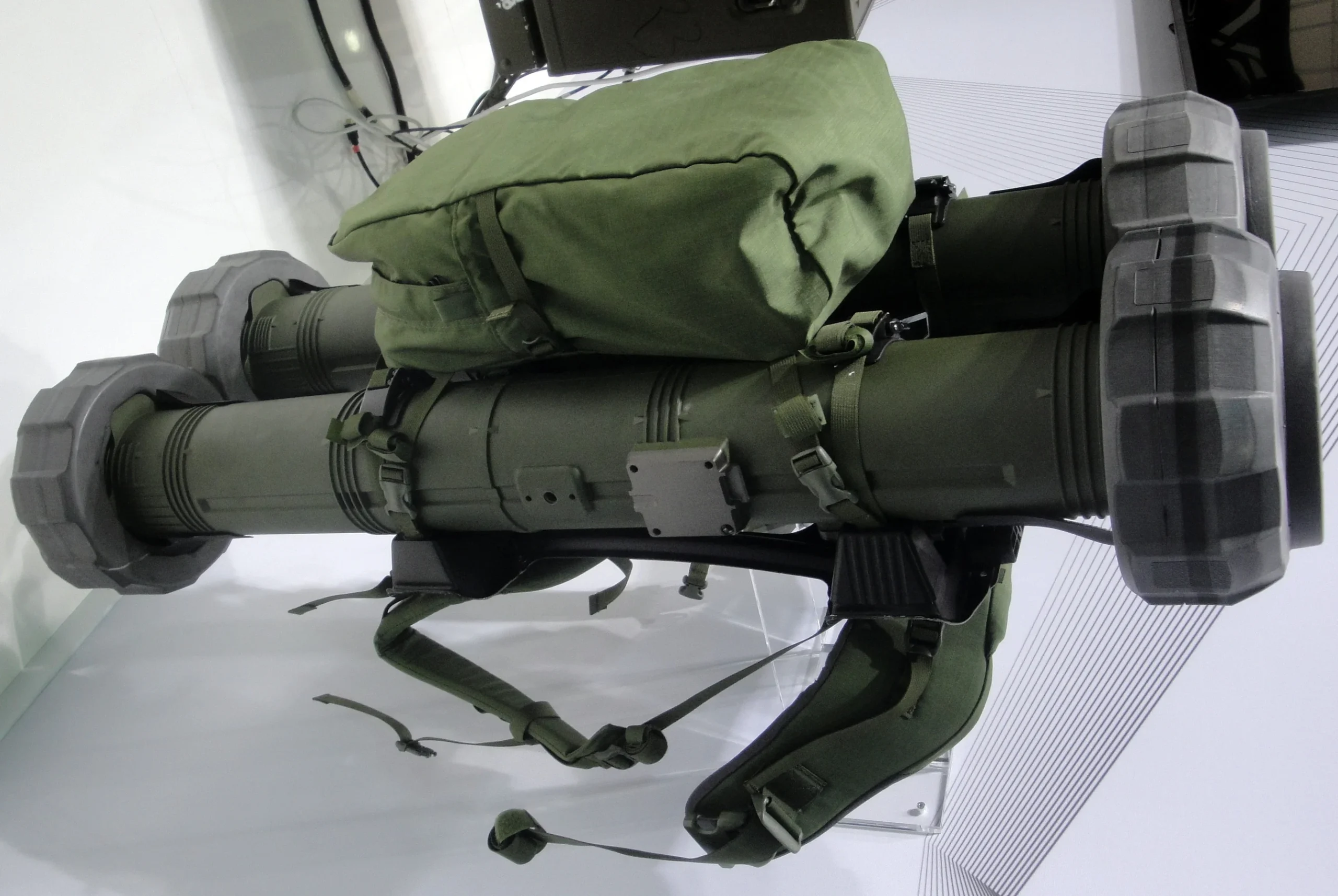
On land, the Spike family is the company’s most widespread product. The SR, MR, LR2, ER2 and NLOS versions cover ranges from a few hundred metres to several tens of kilometres, using electro-optical seekers and fibre-optic or radio data links that allow the operator to update the target after launch. Trophy is an active protection system that detects and destroys incoming anti-tank rockets and missiles. The Samson remote weapon station equips armoured vehicles, and Typhoon is its naval counterpart.
For aircraft, SPICE guidance kits in 250, 1000 and 2000 kg classes convert conventional bombs into electro-optically and satellite-guided weapons. The Litening targeting pod is widely used for target acquisition and laser designation and is produced under licence in the United States by Northrop Grumman. At sea, the Sea Breaker long-range precision missile was unveiled in 2021, and C-Dome is the shipborne variant of Iron Dome.
| Product | Category | Main users |
|---|---|---|
| Iron Dome | Short-range air defence | Israel; US Army (two batteries) |
| David’s Sling | Medium/long-range air defence | Israel; Finland (2023 contract) |
| Spike family | Anti-tank / multipurpose guided missile | Israel, Germany, Poland, India and about 40 countries per company claims |
| SPICE | Guided bomb kit | Israeli Air Force; India (reported) |
| Python-5 / Derby | Air-to-air missile; SPYDER | Israel; India and other SPYDER operators |
| Litening | Targeting pod | Israel; United States (licensed production), Germany, Spain, India |
| Trophy | Active protection system | Israel (Merkava, Namer); US (Abrams); Germany (Leopard 2A7A1); UK (Challenger 3) |
| Samson / Typhoon | Remote weapon station | Israeli land and naval forces; various export customers |
| Iron Beam | Laser air defence | Israel (reported operational 2025) |
| Sea Breaker | Long-range precision-guided missile | No announced user (marketing stage) |
Exports and Partnerships
Spike is the product with Rafael’s widest export footprint. According to the company it has been ordered by roughly 40 countries. In Germany it entered Bundeswehr service under the name MELLS and is produced in Europe through the EuroSpike partnership. Poland has produced it under licence since the early 2000s. India imported Spike MR/LR and moved to local production with Kalyani Rafael. The Netherlands, Belgium, Italy, Spain and the United Kingdom are among other European users.
The United States is Rafael’s most important strategic market. The US Army bought Trophy for its Abrams tanks through Leonardo DRS, acquired two Iron Dome batteries in 2019–2020 and evaluated Spike NLOS as an interim long-range anti-tank solution. US federal funding for Iron Dome and David’s Sling has covered a substantial share of those programmes’ development costs.
One distinction matters: the Arrow 3 upper-tier system that Germany ordered in 2023 belongs to IAI, not Rafael. Rafael’s main European collaborations run through Diehl, Rheinmetall and Leonardo. In India, Astra Rafael Comsys produces communication systems. Finland’s selection of David’s Sling in 2023 is the system’s first announced export. Reports place Spike in service in several further countries, including Azerbaijan, but official confirmation is limited and such reports should be treated with caution.
Türkiye Context
There is no defence trade between Türkiye and Rafael today. SIPRI arms transfer records list a late-1990s purchase of Popeye air-to-ground missiles by the Turkish Air Force, a limited example from the period of close Turkish–Israeli military cooperation. None of Rafael’s current systems, such as Spike, Trophy or Iron Dome, is in the Turkish inventory.
Türkiye restricted defence exports to Israel in late 2023 over the assault on Gaza and in May 2024 halted all imports and exports with Israel. In August 2024 it filed a declaration of intervention in the South Africa v. Israel case at the International Court of Justice. Against this background, Rafael products are not on the Turkish procurement agenda, and the company is followed in Türkiye only as a regional actor.
Gaza, Human Rights and Market Position
Rafael’s Spike missiles, SPICE guidance kits, Litening pods, Trophy system and Iron Dome have been used by the Israeli military in its operations in Gaza. The UN Office of the High Commissioner for Human Rights and major human rights organisations have documented the killing of tens of thousands of Palestinian civilians since October 2023, along with widespread strikes on hospitals, schools and homes. In January 2024 the International Court of Justice issued provisional measures in the case brought by South Africa, finding that the right of Palestinians to be protected from genocide was at plausible risk. In September 2025 the UN Independent Commission of Inquiry concluded that Israel had committed genocide in Gaza. Rafael’s products are therefore directly at issue in human rights debates as weapons used in the occupied Palestinian territory.
These findings have prompted responses from governments and investors. Spain halted arms trade with Israel in 2024 and reportedly cancelled a contract for Spike LR2 missiles. Several European pension funds and banks reviewed or excluded holdings in Israeli defence firms. Campaigns against procuring Rafael products have been run in several countries. The company states that its systems are defensive in purpose and that exports are subject to Israeli Ministry of Defense licensing.
Commercial indicators have nonetheless risen. Israel’s national defence exports reached a record of roughly US$14.8 billion in 2024, and Rafael is among the largest contributors to that total. Domestically it both competes and partners with Elbit Systems and IAI. Rafael regularly appears within the top 50 of SIPRI’s ranking of the 100 largest arms producers. European rearmament has increased demand for Spike, Trophy and air defence products, while the reputational risk arising from Gaza has made the political foundation of that demand fragile.
Frequently Asked Questions
Who owns Rafael Advanced Defense Systems?
Rafael is wholly owned by the State of Israel. Its shares are administered by the Government Companies Authority, its board is appointed by the government, and the company is not listed on any stock exchange.
When was Rafael founded?
Its roots go back to weapons research laboratories established within Israel’s Ministry of Defense in 1948. It took the name RAFAEL in 1958 and was restructured as a state-owned limited company in 2002. It is headquartered in Haifa.
What are Rafael’s best-known products?
Iron Dome and David’s Sling air defence systems, the Spike missile family, SPICE guided bomb kits, Python-5 and Derby air-to-air missiles, the Litening targeting pod, the Trophy active protection system and the Iron Beam laser.
Have Rafael systems been used in Gaza?
Yes. Spike, SPICE, Litening, Trophy and Iron Dome have been used by the Israeli military in Gaza. The UN and human rights organisations have documented mass civilian casualties, and the International Court of Justice ordered provisional measures in January 2024.
Does Türkiye use Rafael products?
No. The current Turkish inventory contains no Rafael system. A limited purchase of Popeye missiles in the 1990s is recorded. Türkiye suspended all trade with Israel in May 2024.
Sources
- Rafael Advanced Defense Systems – official website
- SIPRI Arms Industry Database
- International Court of Justice – South Africa v. Israel (Case 192)
- UN Office of the High Commissioner for Human Rights (OHCHR)