Japan Launches Seventh Taigei-Class Submarine Shōgei at Kobe Shipyard

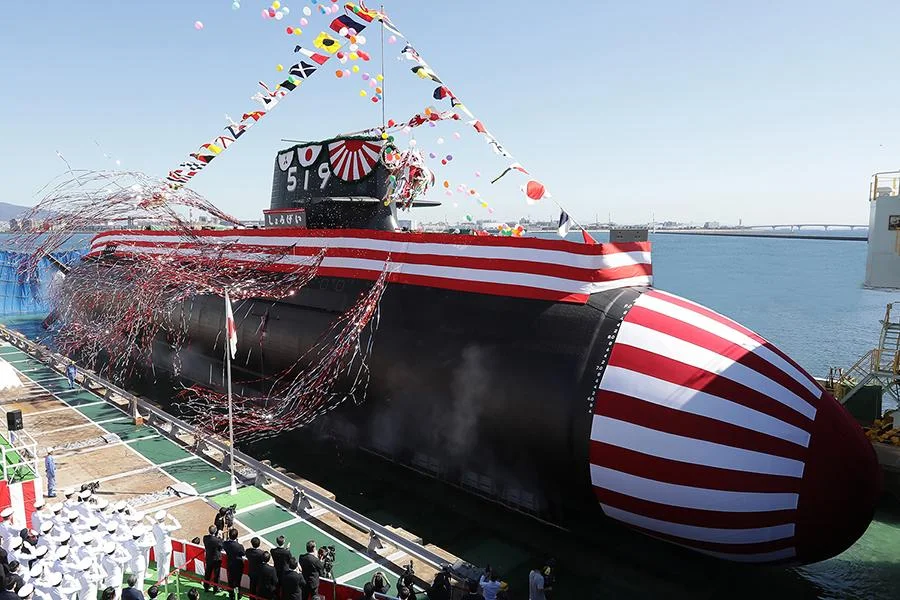
Mitsubishi Heavy Industries (MHI) held the naming and launching ceremony for Shōgei, the seventh submarine of Japan’s Taigei class, at its Kobe Shipyard on October 8. The boat, carrying hull number SS-519, entered the water with its pressure hull complete but internal systems still to be fitted, in a ceremony marked by the traditional flag garlands and streamers of a Japanese launch.
Shōgei is the fourth Taigei-class boat built by MHI and the seventh overall in a program split between two Kobe shipyards. MHI held the naming ceremony for the fifth boat, Chōgei, in October 2024, while the sixth boat, Sōgei, was launched by rival yard Kawasaki Heavy Industries in October 2025.
At roughly 3,000 tonnes submerged displacement, Shōgei shares its predecessors’ hull form. It will carry newer, higher-output Kawasaki diesel engines and the same torpedo countermeasure system fitted to the last four Sōryū-class boats. Its weapons fit includes the Type 18 torpedo and the UGM-84L Harpoon Block II anti-ship missile.
According to MHI, the submarine will be handed over to the Ministry of Defense within fiscal year 2027 — by March 2028 — once hull, propulsion, electrical systems and weapons fit-out are complete. Naval News puts the program cost at roughly 80.5 billion yen.
The ceremony lands in the middle of an active debate over whether Japan should move toward nuclear-powered submarines. Defense Minister Shinjiro Koizumi said on September 11 that Tokyo will not rule out the nuclear option as it revises its security documents by year’s end, while acknowledging the trade-offs: higher cost, a larger hull, specialized crew training, and a possibly louder acoustic signature.
The technical case for considering nuclear propulsion rests on the limits of conventional boats, which must periodically snorkel to recharge batteries and drain them quickly at high speed. China’s expanding naval activity in the Western Pacific has sharpened the urgency Tokyo attaches to closing that gap.
Japan’s Ministry of Defense is separately pursuing a vertical-launch-system (VLS) submarine design under its December 2022 security documents, aimed at carrying longer-range missiles. MHI received a 3.9-billion-yen research contract in July 2026 for that design, running through fiscal 2029; such a system would likely require a larger hull and more onboard power generation.
An expert panel convened in September 2025 recommended research into “next-generation propulsion” without explicitly endorsing a nuclear design, and Tokyo has made no formal decision to acquire nuclear-powered boats. Shōgei’s launch adds the newest conventional hull to the fleet while that debate continues.
The Taigei class isn’t finished at Shōgei. The eighth boat was laid down at Kawasaki’s Kobe yard in December 2024, with launch planned for 2027. As older Sōryū-class boats are retired or shifted to secondary roles, the JMSDF is using the roughly annual launch cadence of the Taigei program to lower its fleet’s average age without growing the total number of hulls.
The program carries lessons for other navies weighing the same trade-off between conventional air-independent propulsion and nuclear power, including Turkey, which is expanding its own Reis-class (Type 214TN) submarine fleet. Japan’s incremental approach — upgrading batteries and countermeasure systems within a stable hull design while keeping the nuclear option formally open — offers a comparative case for navies still years away from that decision.
Sources
- Mitsubishi Heavy Industries, “Naming and Launching Ceremony Held for Defense Ministry’s 3,000-Ton Submarine ‘Shōgei’ at Kobe Shipyard,” October 8, 2026 — https://www.mhi.com/jp/news/26100802.html — official announcement, delivery schedule and technical description
- Naval News (Kosuke Takahashi), “Japan Launches Seventh Taigei-Class Submarine as Nuclear Propulsion Debate Grows,” October 8, 2026 — https://www.navalnews.com/naval-news/2026/10/japan-launches-seventh-taigei-class-submarine-as-nuclear-propulsion-debate-grows/ — technical detail, program cost and nuclear-propulsion debate context