




India Restarts Su-30MKI Production: 12 New Flankers at Nashik With Over 50 Percent Indigenous Content


India’s state-owned Hindustan Aeronautics Limited is reopening the Su-30MKI production line at its Nashik facility. Under a contract signed in December 2024 worth roughly ₹13,500 crore, the 12 fighters will replace aircraft lost in accidents over the years. The first delivery is expected in 2027-28, with the full order completed by 2029.
At a Glance
- Manufacturer and site: Hindustan Aeronautics Limited (HAL), Nashik division
- Quantity and schedule: 12 Su-30MKIs; first aircraft 2027-28, all delivered by 2029
- Contract: December 2024, approximately ₹13,500 crore (about $1.3 billion)
- Indigenisation: More than 50 percent indigenous content targeted
- Rationale: Attrition replacement for aircraft lost in accidents
- Fleet: The Indian Air Force operates around 260 Su-30MKIs
Set up in 1964 to build the MiG-21, the Nashik division has since produced more than 900 aircraft and overhauled roughly 1,900. The Su-30MKI line went quiet when licensed production wound down. Reopening it reflects two decisions at once: keeping the Indian Air Force’s squadron strength from eroding, and keeping a strategic industrial capability alive.
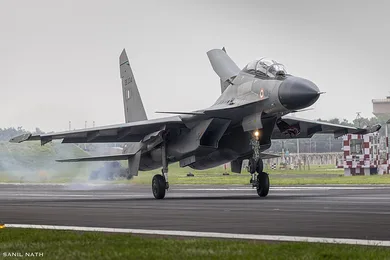
The Su-30MKI is the backbone of Indian air power — a heavy, twin-engine multirole fighter derived from the Russian Su-30 family but distinguished by Indian-specified avionics and weapons integration, with Israeli and French subsystems layered onto a Russian airframe. At around 260 aircraft, it is one of the largest single-type heavy fighter fleets in the world.
Why restarting the line matters
The Indian Air Force has been operating below its sanctioned squadron strength for years. With next-generation light fighters arriving slower than planned, attrition in the heavy fleet widened the gap. Twelve airframes look modest on paper, but the real value lies in preserving a supply chain and a skilled workforce that would be far more expensive to rebuild than to sustain.
The indigenous content figure is the more consequential detail. Exceeding 50 percent means more than fabricating structures locally; it implies a larger Indian share in subsystems, avionics and weapons integration. Every item localised reduces exposure to external supply constraints for spares and future upgrades — a lesson the war in Ukraine drove home for every operator of Russian-origin equipment.
Nashik will also run a two-phase upgrade of the existing fleet. At its centre is the integration of an Indian-developed active electronically scanned array radar intended to extend detection and engagement ranges, alongside indigenous air-to-air missiles and electronic warfare fits.
Su-30MKI Key Characteristics
| Class | Heavy, twin-engine, multirole fighter |
| Crew | 2 (pilot and weapon systems officer) |
| Engines | 2 × AL-31FP with thrust vectoring |
| Max speed | Mach 2 class |
| Payload | External load capacity above 8 tonnes |
| Signature weapon | BrahMos-A air-launched supersonic cruise missile |
| Fleet | Approximately 260 aircraft in Indian Air Force service |
Indigenise an import, or design your own
India’s choice illustrates one of two paths to industrial maturity: take a foreign-origin platform and localise it step by step. It carries less near-term risk and delivers faster, but it does not guarantee authority over the platform’s fundamental design decisions. The other path is to design from scratch — slower and costlier, yet it ends with design ownership.
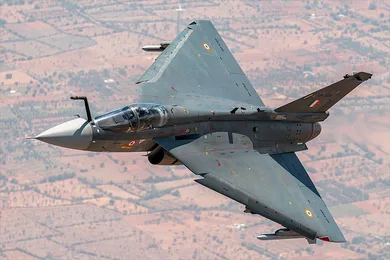
Other states have solved the same equation differently. Türkiye’s decision to go straight to a clean-sheet design with KAAN, and to field its own trainer and light attack platform with HÜRJET, favours design authority over speed. Both approaches carry distinct costs and timelines, and only a decade-scale view will show which pays better.
Sources
- Hindustan Aeronautics Limited (HAL) statements
- The Week – Indian Air Force Su-30MKI fleet report, 10 August 2026
- Business Today – HAL Nashik production line report
- Defense Express (en.defence-ua.com), 13 August 2026
- Indian Ministry of Defence contract announcements