Vietnam Lays Down Its First Indigenously Designed Multipurpose Frigate

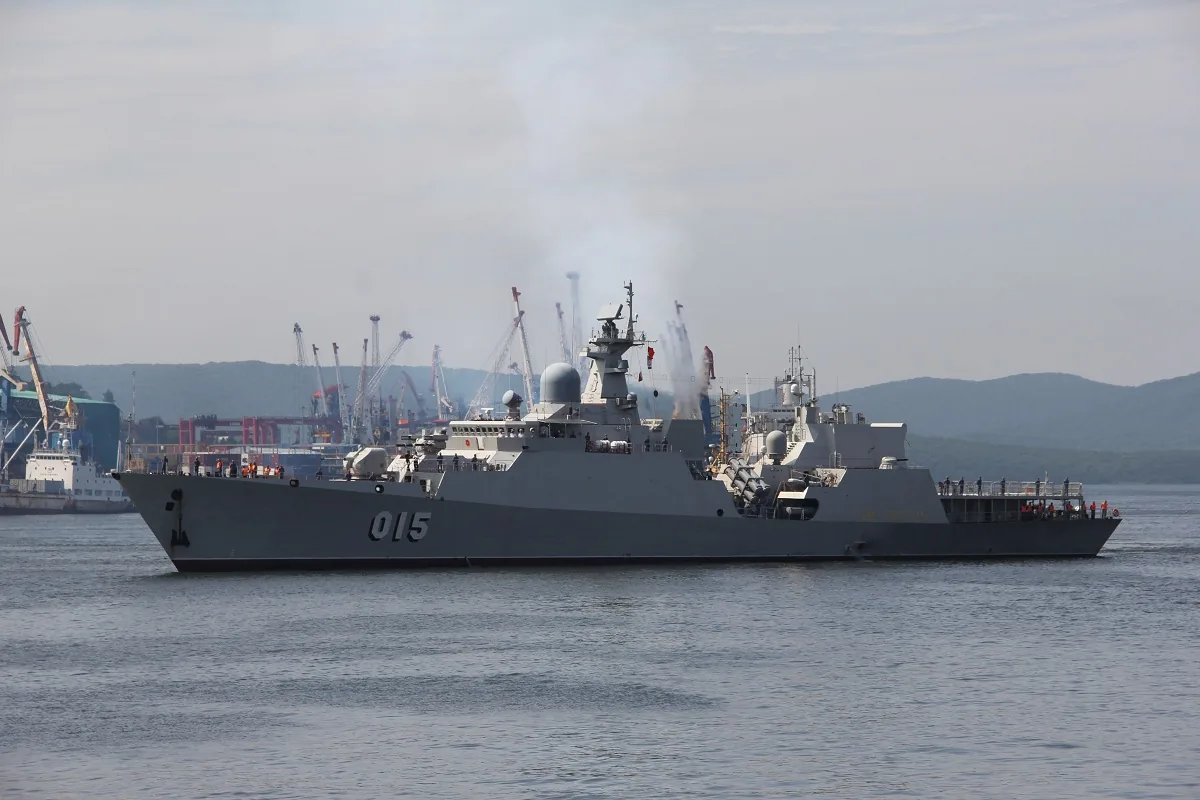
Vietnam has laid the keel of its first indigenously designed multipurpose frigate at the Song Thu shipyard in Da Nang. The anti-submarine-oriented ship will draw the bulk of its weapons and systems from domestic industry.
At a Glance
- The keel was laid on 10 August 2026 at Song Thu Corporation’s yard in Da Nang.
- Construction is expected to take around 36 months.
- Displacement is estimated at 2,500-3,000 tonnes, with a length of roughly 105 metres.
- Main gun: an AK-176-derived 76 mm weapon, plus a 12-cell vertical launch system arranged as two sets of six.
- Two quad VCM-family anti-ship missile launchers and two trainable 533 mm torpedo tubes.
- A phased-array multifunction radar with four fixed panels, hull sonar and a possible towed array.
- The combat management system and electronic support measures were developed by Viettel.
Construction Begins
The keel of the Vietnam People’s Navy’s first indigenously designed multipurpose frigate was laid on 10 August 2026 at Song Thu Corporation’s yard in Da Nang. Speaking at the ceremony, Deputy Minister of Defence Pham Hoai Nam said the ship carries “a very high proportion of domestically developed weapons and technical systems.”
Construction is expected to run roughly 36 months. If that schedule holds, the vessel would launch around 2029. No announcement has been made regarding the class’s total size.
What the Ship Looks Like
The frigate is described as roughly 105 metres long, displacing between 2,500 and 3,000 tonnes. Those dimensions place it in the light frigate or large corvette bracket — a hull built for sustained presence in regional and offshore waters rather than blue-water deployment.
The main gun is an AK-176-derived 76 millimetre weapon. Air defence rests on a 12-cell vertical launch system arranged in two groups of six. Close-in defence comes from two AK-630M 30 mm systems, supplemented by twin man-portable air defence missile launchers.
Strike power comes from two quad VCM-family anti-ship missile launchers. For anti-submarine work the ship carries two trainable 533 millimetre torpedo tubes and an RBU-6000-style weapon. Four chaff launchers are fitted, two forward and two aft.
Sensors and Domestic Systems
The electronics are the ship’s most interesting feature. A phased-array multifunction radar with four fixed panels represents a significant step for Vietnam; fixed-panel arrays offer far faster update rates and simultaneous track handling than a rotating antenna. A separate fire control radar accompanies it.
Underwater detection relies on a hull sonar, with towed array integration reported as a possibility. The combat management system and electronic support measures were developed by Viettel, Vietnam’s telecommunications and defence electronics group.
That last point is where the project’s real significance sits. Building a hull and building the ship’s brain — the software layer that fuses sensor data and directs the weapons — are very different undertakings. A domestic combat management system means Vietnam can modernise the ship across its service life without asking anyone’s permission.
The Regional Read
The Vietnam People’s Navy has been built around Russian-supplied Gepard 3.9 frigates and Kilo-class submarines. Contraction in Russian defence exports and sanctions pressure are pushing Hanoi to diversify sources and lean on domestic production.
Sovereignty disputes in the South China Sea demand continuous naval presence. A 105-metre platform is scaled precisely for that requirement: extended patrol, submarine tracking, and enough firepower to deter when needed.
Why It Matters
The list of countries that can design and build their own frigates is short. Vietnam’s step shows that the military balance in the South China Sea shifts not only through great-power moves, but through mid-sized navies growing their own capability base.
Frequently Asked Questions
When will the ship enter service?
Construction is expected to take about 36 months, putting a launch around 2029. No commissioning date has been announced.
Is the design entirely indigenous?
Deputy Defence Minister Pham Hoai Nam described the proportion of domestically developed weapons and technical systems as very high. The origin of some subsystems has not been disclosed.
How many ships will be built?
No figure has been announced for the class.
Sources
- Vietnamese Ministry of Defence ceremony statements (10 August 2026) — Keel-laying date and the remarks of Deputy Minister Pham Hoai Nam.
- Naval News (13 August 2026) — Ship dimensions, weapon and sensor configuration, construction schedule.
- Song Thu Corporation corporate information — Yard capacity and build process.