Why NATO Is Buying Guns Again: Skynex and the New Economics of Drone Defence
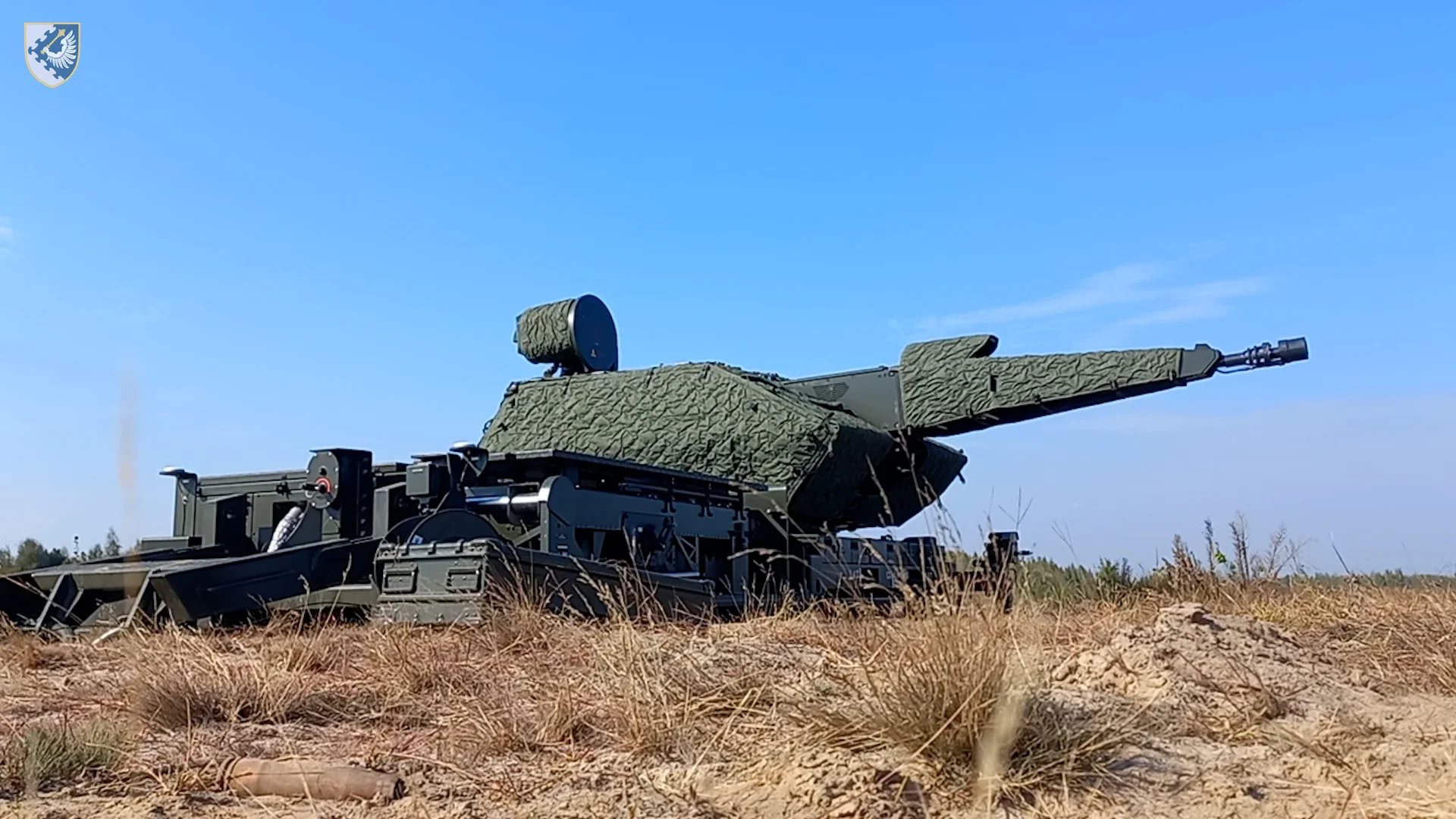
Image: Ukrainian Air Force, Air Command West / Wikimedia Commons (CC BY 4.0)
For thirty years NATO air defence doctrine treated the gun as a museum piece: missiles had won. Then came the cheap drone — and the arithmetic collapsed. Patriot interceptors costing millions were chasing Shaheds costing tens of thousands; European airports were closing over hobby-grade quadcopters no missile battery could sensibly engage. The alliance’s procurement answer to that humiliation has a name from the past: the 35 mm cannon. Rheinmetall’s Skynex is its most successful expression — four systems guarding Ukraine’s power grid with verified kills up to cruise-missile class, a first Italian battery handed over in December 2025, a Qatari installation quietly running since before the trend had a name, and Romania next in line.
| Manufacturer | Rheinmetall Air Defence (Zurich) + Rheinmetall Italia |
| Market segment | Gun-based point defence / C-UAS — the inner ring of layered air defence |
| Core architecture | Skymaster C2 network + 35 mm Revolver Gun Mk3 firing units |
| Killer feature | AHEAD airburst rounds — thousands of euros per engagement |
| Combat record | Ukraine: Shahed drones, Kh-101 and Kalibr cruise missiles |
| Customer base | Ukraine (4), Italy (1 + 3 options), Qatar, Romania (selected) |
| Sibling product | Skyranger 30/35 turret for mobile forces |
| Main rivals | Centurion C-RAM, KORKUT family, K30 Biho hybrid |
The Procurement Story: How a Cannon Got Back on NATO’s Shopping List
Skynex did not win its market at a trade fair; it won it in a cost-exchange spreadsheet. When Russia industrialised Shahed raids against Ukraine’s grid, every Western capital saw the same problem: interceptor missiles are a finite, slow-to-produce resource, and burning a six-figure round against a five-figure drone is a strategy that loses by winning. Germany’s answer in December 2022 was to fund two Skynex systems for Kyiv — about EUR 182 million including the ammunition chain — later doubled to four, with Rheinmetall confirming completion of deliveries in November 2025.
The drone incursions that shut European airports through 2025 turned a Ukrainian lesson into a NATO-wide requirement. Gun-based point defence — survivable against jamming, bottomless of magazine compared with missile batteries, cheap per shot — moved from legacy line item to priority capability. Italy ordered in January 2025 (EUR 73 million for the first system, three options), took delivery at Sabaudia in December, and Romania selected a Skynex architecture wrapped around the GDF-009 guns it already owns — the network-over-platform sales pitch working exactly as designed.
What the System Actually Is — and Is Not
Skynex is best understood as a network that happens to shoot. At its centre sits the Oerlikon Skymaster battle-management node; radars, electro-optics and firing units plug into it like peripherals, and Rheinmetall deliberately keeps the interfaces open to third-party sensors and legacy guns. The standard effector is the containerised 35 mm Revolver Gun Mk3 — 1,000 rounds per minute, each AHEAD round muzzle-programmed to burst into a cone of 152 tungsten sub-projectiles in front of the target. No guidance link to jam, no direct hit required.
Equally important is what Skynex does not claim: anything beyond roughly four kilometres (six against hard targets), anything ballistic, anything at altitude. It is the inner ring of a layered defence — the layer that lets Patriot and IRIS-T save their magazines for the threats only they can touch. Ukraine codified that division of labour into doctrine; NATO planning documents now copy it.
The Combat Ledger: From Shaheds to Cruise Missiles
The system’s Ukrainian service record is the marketing department’s dream and the analyst’s dataset. Deployed around power infrastructure in western Ukraine, Skynex batteries conduct routine night engagements against Shahed waves — Ukraine’s Air Force, whose Air Command West took this article’s cover photo, publicly rated the results ‘impeccable’. The genuinely class-shifting development came when the same 35 mm fire began downing Kh-101 and Kalibr cruise missiles: low, straight flight profiles proved programmable airburst rounds could handle targets doctrine had reserved for missiles.
Defense Express’s cost analysis closes the loop: at roughly EUR 90 million per delivered system including support, and thousands of euros per engagement, a Skynex battery pays for its capital cost in intercepted Shaheds within months of sustained raids. That arithmetic — not the engineering — is why the order book keeps growing.
Technical Specifications
| Manufacturer | Rheinmetall Air Defence AG (Zurich) / Rheinmetall Italia |
| Type | Networked gun-based SHORAD / C-UAS / C-RAM |
| Command and control | Oerlikon Skymaster BMS — sensor- and effector-agnostic |
| Primary firing unit | Oerlikon Revolver Gun Mk3, 35×228 mm revolver cannon |
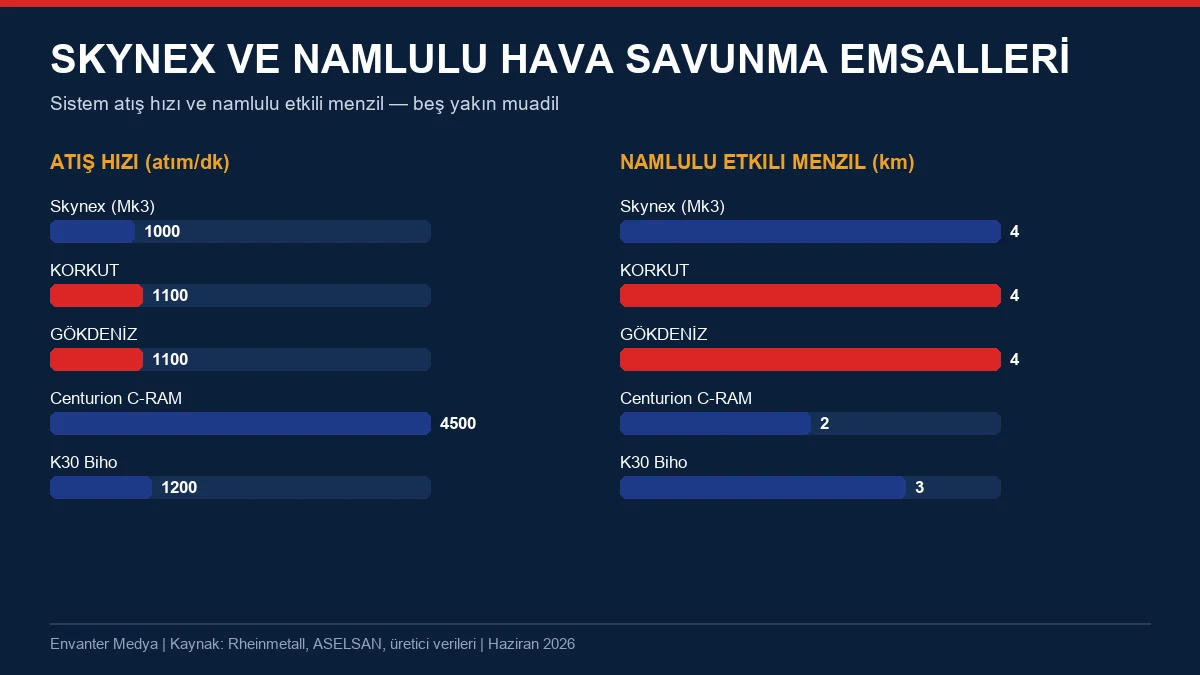
| Rate of fire | 1,000 rds/min per firing unit |
| Ammunition | AHEAD/KETF airburst (152 tungsten sub-projectiles) + standard 35 mm family |
| Effective gun range | ≈4 km; extended capability to 6 km vs hard targets |
| Missile integration | Optional SHORAD missiles extend soft-target coverage to 10 km |
| Radar | X-TAR3D-class 3D search radars; tracking radar on each firing unit |
| Target set | Drones, cruise missiles, RAM, helicopters, slow aircraft |
| Emplacement | Containerised/fixed-site; towed and vehicle-mounted options |
| Future effectors | GDF-009 TREO, high-energy laser (on integration roadmap) |
Operators and Contracts
Publicly confirmed Skynex commitments as of June 2026.
| Country | Status | Scope | Known value |
|---|---|---|---|
| Ukraine | Deliveries complete (Nov 2025) | 4 systems funded by Germany; energy-infrastructure protection | ≈EUR 182M (initial 2-system package) |
| Italy | In service (first delivery Dec 2025) | 1 system + 3 options — Air Defence Artillery Command, Sabaudia | EUR 73M (first system) |
| Qatar | In service | Early configuration: 8x Mk3 guns + X-TAR3D — base and energy-site defence | Not disclosed |
| Romania | Selected / in procurement | Skynex architecture combined with existing GDF-009 guns | Not disclosed |
In-Depth Analysis
Procurement Outlook: Who Buys Next
The Skyranger Sibling: One Family, Two Markets
Strengths Through a NATO Lens
Combat-proven at class-above targets: verified cruise-missile kills move guns from ‘last ditch’ to ‘planned layer’.
Jamming immunity: programmed rounds need no datalink; GPS denial is irrelevant.
Open architecture: third-party radars and legacy guns integrate — Romania’s GDF-009 fleet gains a second life, a template for every NATO army with old 35 mm stock.
Magazine depth: gun ammunition replenishes in days, not the years interceptor missiles now take.
Weaknesses and Honest Limits
Point, not area, defence: one system guards one site; national coverage means dozens of batteries and serious money.
Static by design: container architecture is wrong for brigades on the move; that is Skyranger’s job, at extra cost.
System price vs round price: cheap engagements, expensive launchers — tens of millions per battery strains smaller budgets.
Ammunition single-source risk: AHEAD output concentrates in few lines; wartime consumption makes stockpile contracts as important as the launcher buy.
The Competitive Field
KORKUT / GOKDENIZ (ASELSAN, Türkiye): the most complete rival family — same 35 mm airburst philosophy with sovereign ATOM ammunition, self-propelled and naval variants, and Turkish export pricing; the competitor Skynex will meet most often in Gulf and Asian tenders.
K30 Biho hybrid (Hanwha): gun-missile mix with a UAE reference and aggressive Korean industrial offers.
Pantsir-S1 (Russia): politically unavailable to NATO-aligned buyers and battle-worn in reputation.
MSI Terrahawk, EOS Slinger et al.: the light-turret insurgency from below — cheaper, smaller, eating the low end of the C-UAS market.
Where the System Fits Best
Airports and ports: low collateral airburst debris makes guns the politically tolerable option over civilian-adjacent ground.
Forward operating bases: the original Qatari mission — base and energy-site point defence in open terrain.
Naval facilities: fixed seaward batteries work; salt air raises the maintenance bill.
Mountainous terrain: masking eats gun range — demands a denser, costlier sensor net.
The mobile battlefield: not Skynex’s job; buy the turret sibling.
Turkish Counterparts: How They Compare
No comparison illuminates Skynex better than Türkiye’s KORKUT-GOKDENIZ family — because it is not a paper rival but a parallel, sovereign implementation of the same idea. ASELSAN’s ATOM airburst round mirrors AHEAD’s muzzle-programmed tungsten cloud; KORKUT carries twin 35 mm guns on an amphibious tracked hull that moves with brigades — the mobility Skynex deliberately delegates to Skyranger — and GOKDENIZ takes the same fire unit to sea. All of it runs on Türkiye’s national HERIKKS command network inside the Steel Dome architecture, and all of it is in series production with Turkish forces.
For NATO-market readers the significance is competitive: in every Gulf or Central Asian C-UAS tender of the coming decade, the German network and the Turkish family will sit on the same shortlist — one selling a Ukrainian combat record and open architecture, the other selling mobility, sovereign ammunition and price. It is one of the few segments where a mid-tier defence industry competes with Rheinmetall head-on, product for product.
| Feature | Skynex | KORKUT | GOKDENIZ |
|---|---|---|---|
| Manufacturer | Rheinmetall | ASELSAN + FNSS | ASELSAN |
| Calibre / gun | 35 mm revolver (Mk3) | 35 mm twin | 35 mm twin |
| Smart round | AHEAD (KETF) | ATOM airburst | ATOM airburst |
| Platform | Container/fixed + towed | Tracked amphibious — mobile | Shipborne CIWS |
| Combat reference | Ukraine: drone + cruise-missile kills | In Turkish Army service | Fleet service |
| Status | 4 customers/users | Series production + export talks | Series production |
AHEAD and ATOM are independent implementations of the same airburst principle; figures are manufacturer claims.
Envanter Medya Assessment
Frequently Asked Questions
Why are NATO armies returning to gun air defence?
What did Skynex actually shoot down in Ukraine?
How does AHEAD ammunition work without guidance?
What is the difference between Skynex and Skyranger?
Who operates Skynex today?
What is its closest competitor?
Skynex turned the oldest idea in air defence into the segment NATO cannot stop funding. The next chapters to watch: Romania’s contract signature, the undisclosed European customer’s reveal, AHEAD capacity expansion — and the first tender where the German network meets the Turkish KORKUT family with everything on the line. Envanter Medya follows all four.
Sources
- Rheinmetall — Skynex official product page
- Rheinmetall press release — first Skynex handed over to Italy (23 Dec 2025)
- Kyiv Independent — Skynex engagement footage from Ukraine
- Defense Express — What Skynex and Skyranger cost
- Army Recognition — Germany completes Skynex deliveries to Ukraine
- Wikipedia — Skynex