KF51 Panther: Can Rheinmetall’s 130 mm Tank Win Europe’s Next Armour Race?

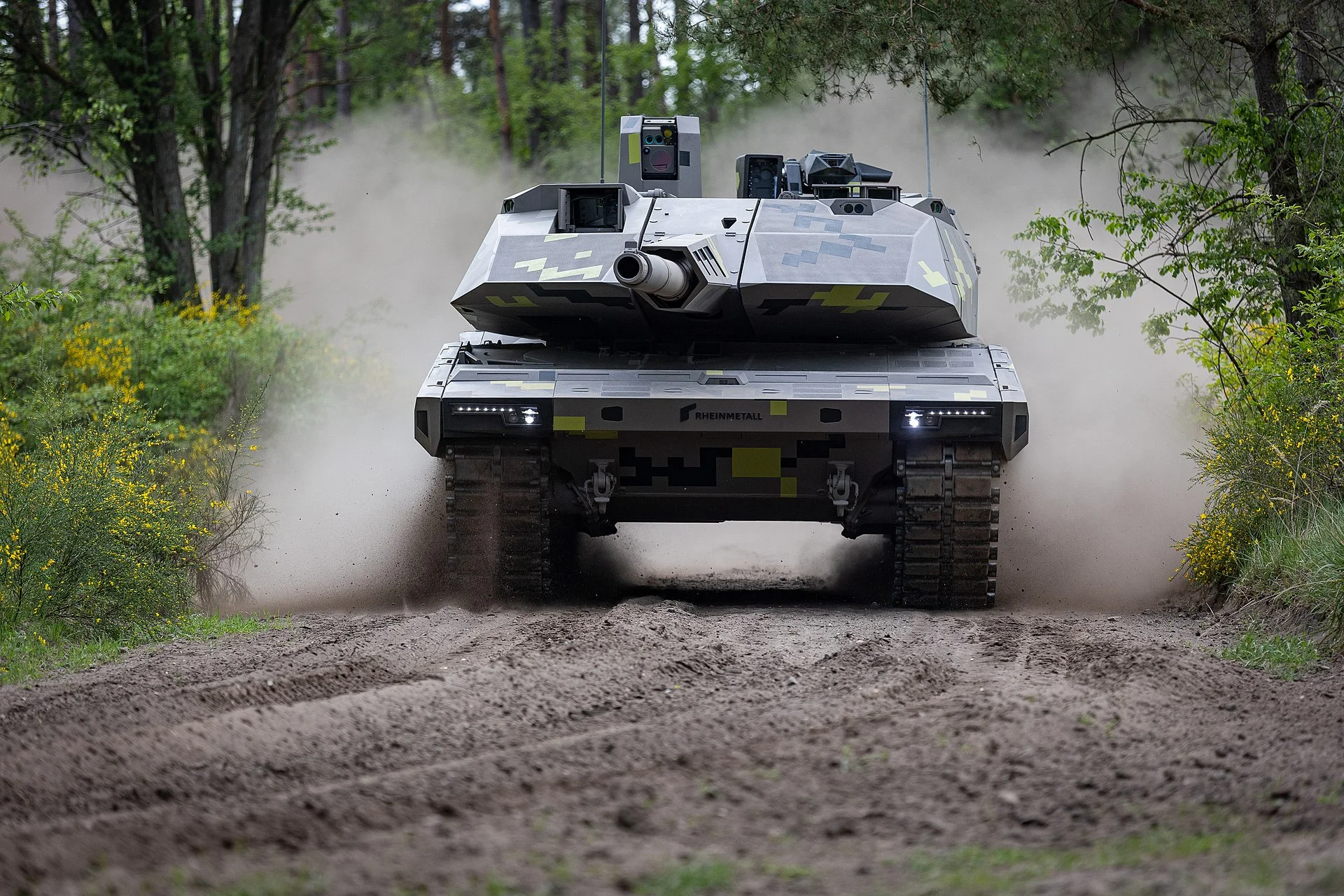
Image: Rheinmetall Defence / Wikimedia Commons (CC BY-SA 4.0)
Europe has not bought tanks like this since the Cold War. Poland alone has ordered hundreds of K2s and Abrams; Germany, the Netherlands, Norway and a queue of others are taking Leopard 2A8s; and the Franco-German MGCS future tank keeps slipping to the right. Into that gap Rheinmetall has thrown the KF51 Panther — a privately funded 130 mm design that is less a product launch than a hostile bid for the European armour market. The question that matters is not whether the Panther is clever engineering. It is whether Hungary’s development contract and Italy’s 380-vehicle plan can turn a demonstrator into the continent’s next standard tank before the window closes.
| Manufacturer | Rheinmetall Landsysteme (Germany) |
| Market positioning | Bridge between Leopard 2A8 and the delayed MGCS |
| Unveiled | Eurosatory 2022, Paris |
| Main armament | 130 mm Rh-130 L/52, autoloaded — first of its calibre offered in NATO |
| Anchor customers | Hungary (EUR 288M development) + Italy (up to 380 vehicles via LRMV) |
| Industrial model | Joint ventures and local production (Zalaegerszeg, LRMV Rome) |
| Direct rivals | Leopard 2A8, K2 Black Panther, M1E3 Abrams |
| Status | Demonstrator/qualification — no army service yet |
A Private Bet on the Post-Ukraine Tank Market
The KF51 exists because Rheinmetall refused to wait. The official German-French answer to the future of armour, MGCS, will not field a vehicle before the 2040s on current form, while the Bundeswehr’s near-term money went to KNDS for the Leopard 2A8. Rather than supply guns and electronics to other people’s tanks forever, Rheinmetall spent its own capital on a complete vehicle and unveiled it at Eurosatory 2022 — a direct challenge to the KNDS-led order of European tank building.
The business logic is visible in the design itself. By reusing the proven Leopard 2A4 hull and MTU powerpack, Rheinmetall kept development risk and cost down; by putting everything new — the 130 mm gun, the autoloader, the digital NGVA backbone, the HERO 120 loitering-munition launcher — into the turret, it created a product that existing Leopard operators can absorb logistically while buying a genuine generational jump in firepower.
The 130 mm Question: Firepower as Market Differentiator
Every tank salesman in Europe is selling protection and digitalisation. Rheinmetall alone is selling a new calibre. The Rh-130 L/52 delivers roughly 50 percent more muzzle energy than NATO’s standard 120 mm, which the company pitches as the only honest answer to future Russian armour — and, just as importantly, as something KNDS cannot offer tomorrow. The 20-round autoloader that comes with it cuts the crew to three, a quiet revolution for armies that struggle to fill four seats per tank.
The counter-argument is NATO standardisation. Alliance logistics, ammunition stockpiles and training pipelines are built around 120 mm; a 130 mm fleet means a parallel supply chain from day one. Rheinmetall’s hedge is pragmatic: the Hungarian KF51 EVO launches with the proven 120 mm L/55A1, in a turret architected to take the 130 later. Sell the tank now, deliver the calibre revolution when the customer is ready.
From Budapest to Rome: Building an Order Book Without Berlin
Hungary signed first — a EUR 288 million development contract in December 2023 for the EVO variant, extending the Zalaegerszeg industrial model that already builds the Lynx IFV. Budapest gets co-ownership of a next-generation tank programme; Rheinmetall gets a funded path from demonstrator to qualified series design.
Italy turned the programme from interesting to serious. The 50:50 LRMV joint venture with Leonardo, stood up in July 2024, gave Rome industrial workshare and gave Rheinmetall the political cover that pure imports never get. In January 2025 the Italian MoD confirmed plans for up to 380 KF51-based vehicles including recovery and engineering variants. Germany itself remains absent from the order book — a fact rivals quote freely — but with Ukraine in talks and the Italian programme moving, the Panther no longer needs Berlin to exist.
Technical Specifications
| Manufacturer | Rheinmetall Landsysteme GmbH (Germany) |
| Type | Main battle tank |
| Unveiled | 13 June 2022, Eurosatory (Paris) |
| Hull | Based on Leopard 2A4 chassis (EVO: Bergepanzer 3-derived hull) |
| Main gun | 130 mm Rh-130 L/52 Future Gun System (EVO: 120 mm L/55A1) |
| Loading | Autoloader, 20 ready rounds |
| Secondary | 12.7 mm coaxial MG + Natter 7.62 mm remote weapon station |
| Loitering munitions | HERO 120 — 4-cell turret-integrated launcher |
| Active protection | StrikeShield hybrid APS + dedicated top-attack protection |
| Architecture | NGVA-compliant fully digital backbone |
| Combat weight | ≈59 tonnes |
| Engine | MTU MB 873 Ka-501 turbo diesel, 1,500 hp (≈25.4 hp/t) |
| Range | ≈500 km |
| Crew | 3 + 1 optional mission specialist |
Operators and Contracts
Programme commitments as publicly confirmed, June 2026.
| Country | Status | Scope | Known value |
|---|---|---|---|
| Hungary | Development contract (Dec 2023) | KF51 EVO demonstrator + qualification; production targeted at Zalaegerszeg | EUR 288 million |
| Italy | Programme decision (Jan 2025) | New MBT based on KF51 — up to 380 vehicles incl. recovery/engineering, via LRMV JV | Not disclosed (multi-year) |
| Germany | No order | Opted for Leopard 2A8 in the near term | — |
| Ukraine | Talks/interest | Local production scenarios discussed; no contract | — |
In-Depth Analysis
Procurement Politics: Who Buys What in Europe’s Tank Wave
Industrial Base: Production Lines and the Localisation Play
Strengths in the Eyes of NATO Planners
Crew economics: three-man operation answers the alliance-wide recruitment crisis better than any armour package.
Drone-age design: top-attack protection and organic HERO 120 loitering munitions were requirements from day one, not Ukraine-war retrofits.
Leopard logistics inheritance: hull, powerpack and training pipelines carry over for the 2A4 user club.
Industrial sweeteners: joint ventures and in-country production as standard offer, not concession.
The Risk Register: What Could Stall the Panther
Calibre isolation: a 130 mm fleet breaks NATO ammunition commonality until others follow — and nobody has.
Schedule exposure: Italian series deliveries stretch late-decade; every year of delay sells more 2A8s and K2s.
MGCS resurrection risk: if Paris and Berlin accelerate their joint tank, political money may abandon interim solutions.
Internal cannibalisation: Rheinmetall itself profits from every 2A8 (gun, ammunition) — the Panther competes partly against its own revenue.
The Competitive Field: 2A8, K2, M1E3 and the Ghost of MGCS
K2 Black Panther (Hyundai Rotem): the schedule killer. Polish-built, autoloaded, delivered in years not decades.
M1E3 Abrams (GDLS): America’s lighter next-gen Abrams, mostly a US-market play but a benchmark in every NATO study.
Challenger 3 (RBSL): Rheinmetall’s own UK joint venture — proof the company plays every side of the board.
MGCS (KNDS/Thales/Rheinmetall): the institutional future that, if it ever arrives, reclassifies the KF51 as a bridge. Until then, the bridge is the market.
Export Geographies: Where the Panther Sells Best
Turkish Counterparts: How They Compare
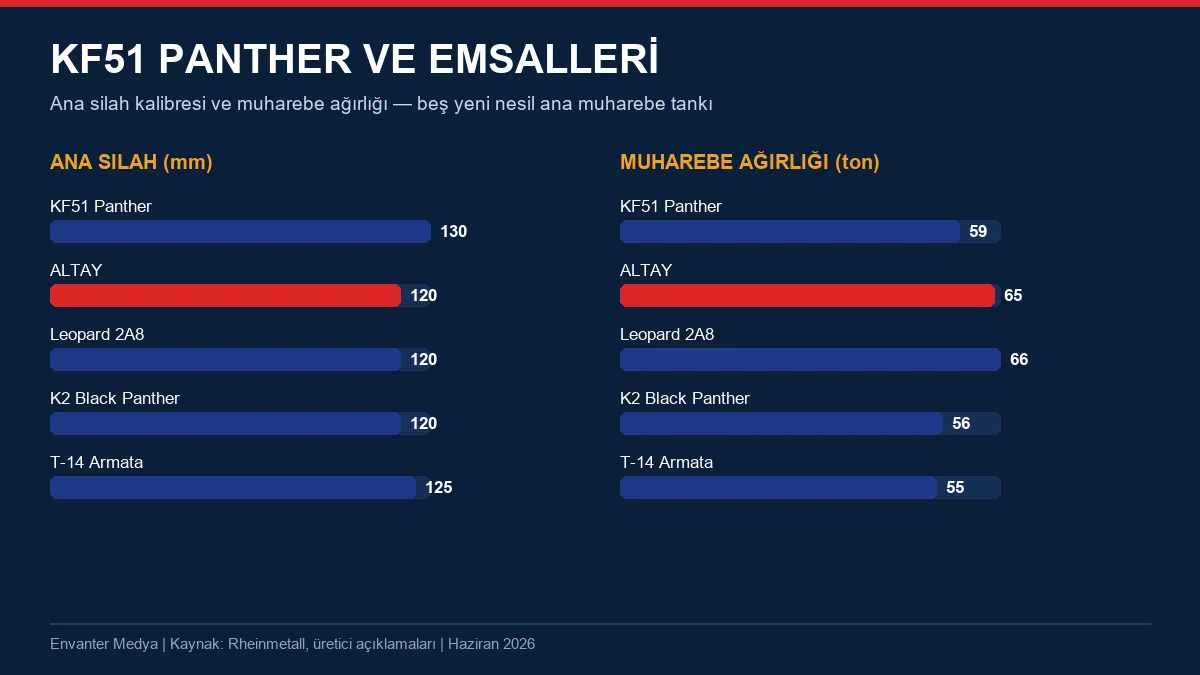
For international readers, the most instructive comparison is not Panther-versus-Leopard but Panther-versus-ALTAY — Türkiye’s national MBT, now in series production at BMC with first deliveries to the Turkish Army since 2025. The two programmes answer the same strategic question in opposite ways: Rheinmetall differentiates through a calibre jump and crew automation; Ankara differentiated through sovereignty, building a national chain from the MKE 120 mm gun to ASELSAN’s AKKOR active protection while keeping a proven four-man, 120 mm architecture.
The scoreboard as of June 2026 favours execution over ambition: ALTAY tanks are reaching battalions while the Panther remains in qualification. But the two will increasingly meet in the same export conversations — Gulf and Asian customers now routinely shortlist Turkish systems alongside German ones, and Türkiye’s willingness to transfer technology mirrors Rheinmetall’s own localisation playbook. The Panther sets the technological benchmark; ALTAY demonstrates that mid-tier defence industries can now field credible alternatives to it.
| Feature | KF51 Panther | ALTAY (T1) | Leopard 2A8 |
|---|---|---|---|
| Main gun | 130 mm Rh-130 L/52 | 120 mm MKE L/55 | 120 mm L/55A1 |
| Loading | Autoloader (20 rds) | Human loader | Human loader |
| Crew | 3 (+1 optional) | 4 | 4 |
| Combat weight | ≈59 t | ≈65 t | ≈66 t |
| Active protection | StrikeShield + top-attack kit | ASELSAN AKKOR | Trophy |
| Status (June 2026) | Demonstrator; Hungary + Italy programmes | In production, deliveries to Turkish Army | In production, multiple NATO orders |
Figures from manufacturer statements and open sources; some ALTAY subsystem details remain classified.
Envanter Medya Assessment
Frequently Asked Questions
Why did Germany choose the Leopard 2A8 instead of the KF51?
How does a 130 mm gun affect NATO standardisation?
What exactly is LRMV?
When will the first production KF51 actually be delivered?
Is the KF51 competing for the US Army?
How does it compare with the K2 on schedule and price?
The KF51 Panther has already changed the European conversation: every tank tender now asks about calibre growth, crew reduction and drone integration because Rheinmetall put them on the table. Whether it also changes European inventories depends on execution in Rome and Zalaegerszeg between now and 2030. Envanter Medya will track the LRMV contract flow, the EVO qualification milestones and the next national decisions in Athens, Bucharest and Kyiv.
Sources
- Rheinmetall — Panther KF51 official product page
- Rheinmetall press release — Hungarian KF51 development contract (15 Dec 2023)
- The Defense Post — Hungary, Rheinmetall Ink Panther KF51 EVO Deal
- Army Recognition — KF51 Panther technical data sheet
- Wikipedia — Panther KF51