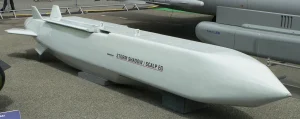
MBDA AQUILA Hypersonic: Europe’s Answer to the Mach 5+ Arms Race


Russia’s Kinzhal demonstrated in Ukraine that hypersonic missiles are not theoretical future threats — they are current operational weapons. China’s DF-ZF boost-glide vehicle has completed test flights. The United States has allocated billions to ARRW and HACM. Against this backdrop, MBDA’s AQUILA hypersonic programme represents Europe’s attempt to remain relevant in the next generation of long-range precision strike. AQUILA targets Mach 5+ flight, boost-glide or scramjet propulsion, and strike ranges that would create genuine strategic depth for NATO air forces.
1. Why Hypersonic Is Strategically Different
The combination of high speed and manoeuvre capability creates a defeat vector that current air defence architectures cannot reliably engage:
- Ballistic missiles: Fast, but follow a predictable arc — engagement window at apogee is calculable
- Cruise missiles: Manoeuvrable, but subsonicor low supersonic — sufficient intercept time
- Hypersonic boost-glide: Mach 5-20 with lateral manoeuvre capability — engagement window measured in seconds, not minutes
The fundamental problem is not speed alone, but the collapse of the sensor-to-shooter timeline. A Patriot engagement sequence assumes a predictable track. A Kinzhal-class weapon alters track mid-engagement — the intercept solution calculated 8 seconds ago is no longer valid.
2. AQUILA Programme Parameters
| Parameter | Value / Status |
|---|---|
| Speed class | Mach 5+ (design target) |
| Flight regime | Boost-glide + powered terminal phase |
| Range | 500+ km (objective) |
| Guidance | INS mid-course + active seeker terminal (plasma sheath management TBD) |
| Warhead | Conventional HE / multi-option capability |
| Launch platform | Air-launched (Rafale compatibility); ground/sea variants planned |
| Programme status | Research and demonstration phase; 2030s operational objective |
3. Technical Challenges
Thermal Management
At Mach 5, aerodynamic heating generates surface temperatures exceeding 1,500°C on leading edges. Conventional aluminium and titanium structures fail above 500°C. AQUILA’s airframe requires ceramic matrix composites and ablative thermal protection systems derived from space reentry vehicle technology — materials that are expensive to manufacture and difficult to quality-assure at scale.
Plasma Sheath and Guidance Blackout
Hypersonic flight generates an ionised plasma layer around the vehicle that attenuates or blocks GPS, satellite uplink, and radar seeker signals. Solutions under investigation include:
- Plasma window aperture — selective frequency “window” in the plasma for seeker transmission
- Terminal deceleration — speed reduction below plasma threshold in final kilometres
- Terrain-mapping optical guidance — INS + offline pre-loaded mapping for GPS-denied terminal phase
Scramjet Ignition and Transition
Scramjet (supersonic combustion ramjet) engines operate only above approximately Mach 4–5. The transition from rocket-boost acceleration to sustained scramjet operation requires precise intake management and fuel timing. MBDA is co-developing scramjet propulsion with ONERA, France’s national aerospace research agency, whose dual-mode scramjet test work provides the technical foundation for AQUILA’s propulsion architecture.
4. The Geopolitical Context: Ukraine and Beyond
Russia’s Kinzhal employment against Ukrainian targets established three verified operational conclusions:
- Existing intercept was unreliable: Early Kinzhal attacks were not engaged — Patriot intercepts came later, with mixed results and high missile expenditure.
- Time-sensitive targets demand extreme speed: A Mach 10 weapon launched from the Russian border reaches Kyiv in approximately 90 seconds — no sensor-to-shooter system in current inventory can respond in that window.
- Psychological effect is strategic: The mere presence of hypersonic weapons in an adversary’s inventory forces defensive reallocation, even if every individual shot is eventually intercepted.
For Europe, the conclusion is uncomfortable: a NATO without indigenous hypersonic strike capability is dependent on the United States to provide deterrence in the Mach 5+ envelope. AQUILA is, at its core, a European sovereignty argument made in aerodynamics.
5. Assessment
AQUILA represents the most technically ambitious project in MBDA’s current research portfolio. The physics of hypersonic flight are solvable — Russia and China have demonstrated that — but the engineering challenge of doing so with the precision, reliability, and cost characteristics of a deployable weapon system is non-trivial. The 2030s timeline is realistic only if the plasma guidance problem is resolved and scramjet manufacturing scales. What AQUILA has already achieved is strategic: it has established MBDA as the lead European industrial partner in hypersonic development, positioning the company for the procurement programmes that will follow when European governments decide hypersonic capability is no longer optional.