Software Alone: SGT STOUT M-SHORAD Downs Group 1-2 Drones With No New Hardware

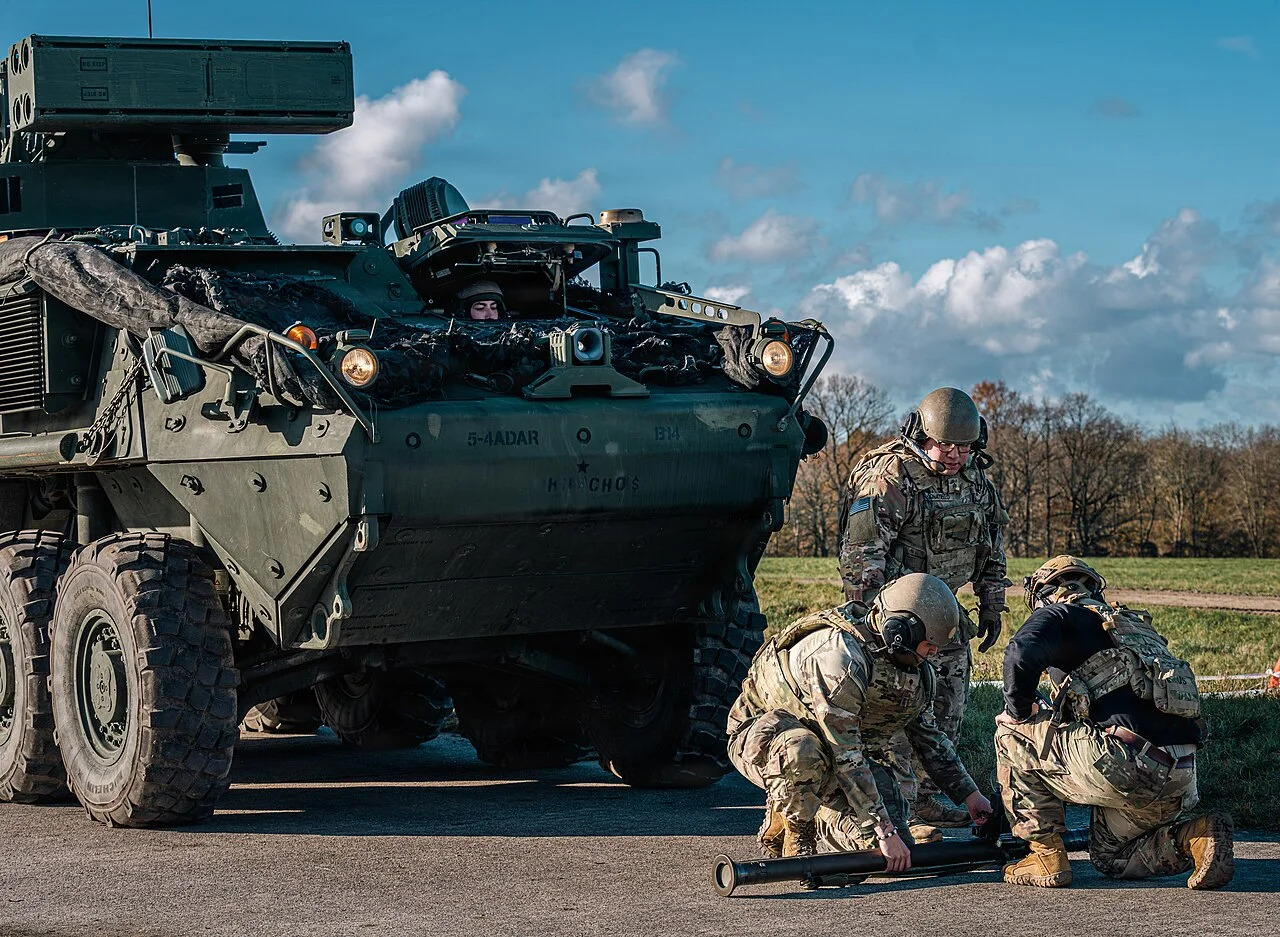
Leonardo DRS has announced that the US Army’s Stryker-based SGT STOUT manoeuvre short-range air defence system defeated Group 1 and Group 2 small unmanned aircraft during a US Government test event. The detail that matters is how it was done: through detection and fire-control software updates only, with no new hardware added to the mission equipment package.
A capability the system was not built for
SGT STOUT was originally optimised against Group 3 and larger unmanned aircraft, along with fixed- and rotary-wing threats. Group 1 and 2 systems — from a few kilogrammes up to around 25 kg, flying low and slow — present small radar cross-sections and weak thermal signatures, which is precisely why conventional air defence sensors struggle with them.
Aaron Hankins, senior vice president and general manager of the Leonardo DRS Land Systems business unit, said the vehicle was “engineered from the start for modernisation, so capability can evolve as the threat evolves,” adding that the upgrade path emphasises speed, safety, cybersecurity-by-design and interoperability.
What is on the vehicle
The mission equipment package is built around the RIwP turret on a Stryker A1 hull, carrying Stinger missiles, an XM914 30 mm cannon, an M240 7.62 mm machine gun, the MX-GCS electro-optical/infrared sight, a multi-mission hemispheric radar and an IFF antenna. It is a self-contained sense-and-shoot node rather than a launcher dependent on external cueing.
Several hundred SGT STOUT vehicles are already in service with US manoeuvre formations, which is what gives a software-only upgrade its leverage: the training pipeline, spares and sustainment base already exist.
The cost argument
Air defence economics have become the central problem of the drone era. Spending a six-figure interceptor on a target worth a few thousand dollars is not sustainable across a long campaign. Letting existing sensors classify small targets and cueing the 30 mm gun onto them shifts the exchange ratio back towards the defender.
There is a second, quieter point here. Modular open architecture has been promised across the defence industry for two decades and demonstrated in the field far less often. A capability increase that requires no depot visit, no field modification kit and no recertification of hardware is one of the clearer proofs that the concept works as advertised.
Where it matters
Short-range air defence is the gap NATO’s eastern flank has spent years trying to close, and US units in Europe depend directly on M-SHORAD to do it. Live-fire certification at ranges such as Grafenwöhr and Putlos in Germany has kept the capability visible on the continent — and the drone threat that drove this upgrade is not confined to any single theatre.
Sources
- Leonardo DRS press release, 11 August 2026
- Army Recognition, 13 August 2026
- Defence Industry Europe, 13 August 2026