Ghana Military Strength 2026: Budget, Forces & Turkey Ties

Ghana Military Strength 2026: Forces, the 69% Defense Budget Jump, and Where Turkish Suppliers Could Fit
Ghana’s Armed Forces (GAF) field roughly 15,500 active personnel across the Army, Navy and Air Force, and Parliament approved a 2026 defense budget of GH¢10.77 billion (about $329 million) — a 69% jump from 2025. The increase is driven mainly by jihadist spillover from Burkina Faso along Ghana’s northern border, and it is earmarked for offshore patrol vessels, helicopters and armoured personnel carriers rather than any single foreign supplier. No Turkish system is a confirmed part of the Ghana Armed Forces inventory yet, even as neighbors such as Nigeria and, further east, Kenya have added Turkish drones.
Ghana Armed Forces: structure and personnel
The Ghana Armed Forces are organized into three services under a single Chief of the Defence Staff, headquartered at Burma Camp, Accra:
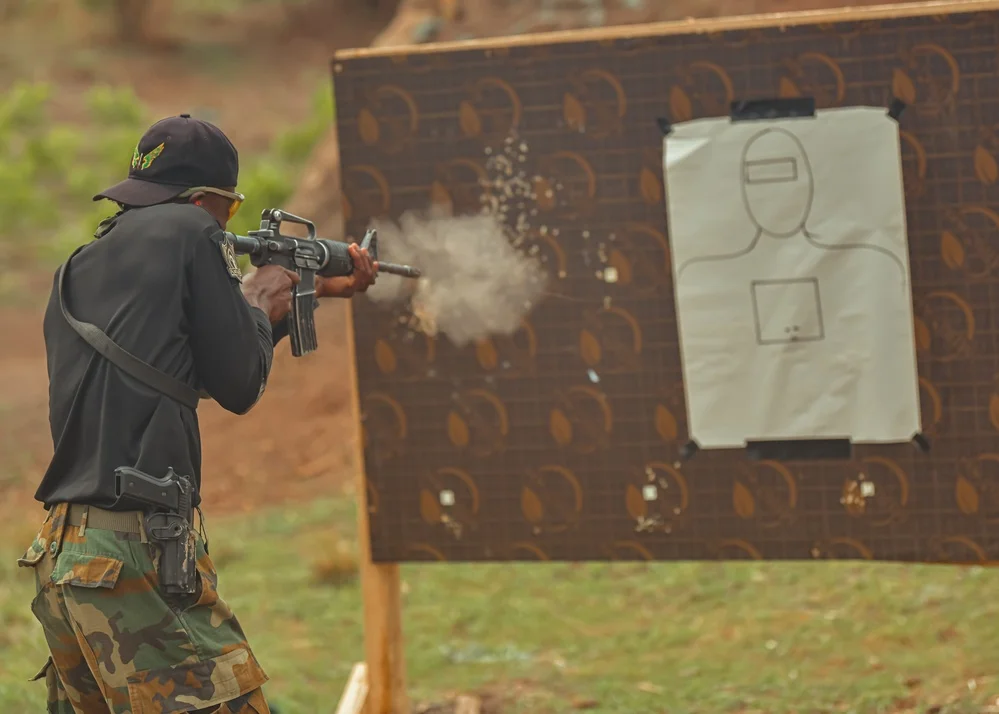
- Ghana Army — roughly 12,000 personnel, organized around two brigades with an infantry-heavy structure geared toward internal security, border operations and UN peacekeeping.
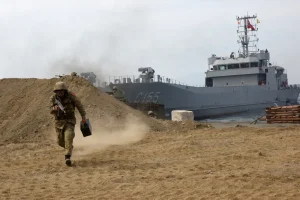
- Ghana Navy — roughly 2,000 personnel, focused on littoral defense, anti-piracy patrols in the Gulf of Guinea, and monitoring Ghana’s Exclusive Economic Zone (EEZ), including offshore oil and gas installations.
- Ghana Air Force — roughly 2,000 personnel operating a small fleet of trainers, transports and utility helicopters; Ghana does not currently operate a dedicated fighter jet fleet.
Widely cited indices such as Global Firepower (GFP) rank Ghana in the lower-middle tier of African militaries by raw score. GFP is a useful comparative snapshot, not an official military assessment — it weights dozens of factors with fixed formulas and does not capture readiness, training quality or doctrine. Treat rankings as a starting point, not a verdict, and cross-check specific claims against official Ghanaian government statements or recognized bodies like IISS and SIPRI where possible. For continent-wide context, see our full GFP ranking of Africa’s strongest armies.
The 2026 budget jump: what’s driving it
Ghana’s Finance Ministry raised the Ministry of Defence’s 2026 allocation by 69% to GH¢10.77 billion, part of a wider “retooling” program for the GAF that budget documents describe as intended to “enhance defence readiness.” The increase follows years of warnings from Ghanaian officials, delivered as recently as 2026 in a submission to the ECOWAS Parliament, about jihadist groups — including JNIM-linked networks operating out of Burkina Faso — using Ghana’s northern border areas for logistics, medical treatment and recruitment rather than open combat, so far.
In February 2026, Ghana and Burkina Faso reactivated their Permanent Joint Commission for Cooperation (PJCC), producing seven bilateral agreements on cross-border cooperation, boundary management and counter-narcotics. Ghana has also announced plans to build new military bases along the frontier — the practical, on-the-ground counterpart to the budget increase.
Personnel costs (salaries, allowances and UN peacekeeping mission per diems) still absorb the largest share of defense spending, which is typical for African militaries and leaves a comparatively thin envelope for new hardware once the retooling program is netted out.
Current equipment: Army, Navy, Air Force
Ghana’s current inventory reflects decades of mixed procurement from China, Western Europe, the US and, more recently, Japan — not any single-supplier relationship.
| Branch | Key platforms | Origin |
|---|---|---|
| Air Force | K-8 jet trainers/light attack, CASA C-295 transports, Mi-17 and Z-9 utility helicopters | China, Spain, Russia/China |
| Air Force (on order) | 2 Airbus H175 and 1 Airbus H160 VIP/utility helicopters | France/EU (Airbus) |
| Navy | Boundary-class, Defender-class, Snake-class and Albatros-class patrol craft; GNS Achimota | UK/local build, US, Germany, Japan |
| Army | Light infantry weapons, legacy armoured vehicles; new APCs budgeted for 2026 | Mixed, not publicly itemized |
A Ghana Air Force Harbin Z-9 helicopter crashed in August 2025, one of the incidents cited in domestic debate over the age and readiness of the fleet the 2026 retooling budget is meant to address.
DIHOC: Ghana’s push to build its own kit
Rather than leaning on a single foreign partner, Ghana has spent the past several years building the Defence Industries Holding Company Limited (DIHOC), the GAF’s industrial arm. Reconstituted with a new governing board in 2025, DIHOC runs 13 joint-venture companies with private and state partners covering munitions, vehicle assembly and retrofitting, and military logistics. Two projects are already operating: a footwear factory in Kumasi and an armoured bullion-van assembly line at Burma Camp. Ghanaian officials have acknowledged DIHOC’s limited capital constrains how much equity it can hold in these ventures — the program is real but still early-stage industrial policy, not yet a domestic arms industry on the scale of Nigeria’s or Turkey’s own.
Turkey and Ghana: no deal yet, but a widening regional footprint
Ghana has not signed a confirmed defense-industrial or procurement agreement with Turkey, and there is no public record of the Ghana Armed Forces operating Bayraktar TB2s, AKINCI, or any other Turkish platform as of this writing. That puts Ghana behind several of its regional peers in the current wave of Turkish defense-export growth into Africa: Nigeria and several Sahel states already fly Turkish UAVs against jihadist and insurgent threats — see our region-by-region breakdown of which African countries operate the Bayraktar TB2 and how AKINCI has spread across the continent — and Kenya signed a bilateral defense cooperation agreement with Turkey and added Bayraktar TB2s in 2024, a process detailed in our Kenya Defence Forces profile.
Two things make Ghana a plausible future customer without making it a confirmed one. First, the threat profile — a porous northern border, JNIM-linked spillover, and a stated 2026 budget priority on ISR-relevant platforms (helicopters, patrol vessels) — mirrors the case that drove Turkish UAV adoption elsewhere in West Africa and the Sahel — see our comparison of Turkish vs. Chinese drones in the Sahel and how neighboring Nigeria has structured its own recruitment and force. Second, Turkey’s export model (financing flexibility, shorter delivery timelines, and technology-transfer options through joint local production) has been the deciding factor in comparable Gulf and African deals. Neither point is evidence of an actual Ghanaian order, and readers should treat any claim of a Ghana-Turkey drone deal circulating online as unverified unless it is confirmed by Ghana’s Ministry of Defence or Turkey’s SSB.
Who currently supplies Ghana
Ghana’s current supplier base is genuinely diversified rather than concentrated: China (K-8 trainers, Z-9 helicopters), Spain (C-295 transports), the US and EU (training, the 2026 EU-Ghana Security and Defence Partnership and associated equipment handovers), and Japan (the patrol vessel GNS Achimota, transferred in 2025). This spread reflects budget-driven, opportunity-by-opportunity procurement rather than a strategic single-country alignment — the same pattern that has left an opening for new entrants, Turkish suppliers included, once Ghana starts converting its 2026 budget increase into signed contracts.
FAQ
How big is the Ghana Armed Forces?
Around 15,500 active personnel: about 12,000 Army, 2,000 Navy and 2,000 Air Force, according to open-source estimates; Ghana does not publish a detailed official order of battle.
What is Ghana’s 2026 defense budget?
GH¢10.77 billion, roughly $329 million at prevailing exchange rates, a 69% increase over the 2025 allocation.
Does Ghana operate Turkish drones like the Bayraktar TB2?
No. There is no confirmed Turkish UAV or other Turkish platform in Ghana Armed Forces service as of this article’s last update.
Why is Ghana increasing defense spending now?
Primarily jihadist spillover from Burkina Faso along its northern border, alongside a broader “retooling” program covering aging Air Force and Navy equipment.
What is DIHOC?
The Defence Industries Holding Company Limited, the GAF’s industrial arm, which runs joint ventures in munitions, vehicle assembly and military logistics with private and state partners.
Does Ghana operate fighter jets?
No. The Ghana Air Force’s fastest fixed-wing aircraft are Hongdu K-8 trainer/light-attack jets; it has no dedicated fighter fleet.
Sources
- Ghana Ministry of Finance, 2026 Budget Statement (as reported)
- Ghana Ministry of Defence, DIHOC briefings (mod.gov.gh)
- Global Firepower, 2026 Ghana Military Strength (comparative index, not an official source)
- African Arguments, “Ghana’s Northern Sovereignty Gap: JNIM and the Burkinabe Border” (2026)
- Ghana MPs / ECOWAS Parliament submission on Sahel jihadist spillover (2026)
- EEAS, Ghana-EU Security and Defence Partnership press release (2026)
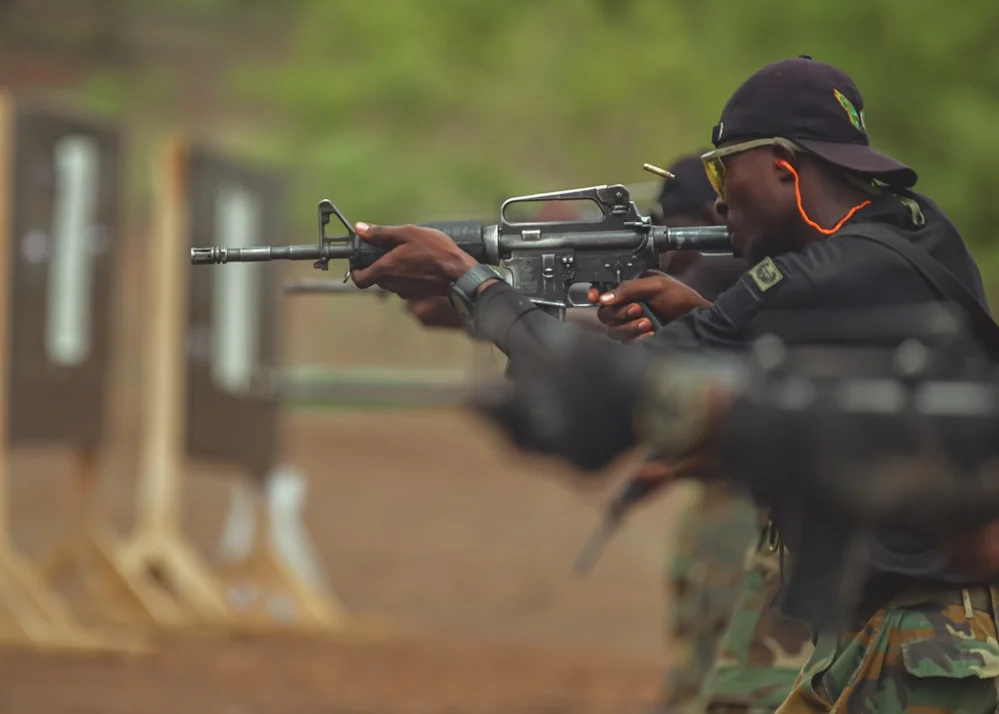
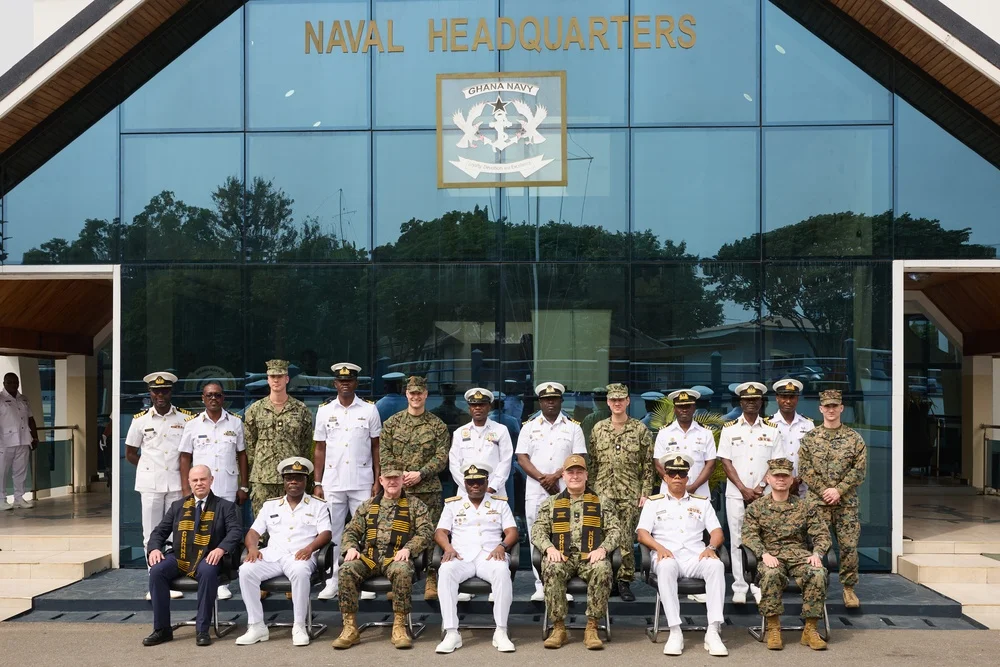
- DVIDS (US Department of Defense), Exercise Flintlock 24 and Ghana Navy Headquarters visit imagery
Last updated: August 2026.