France Moves to Buy Ship-Launched Long-Endurance Naval Drones

France has opened the procurement process for a class of uncrewed surface vessels the navy can carry to sea and launch from its own ships. The French defence procurement agency DGA published the requirement on 14 September. The vessels are to operate at least 100 nautical miles from their mothership and remain at sea for five to ten days depending on the mission.
The acquisition is structured as a framework contract with a ceiling of “a few dozen drones,” with fixed pricing and provisional order tranches. Applications close on 15 October 2026 through PLACE, the French state purchasing platform.
Which ships will carry them
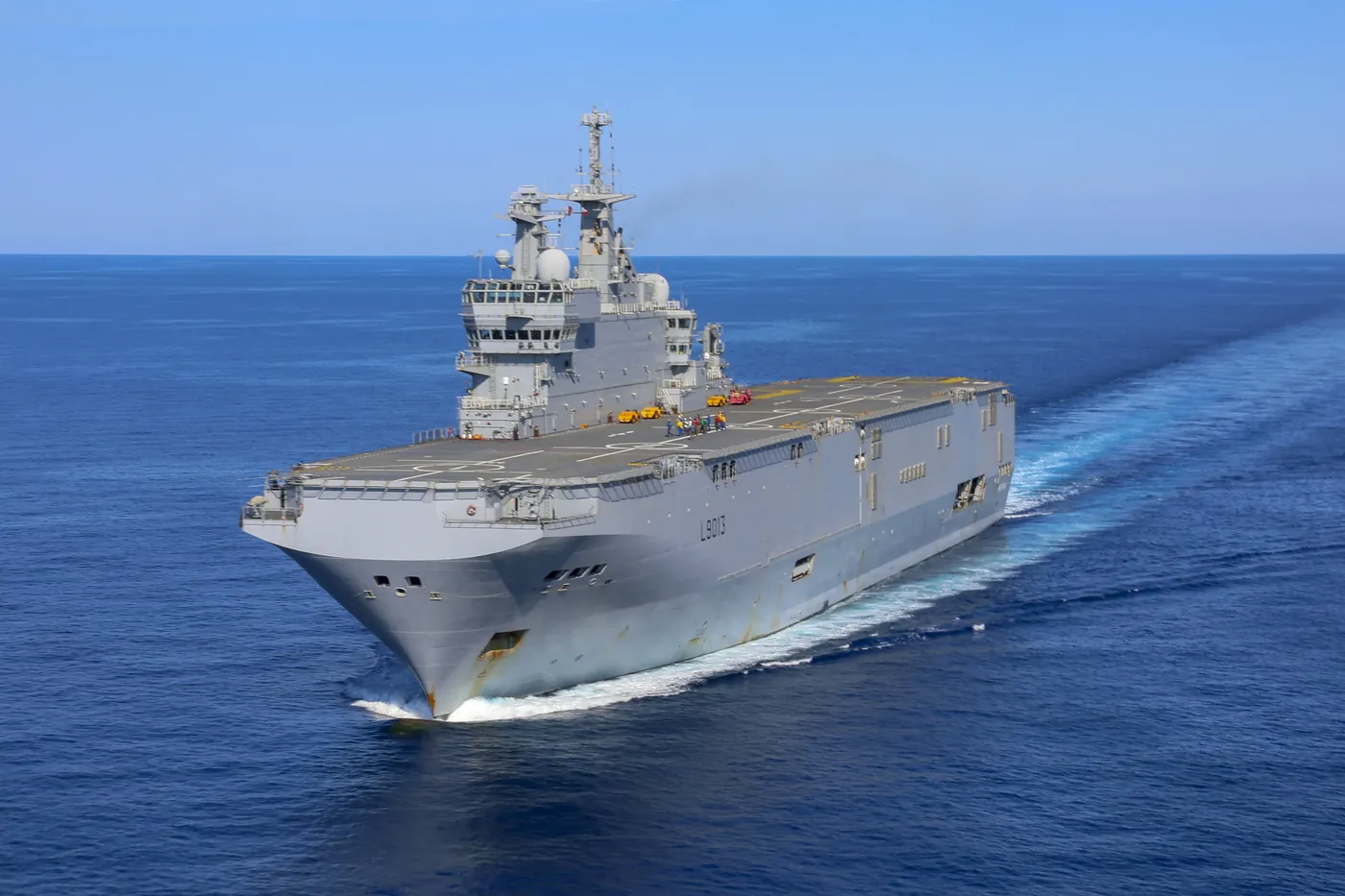
Two host platforms are named: Mistral-class landing helicopter docks and Loire-class offshore support vessels. That choice says a good deal about what the navy wants. The Mistral class, at 199 metres and around 21,500 tonnes full load, has the well deck and crane capacity to launch and recover a substantial vessel. The Loire class is smaller, built for mine warfare and diving support.
In other words, the DGA is not describing an independent system operating from a shore base. It is describing an organic sensor arm for a deployed task group. A 100-nautical-mile radius is enough to throw a surveillance ring around an amphibious group without putting the mothership forward.
The requirement
- Operating radius: at least 100 nautical miles
- Endurance: five to ten days depending on mission
- Sea state: round-the-clock operations in Sea State 4
- Architecture: modular and scalable, able to carry a range of payload types
- Control: delivered with an integrated command-and-control system
Sea State 4 corresponds to significant wave heights of roughly 1.25 to 2.5 metres — the average condition across much of the Mediterranean and North Atlantic for most of the year, and a demanding threshold for autonomous navigation and payload stability. Requiring continuous operation in it signals that the DGA is buying a working vessel, not a trade-show demonstrator.
Who can bid
Two filters shape the field. Bidders need a minimum annual global turnover of €10 million, and their design and production facilities must sit inside the European Union or the European Economic Area. Security-of-supply protocols are mandatory. Together these conditions exclude non-European suppliers.
France’s principal domestic reference in this class is Naval Group’s Seaquest-S, trialled from FREMM frigates and Loire-class vessels during NATO exercises. The framework structure, however, leaves room for more than one supplier and more than one configuration.
Why now
European interest in uncrewed surface vessels has accelerated sharply over two years, for two reasons. The first is the Black Sea. What Ukraine’s Magura and Sea Baby attack USVs did to the Russian Black Sea Fleet demonstrated what small, cheap surface craft can achieve against major warships. The second is the growing concern over sabotage of undersea cables and pipelines in the Red Sea and Eastern Mediterranean — a mission that calls for long, slow, repetitive patrolling that is expensive to do with crewed ships.
France’s chosen path is not the Ukrainian one. The published mission profile is intelligence, surveillance and reconnaissance. The vessel is meant to be the task group’s forward eye, not a weapon.
Comparison and context
Turkey is one of the few NATO states ahead of most of Europe in this field. The ULAQ family from Ares Shipyard and Meteksan, Aselsan and Sefine’s MARLIN, and the SALVO design have all been trialled across different mission profiles, and deploying uncrewed craft from TCG Anadolu has been under discussion. The French requirement — 100 nautical miles, five to ten days — sits in a band where Turkish systems would compete comfortably on capability. The EU/EEA origin condition rules them out of this particular competition.
That, in itself, is the pattern worth noting. Across European defence procurement, a geographic origin clause increasingly sits alongside the technical requirement, turning a capability competition into an instrument of industrial policy.
Sources
- French defence procurement agency (DGA) tender notice, PLACE state purchasing platform, 14 September 2026
- Naval News, “France Launches Procurement for New Embarked Long-Endurance USV”, 14 September 2026
- Opex360, “La Marine nationale va acquérir des drones de surface d’endurance”, 14 September 2026