FNSS Wants to Take Crews Out of the First Wave — Meet the Unmanned İ-ZAHA

The first wave of an amphibious landing has always been the part nobody wants to be in. It is the moment when the defender’s guns are still intact, the mines have not been cleared, and the attacker is at his most exposed. Turkish armoured vehicle manufacturer FNSS now proposes a straightforward answer to that problem: send a machine instead.
The company unveiled İ-ZAHA, a multi-purpose modular unmanned amphibious vehicle, at TEKNOFEST Mavi Vatan 2026. In FNSS’s own words, the vehicle is designed “to take the crew out of the first wave, which is the highest-risk phase of any amphibious assault, and to operate as part of a manned-unmanned team.”
What the numbers say
İ-ZAHA is a four-wheeled platform in the eight-tonne class. It makes seven knots in the water and 70 kilometres per hour on land — enough sea capability to make the ship-to-shore transit under its own power, and enough road speed to keep up with wheeled formations once ashore.
The more interesting figure is 40 minutes. That is how long FNSS says it takes to swap the vehicle’s mission payload module. The advertised options cover machine-gun fire support, mine-clearing equipment, electronic warfare payloads and counter-drone systems. One hull, several jobs, reconfigured on the beach rather than back at a depot.
Navigation runs on a combined GNSS/INS solution. That pairing matters more than it sounds. Satellite positioning is the first thing a defender jams along a contested shoreline; the inertial system keeps the vehicle’s position estimate alive when the satellite signal disappears. An IFF module and AI-assisted image processing round out the sensor package.
Built on ZAHA, not from scratch
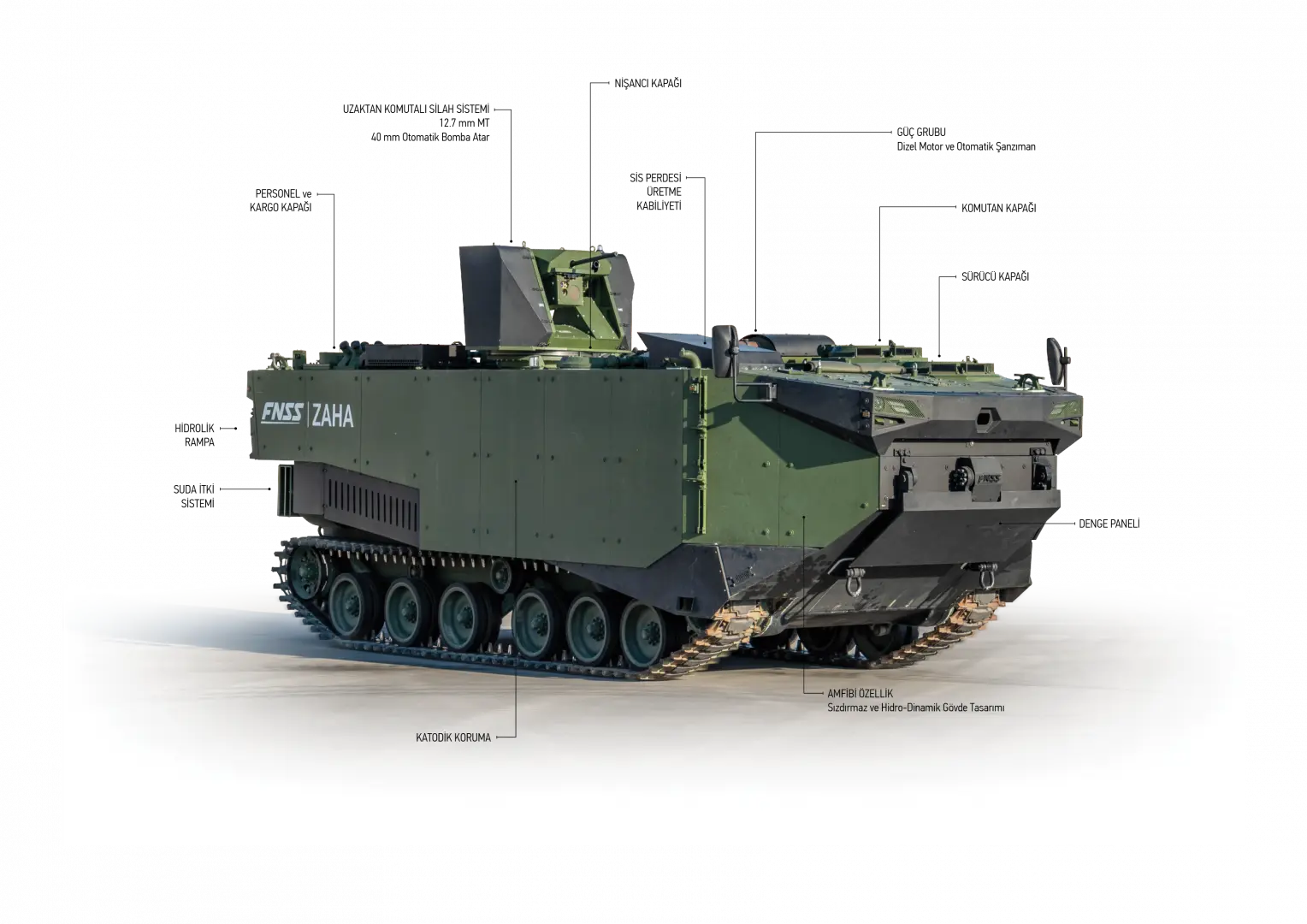
İ-ZAHA inherits directly from the ZAHA marine assault vehicle already in service with the Turkish Naval Forces Command. That lineage solves a lot of hard problems in advance. Amphibious vehicles fail on unglamorous engineering — watertight integrity, stability in a swell, the transition from swimming to climbing a beach gradient — and FNSS has already worked through those on a fielded platform.
It also means the manned and unmanned vehicles in the same landing force share a technical baseline, which is worth a great deal in logistics and training terms.
Why the first wave got more dangerous
The doctrine that shaped amphibious assault belongs to an era when a defender’s ability to see and strike an approaching landing craft was limited. That era is over. Cheap loitering munitions, coastal anti-ship missiles and smart mines have made the littoral one of the most heavily contested environments in modern warfare — a lesson delivered repeatedly in the Black Sea and the Red Sea.
Every serious amphibious force is now looking at the same answer. The US Marine Corps, South Korea and Japan are all pursuing uncrewed options for the ship-to-shore leg. What distinguishes FNSS’s move is that it has an actual vehicle to show, and an in-service manned parent design behind it.
The Blue Homeland context
The choice of venue is not incidental. Turkey’s naval ecosystem has expanded quickly: TCG Anadolu is in service, unmanned surface vessels have moved into serial production, and indigenous frigate programmes are advancing. Automating the land component of an amphibious operation closes an obvious gap in that picture.
FNSS, wholly owned by Nurol Holding, exports its Kaplan and Pars families to Indonesia, Malaysia, Oman and the Philippines. No production timeline or Naval Forces order for İ-ZAHA has been announced.
Sources
- FNSS Savunma Sistemleri A.Ş. official statement, TEKNOFEST Mavi Vatan 2026
- Breaking Defense, 24 August 2026
- Turkish Naval Forces Command ZAHA/MAV programme information