Fergani’s Sixth Test Satellite FRG-100D4 Reaches Its Orbit

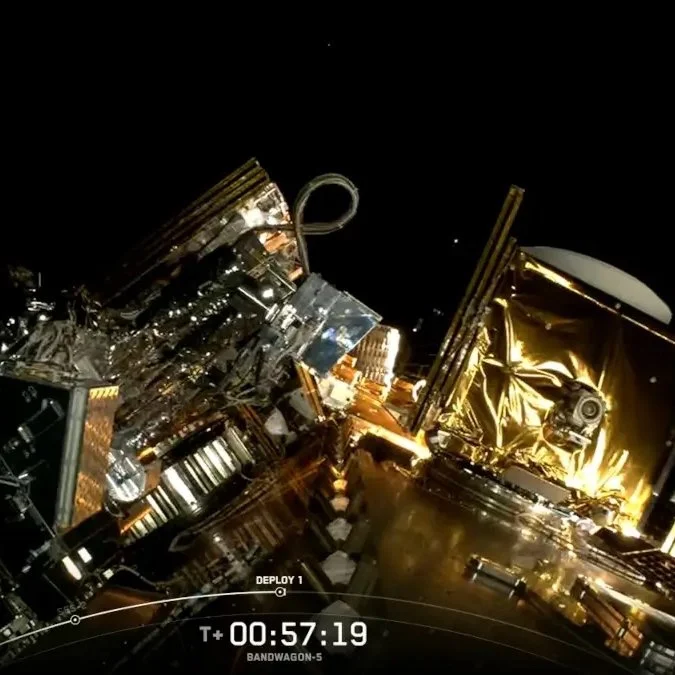
Fergani Space Technologies, founded by Baykar Chairman Selçuk Bayraktar, placed its sixth test satellite, FRG-100D4, into orbit on October 20, 2026. The satellite launched aboard SpaceX’s Bandwagon-5 mission from Cape Canaveral Space Force Station in the United States at 14:04 Turkey time, separating from the launch vehicle roughly 63 minutes later, at 15:07, to settle into its target orbit at 590 kilometers altitude. Baykar announced the launch on its own news page on October 21.
The 160-kilogram FRG-100D4 was developed entirely with domestic resources and carries both communication and navigation payloads. According to Fergani, it has the highest power-generation capacity of any platform the company has built to date. Its technical package includes a reaction wheel, a magnetic torquer rod, a magnetometer, an inertial measurement unit, a GNSS receiver, steerable solar panels, a battery pack, a regenerative modem and a phased-array antenna. The satellite also carries an AI-powered onboard computer intended for more advanced future missions.
FRG-100D4 belongs to Fergani’s Uluğ Bey satellite system family. The company has stated its ambition to complete a constellation of more than 200 satellites within five years using its own resources. The successful orbital insertion of a sixth test satellite indicates that the launch cadence behind that goal is continuing; Fergani has previously flown earlier test satellites on other Bandwagon-class shared-launch missions.
Baykar’s core defense business centers on UAV and combat drone platforms, but its move into the space segment is not incidental. As modern drone operations grow more dependent on satellite communication and navigation, building that infrastructure in-house rather than sourcing it externally fits the vertical-integration strategy Baykar has pursued in recent years. Long-range operations by platforms such as AKINCI and Kızılelma rely on dependable satellite links as a core requirement.
Across the sector, building small-satellite constellations has become increasingly common among defense companies. The model popularized by SpaceX’s Starlink and various commercial Earth-observation operators, built on low-cost, frequent launches, has turned the constellation approach into something close to an industry standard. Fergani’s use of shared launch capacity through Bandwagon missions fits that same cost-efficiency logic.
Viewed alongside Fergani’s earlier test satellites, the successful placement of FRG-100D4 reflects a gradual maturing of the company’s satellite development process. Each new test satellite has shown improvements over the previous generation in parameters such as power generation and communication capacity, a method that allows the technology to be validated repeatedly in orbit before the company commits to its 200-satellite target.
Türkiye’s institutional space framework provides useful context here. The National Space Programme, coordinated by the Turkish Space Agency, has pursued a policy line that encourages private-sector entry into the field alongside state-run satellite projects. A defense-industry company like Fergani building its own satellite family can be read as a concrete outcome of that policy environment, though whether the 200-satellite goal is actually met will depend on the pace and performance of future launches.
The phased-array antenna and regenerative modem aboard FRG-100D4 suggest the satellite is not a purely passive observation or positioning asset but one built around an architecture capable of handling active communication traffic. Adding an AI-powered computer to the platform points toward future missions designed for limited onboard data processing and decision-making, a step toward more autonomous satellite operations that do not require constant contact with a ground station.
Sources
- Baykar, “Fergani’s Sixth Satellite Is in Space!,” 21.10.2026 — baykartech.com — Primary source for the launch date, satellite specifications and Fergani’s statements.