F-15EX Eagle II Arrives at Kadena: First Permanent Overseas Basing Begins

The U.S. Air Force’s first permanently assigned F-15EX Eagle II fighters arrived at Kadena Air Base in Japan on November 15. The two jets, assigned to the 67th Fighter Squadron, mark the type’s first permanent overseas basing — a development being read as a turning point for airpower balance in the Indo-Pacific.
Kadena, home to the 18th Wing on Okinawa, is one of the largest U.S. air power hubs in the region. The base will gradually replace its current fleet of 48 F-15C/D Eagles with 36 F-15EX Eagle IIs. Built by Boeing, the F-15EX is positioned as a modernized evolution of the classic F-15 airframe, carrying updated avionics, electronic-warfare systems and expanded weapons capacity.
The jets’ arrival came later than originally planned. Air Force Secretary Troy Meink said in May that the first Eagle IIs would arrive in 2027, a projection repeated in subsequent briefings. The delay was attributed to production issues and labor strikes at Boeing’s St. Louis facility. In the interim, the base relied on temporary F-22 Raptor rotations to sustain its air-defense posture.
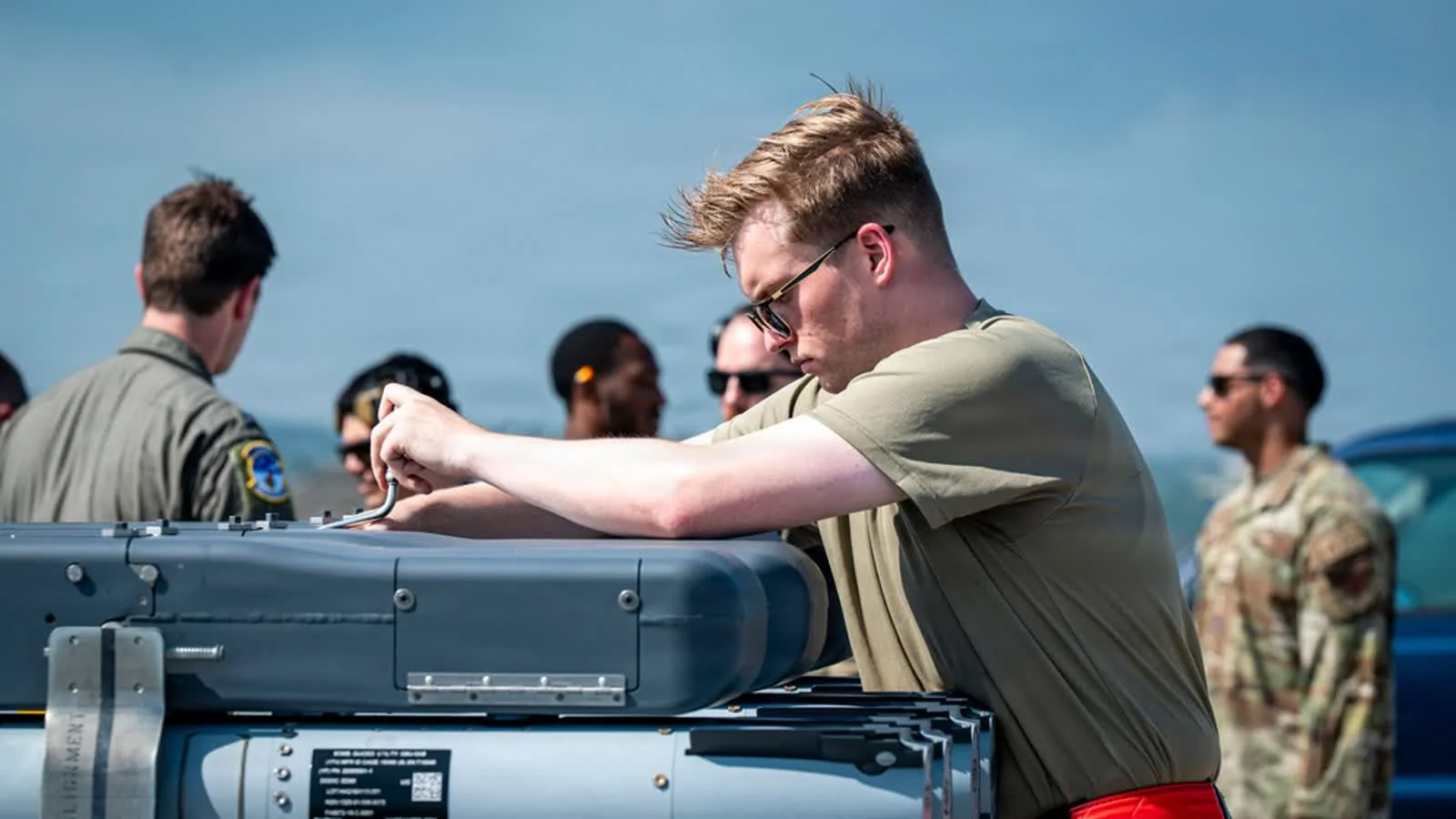
Since July, airmen from the 67th Fighter Generation Squadron and the 85th Test and Evaluation Squadron have been running weapons-load procedures for the F-15EX at Kadena. The training is meant to standardize precision-guided munitions loading across both the new F-15EX and the legacy F-15E Strike Eagle. The Air Force says further aircraft deliveries to Kadena will continue as production and operational needs allow, without committing to a firm schedule.
The permanent F-15EX presence at Kadena is being watched closely for what it signals about regional posture. As the U.S. Navy moves a third carrier strike group toward the Middle East, the Air Force is simultaneously working through a broader refresh of its Pacific air assets. Kadena’s location — close to the Taiwan Strait and the East China Sea — makes it a critical forward-basing point for regional contingency planning.
The F-15EX program traces back to 2019, when the Air Force added the type back to its procurement list after the F-35 production line proved unable to keep pace with demand and the existing F-15C/D fleet approached the end of its structural service life. Boeing built the domestic variant on the engineering base of its F-15QA (Qatar) and F-15SA (Saudi Arabia) export models, a choice that shortened development time and cost — even as the program repeatedly slipped due to supply-chain and labor issues.
Analysts note that the F-15EX’s conformal fuel tanks and expanded external weapons stations let it carry a far larger munitions load over long range than low-observable platforms such as the F-35 can manage. That capability positions the F-15EX as a complementary platform to the F-22 and F-35 within the Air Force’s “high-low mix” fleet strategy — and Kadena’s buildup is the first large-scale application of that approach in the Pacific.
Sources
- The Aviationist, “Kadena Welcomes Its First F-15EX Eagle II Fighters”, November 15, 2026 — https://theaviationist.com/2026/11/15/kadena-welcomes-its-first-f-15ex-eagle-ii-fighters/ — primary confirmation of the first permanent basing.
- Air & Space Forces Magazine, “Kadena Gets First Permanent F-15EX in Boost to USAF’s Pacific Airpower” — https://www.airandspaceforces.com/kadena-first-permanent-f-15ex-arrives/ — fleet transition schedule and delay background.
- DVIDS / U.S. Air Force (Public Domain), “F-15EX Weapons Load Inspection Advances Kadena Integration”, photo by Airman 1st Class Gracelyn Hess, July 2026 — https://www.dvidshub.net/image/9821687/f-15ex-weapons-load-inspection-advances-kadena-integration — source of the cover image.