Australia Opens a $3 Billion Credit Tap for Its Defence Industry

The Australian government has stood up a US$3 billion (A$4.2 billion) state financing vehicle to unlock capital for its defence companies. Called the Defence Industry Growth Facility, it replaces the Defence Export Facility that has existed since 2018 but was barely used. The difference matters: the old fund could only finance exports, while the new one can also pay for building factories at home, expanding production lines and developing new capabilities.
At a Glance
- What happened: Australia launched the Defence Industry Growth Facility.
- Size: US$3 billion, roughly A$4.2 billion.
- Who runs it: Export Finance Australia, through the National Interest Account.
- What it replaces: The Defence Export Facility, created in 2018 with A$3.8 billion.
- Instruments: Loans, bonds, guarantees and direct equity.
- Priority users: Small and medium enterprises that cannot get finance quickly.
- Eligible uses: New export opportunities, facility expansion or upgrade, new capability development, sovereign industrial capability.
- Why it matters: A middle power reframing defence industry from an export-promotion problem into a capital-infrastructure problem.
Why Canberra opened the tap now
The measure announced on 28 August rebuilds the mechanism through which the Australian state finances defence companies. The new vehicle is the Defence Industry Growth Facility, worth US$3 billion, or about A$4.2 billion in local currency. It will be run by Export Finance Australia, the country’s official export credit agency. Crucially, the money does not sit on the agency’s own balance sheet: it flows through the National Interest Account, where the government carries the risk. In plain terms, the state is standing behind exactly the transactions commercial banks have decided are too risky to touch.
The underlying problem is not uniquely Australian. Defence manufacturing is among the hardest sectors in the world to bank: contract cycles run long, cash flow is lumpy, and the collateral on offer is often single-purpose tooling built for one customer. Layer environmental, social and governance screens on top of that, and a large slice of the lending market simply exits. The result is a generation of firms holding orders they cannot afford to build.
Trade and Tourism Minister Don Farrell framed the facility as an answer to that gap: “The Defence Industry Growth Facility responds to the needs of our defence sector.” He added that the government is “supporting our world-class defence businesses to thrive in international markets while delivering sovereign defence capabilities at home.” Defence Industry Minister Pat Conroy deliberately shifted the emphasis away from exports and toward self-reliance: “Sovereign defence capability is essential for our nation’s security.”
The timing is not accidental either. Australia is simultaneously carrying three heavy industrial loads — the AUKUS nuclear-powered submarine programme, a continuous naval shipbuilding enterprise, and a push to manufacture guided weapons domestically. None of those can be carried by prime contractors alone. The second tier of the supply chain has to grow at the same pace, and that second tier is precisely who this facility is aimed at.
Why the old fund jammed: three loans in eight years
To understand the new facility you have to go back to 2018. Australia’s Defence Export Strategy set the goal of pushing the country into the world’s top 10 defence exporters, and the Defence Export Facility — A$3.8 billion — was its financing leg. At the time it was one of the most ambitious state-backed defence finance packages in the region.
It never operated at anything close to that scale. According to the Australian National Audit Office, the transactions actually written were modest: US$75 million in buyer finance for patrol boats sold to Trinidad and Tobago, A$90 million for CEA Technologies’ radar manufacturing facility in Canberra, and A$10 million to Ferra for capital equipment. A multibillion-dollar capacity produced a few hundred million in lending. The government’s own 2026 Defence Industry Development Strategy, published in July, concedes the point, describing the facility as underutilised since its establishment.
The blockage was definitional, not financial. The old mandate covered exports only. But the decisive moment for a defence firm is rarely the signature on an export contract; it is the moment it has to build the plant capable of delivering that contract. A company that cannot fund the factory never reaches the door of an export loan. Add a process in which every application escalated to ministerial approval, and the mechanism became effectively unreachable for smaller firms.
The new facility targets both blockages at once. Its mandate now stretches beyond exports to sovereign industrial capability and supply-chain resilience, and the government has promised a faster, more flexible process aimed particularly at SMEs. What is on the table is not new money so much as the redefinition of an instrument that had gone unused — and in defence economics, definitions frequently matter more than headline numbers.
Four instruments: loans, bonds, guarantees, equity
Technically, the most interesting feature of the facility is the breadth of tools it can deploy. A conventional export credit agency does two things: it lends to the buyer, or it insures the seller’s risk. The Defence Industry Growth Facility can act through four separate instruments — loans, bonds, guarantees and direct equity.
Equity is the line that changes the arithmetic. Lending to a defence company and taking a stake in it are entirely different balance-sheet events. Debt worsens the credit profile of a small firm already carrying leverage; equity grows the capital base and opens the door to commercial bank lending afterwards. A company the state has invested in also reads as lower risk to private investors — which is exactly the crowding-in effect the government says it wants.
The guarantee line addresses a less discussed but decisive obstacle in defence exports. International tenders typically require a performance bond worth a set share of contract value, meaning the supplier must provide a bank instrument the customer can call if delivery fails. For a small firm, getting a bank to tie up that capital is often harder than winning the tender itself. A sovereign guarantor is the precondition for mid-tier companies bidding into large programmes at all.
The bond leg ties the facility to capital markets. Defence investments can take seven to ten years to pay back, so financing them with short-term bank credit is structurally wrong — the maturity mismatch strands the firm mid-contract. Long-dated paper is the correct tool on paper, but defence SMEs rarely reach the scale to issue on their own; state intermediation is what makes that route usable.
Where the money goes: sovereign industrial priorities
What the facility funds will be shaped by the Sovereign Defence Industrial Priorities set out in the 2026 Defence Industry Development Strategy, released on 2 July. That list defines the capabilities Australia believes it must be able to produce on its own soil under any circumstances, and it will function as the de facto filter in approvals.
Seven headings appear on it: maintenance, repair, overhaul and upgrade of ADF aircraft; continuous naval shipbuilding and sustainment; sustainment and enhancement of the combined-arms land system; domestic manufacture of guided weapons, explosive ordnance and munitions; development and integration of autonomous systems; integration and enhancement of battlespace awareness and management systems; and test, evaluation, certification and systems assurance.
None of those are arbitrary. Each maps onto the point where Australia is geographically most exposed: how long the country could sustain itself if long supply lines were cut. The guided-weapons heading in particular reflects the lesson the Ukraine war taught every Western military — in a modern fight, munitions stockpiles are measured in weeks while production lines are measured in years.
The strategy also put an additional A$80 million into Defence Industry Development Grants. The relationship between grant and facility is designed as a ladder: grants keep immature technology alive, while the facility carries a mature product into serial production and export. Unlike the “grants at every stage” habit common in defence industrial policy, that division is economically coherent.
Defence Export Facility versus Defence Industry Growth Facility
| Item | Defence Export Facility (2018) | Defence Industry Growth Facility (2026) |
|---|---|---|
| Established | 29 January 2018, with the Defence Export Strategy | 28 August 2026 |
| Size | A$3.8 billion | US$3 billion (~A$4.2 billion) |
| Mandate | Export finance only | Exports + sovereign capacity + supply chain |
| Instruments | Mainly loans | Loans, bonds, guarantees, equity |
| Administrator | Export Finance Australia | Export Finance Australia (National Interest Account) |
| Known drawdowns | Trinidad and Tobago patrol boats US$75m; CEA Technologies A$90m; Ferra A$10m | Not yet announced |
| Primary goal | Break into the top 10 defence exporters | Fast SME access to capital, self-reliance |
| Policy frame | 2018 Defence Export Strategy | 2026 Defence Industry Development Strategy |
The shop window: from Bushmaster to Ghost Shark
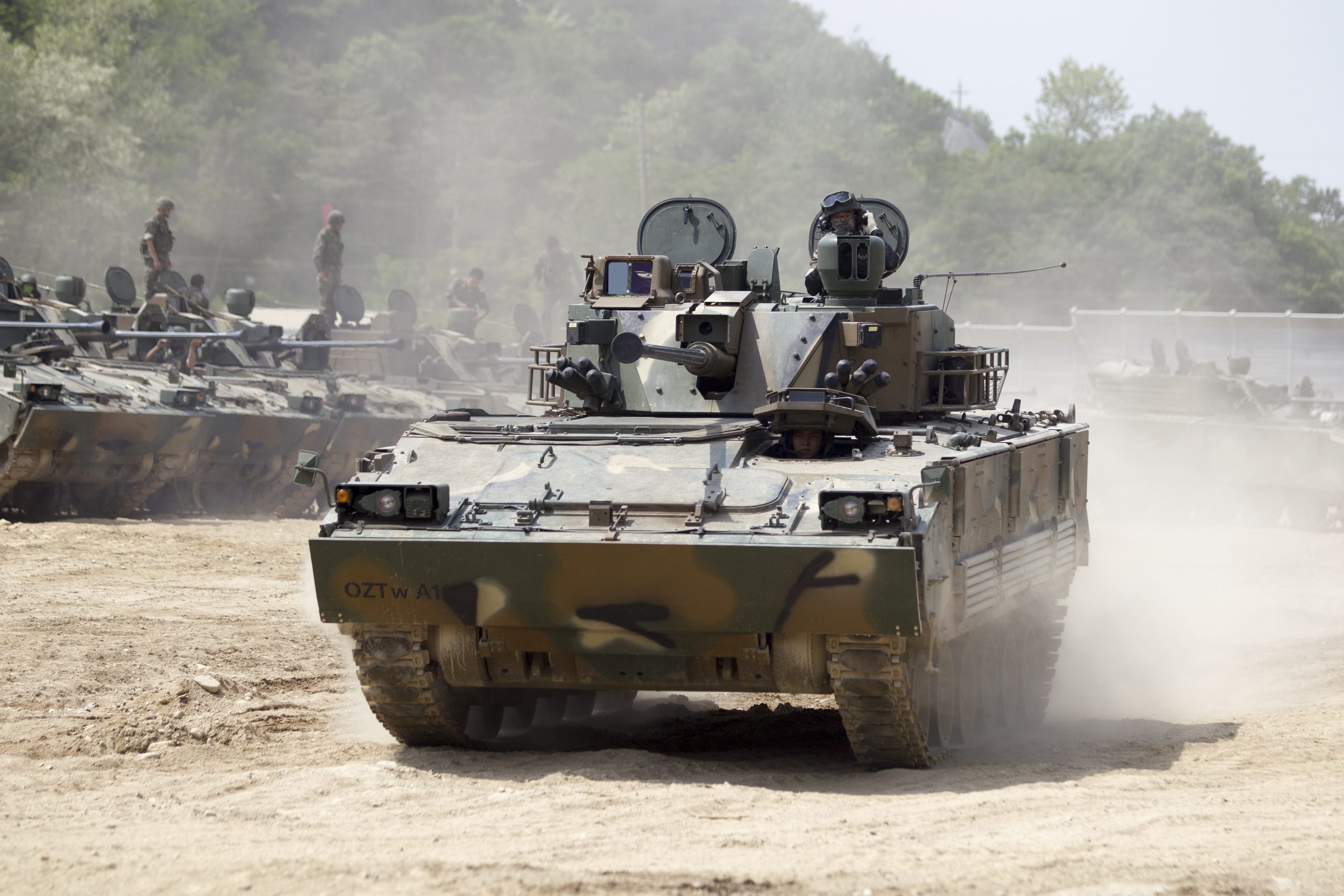
To see the product range this money will chase, look at the Australian Defence Strategic Sales Office priority export list: the Bushmaster and Hawkei protected vehicles, the Boxer 8×8 combat reconnaissance vehicle, the AS9 Huntsman howitzer, the AS21 Redback infantry fighting vehicle, the MQ-28A Ghost Bat uncrewed combat aircraft, the Jindalee Operational Radar Network, and — newly added under the 2026 strategy — the Ghost Shark autonomous underwater vehicle.
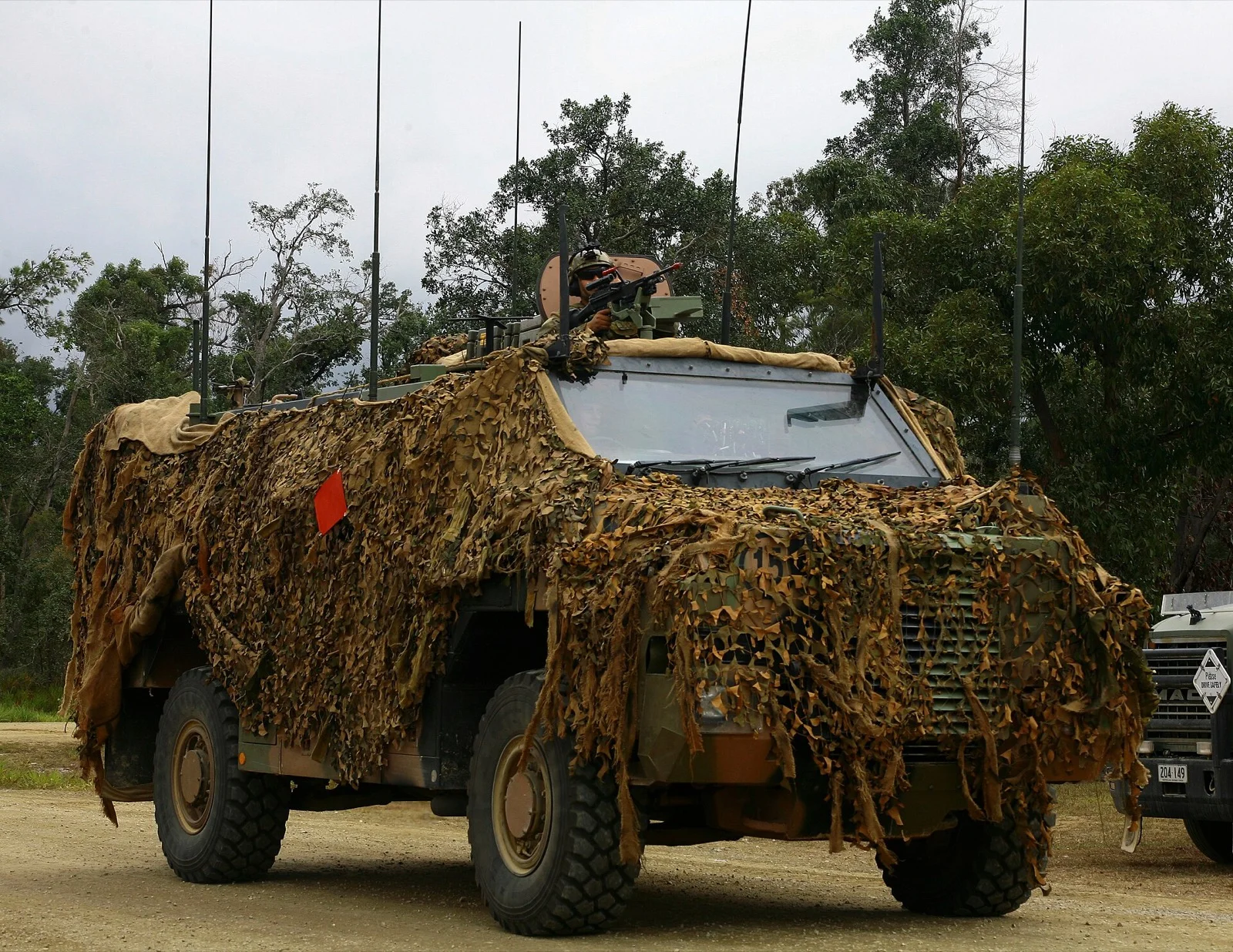
Bushmaster is still the backbone of that list. Built by Thales Australia at Bendigo, the mine-resistant vehicle was developed in the late 1990s and became the platform Australian troops rode in Iraq and Afghanistan. Its V-shaped hull, which channels blast energy outward, made its reputation; it has been exported to the Netherlands, Japan, Indonesia, New Zealand, Jamaica and Fiji, and the batches sent to Ukraine put the name back in the headlines.
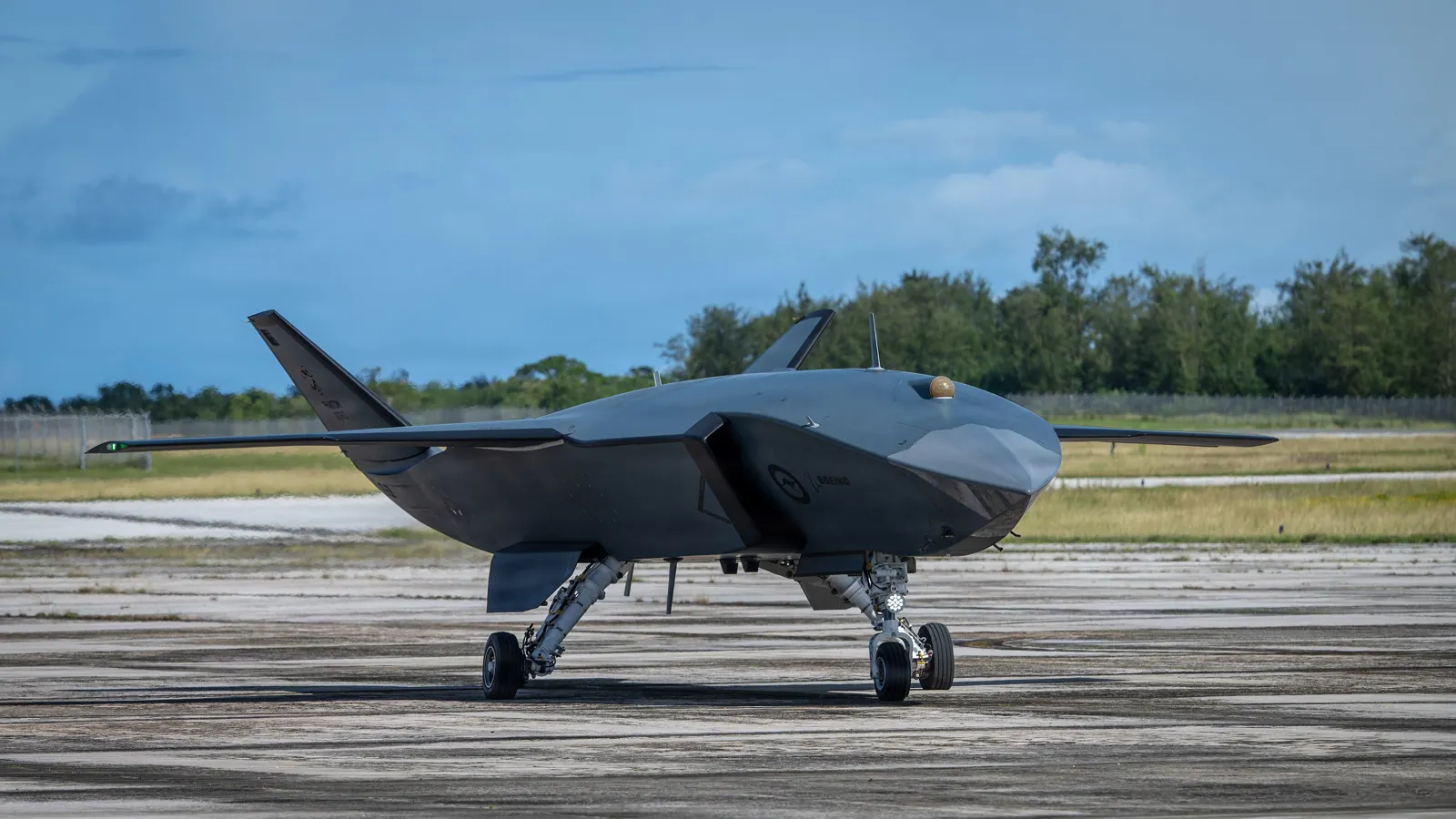
MQ-28A Ghost Bat represents a different Australian ambition. Developed under Boeing Australia’s lead, the loyal-wingman uncrewed combat aircraft is the first military aircraft designed on Australian soil since the 1940s. With AI-enabled autonomy software, a modular nose section and an architecture built to operate alongside crewed fighters, Ghost Bat is the shop window for Canberra’s system-integrator ambitions.
Ghost Shark is the newest and most contested entry. The extra-large autonomous underwater vehicle developed by Anduril Australia is built for long-endurance reconnaissance and surveillance, and the 2026 strategy added it to the priority export list. Clearing an autonomous underwater system for export is a sensitive threshold in any export-control regime; that Australia has crossed it says something about its risk appetite.
Industrial policy in the shadow of AUKUS
The largest shadow over Australia’s refit of its defence finance machinery is AUKUS. Acquiring a fleet of nuclear-powered attack submarines under the trilateral partnership with the United States and the United Kingdom is the most expensive defence undertaking in the country’s history. The hard part, though, is not the cost; it is keeping an industrial base alive for the decades the programme will run.
Sustaining nuclear submarines demands a cluster of competencies Australia largely lacks — from weld qualification and pressure-hull machining to nuclear regulation and radiation safety. That cluster can only form if hundreds of small and mid-sized firms scale at once, and every one of them is looking for money today. The facility’s emphasis on supply-chain resilience points straight at that requirement.
The same logic applies on the surface. Hunter-class frigates, the general-purpose frigate programme won by Hanwha and the continuous shipbuilding enterprise promise decades of steady workload. Steady workload makes supplier planning possible — but it also demands serious up-front investment from those suppliers. State credit is being positioned as the bridge across that gap.

Read from Ankara
Australia’s move will feel familiar to anyone who follows the defence financing debate in Türkiye. The idea of treating defence industry not as a budget line but as a permanently running capital infrastructure was implemented in Türkiye back in 1985, through the Defence Industry Support Fund established under Law 3238. Its defining feature was independence from annual budget haggling: fed by regular dedicated revenues, it could underwrite long-horizon programme commitments. What Canberra now describes as “flexible and responsive finance” is essentially the problem that structure solved.
The second parallel sits in export finance. The rise of Turkish defence exports over the past decade owes as much to the credit and guarantee structures Türk Eximbank offers buyer countries as it does to product quality; in defence tenders, the payment schedule often decides the contest before the technical specification does. The numbers reflect it: according to the Presidency of Defence Industries, Turkish defence and aerospace exports rose from US$7.1 billion in 2024 to US$10.054 billion in 2025, an increase of roughly 48 percent.
That said, the two problems are not identical and a direct comparison would mislead. Australia is a small-scale but deeply capitalised economy with a very high sovereign credit rating; its difficulty is not finding money but building the instrument that channels money into defence. Türkiye’s industrial base is far broader in product range and serial-production experience, while the financing constraint its firms face concentrates more on cost and tenor. The two countries are looking at different faces of the same problem.
The trend is what deserves attention. Retiring an export fund and replacing it with an industrial growth fund is a concrete marker of how Western middle powers now see defence industry: the question is no longer whether you can sell, but whether you can produce under any circumstance. Türkiye reached that conclusion four decades ago and built its institutions accordingly. What matters for Ankara now is the competitive consequence as similar mechanisms proliferate across Australia, Japan and Europe — buyer nations will increasingly compare not just the product, but the financing package behind it.

What to watch next
The facility will be judged by the size of the firms in its first drawdowns. If the money again flows to primes and flagship programmes, the 2018 outcome repeats itself. The real test of the government’s SME rhetoric is whether application-to-approval is measured in weeks or in months.
The second question is how the equity instrument is used. State shareholdings in defence companies raise a chain of sensitive issues, from valuation to exit strategy. The answers will determine whether other middle powers treat the Australian model as a template.
Sources
- Defence Industry Europe — Australia launches $3 billion defence industry finance drive (30 August 2026)
- Australian Department of Defence — 2026 Defence Industry Development Strategy (2 July 2026)
- Export Finance Australia — Supporting Australian defence exporters
- Australian National Audit Office — Design and Implementation of the Defence Export Strategy
- Australian Department of Defence — Defence Export System