Australia Picks the Ears for Its Robot Submarine Hunters: 40 Acoustic Payloads for the Bluebottle Fleet

Australian manufacturer Ocius Technology has signed agreements to integrate sonar systems from ThayerMahan and Thales Australia across its fleet of Bluebottle uncrewed surface vessels. Forty acoustic intelligence payloads will be procured under the Royal Australian Navy’s SEA1200 undersea threat programme.
Two suppliers, two missions
The first agreement is with ThayerMahan. The US company will deliver 40 Outpost acoustic intelligence payloads together with its TransparenSea processing software. The payloads are anti-submarine warfare capable and will operate within a distributed surveillance architecture that detects, localises and tracks contacts of interest, feeding data to operators and commanders.
The second is with Thales Australia, covering the company’s Australian-manufactured BlueSentry thin-line arrays and BlueSentry acoustic processing. Those systems will support the round-the-clock operations Ocius already runs north of Australia for Maritime Border Command.
What a thin-line array does
A thin-line array is a slender cable of sequenced hydrophones towed behind a vessel. Unlike hull-mounted sonar, it works well away from the platform’s own machinery noise, which lets it pick out much lower-frequency and much weaker signals. That is precisely the problem in submarine detection: a modern boat’s radiated noise sits close to the ambient level of the sea around it.
The arrays going aboard the Bluebottles are fully retractable, meaning the vessel can recover the array and keep transiting in shallow water or on port approaches — flexibility fixed towed systems do not offer.
Why Bluebottle
Bluebottle is powered by solar, wind and wave energy, and can stay at sea for months without carrying fuel. That endurance answers the most expensive requirement in anti-submarine warfare: persistence. Holding contact after detection matters as much as detection itself, and holding contact requires sensors that are simply always there.
The vessel’s keel, winch and payload bay architecture is deliberately supplier-agnostic, letting arrays from different manufacturers be fitted to the same hull. Vessels and array integration are handled at Ocius’s production facility in Sydney.
Programme and budget
The systems will be fielded under the Royal Australian Navy’s recent A$176 million Program of Record. Ocius said the selection followed a rigorous evaluation that compared four separate thin-line array providers, and included navy-controlled validation, extended deployments under representative mission conditions and comprehensive operational testing.
The company describes the resulting contracts as the largest fielded deployment of persistent above-water and below-water surveillance for undersea warfare missions anywhere to date.
The AUKUS Pillar II angle
The ThayerMahan collaboration is presented as a practical application of AUKUS Pillar II. Unlike Pillar I, which covers the nuclear submarine transfer, Pillar II is about sharing capability in artificial intelligence, autonomy, quantum and cyber. Pairing an Australian autonomous maritime platform with American acoustic sensing and processing is one of the more tangible outputs that pillar has produced.
The scale of Australia’s maritime domain makes the calculation straightforward. Sustaining continuous patrol with crewed ships costs a different order of magnitude from doing the same job with an autonomous, renewably powered fleet.
The wider read
What distinguishes this programme is that it treats the uncrewed surface vessel as a persistent sensor carrier rather than a weapons carrier. Most of the public attention on USVs over the past three years has gone to one-way attack craft in the Black Sea and the Red Sea; the quieter application is exactly this one.
Turkey’s own USV portfolio has broadened along both branches — the ULAQ family from ARES Shipyard and Meteksan, ASELSAN’s MARLIN, and kamikaze configurations such as TUFAN unveiled at TEKNOFEST Blue Homeland. In acoustically difficult, submarine-dense basins like the Aegean and the eastern Mediterranean, persistent undersea surveillance is at least as decisive as strike capability, and Turkish industry’s existing work in towed array sonar and acoustic processing provides the technical base for a comparable platform-sensor pairing.
Sources
- Ocius Technology press release, 25 August 2026
- Statements by Australian Minister for Defence Industry Pat Conroy
- Royal Australian Navy SEA1200 programme information
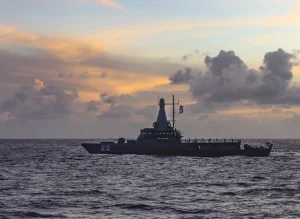
Image: Uncrewed surface vessel (illustrative). Source: Wikimedia Commons.