What Is Elbit Systems? Israel’s Largest Private Defence Firm Explained
- 24 Nov 2026 15:52
- Updated: 11 Nov 2026

Elbit Systems is an Israeli defence electronics company headquartered in Haifa and listed on NASDAQ and the Tel Aviv Stock Exchange. Founded in 1966 as Elbit Computers, it became a stand-alone defence firm after a 1996 split and grew through acquisitions of El-Op, Elisra, Tadiran and IMI Systems into Israel’s largest privately owned arms producer. Its portfolio includes the Hermes 450 and 900 unmanned aircraft, PULS rocket artillery, electro-optics and the F-35 helmet-mounted display. Elbit’s systems are used by the Israeli military in Gaza and the occupied West Bank, which has made the company a focus of pension-fund divestment and protest.
Overview and History
Elbit Systems traces its origins to Elbit Computers, established in Haifa in 1966 as a subsidiary of Elron Electronic Industries. The young company built computers and avionics for the Israeli military, and by the 1970s it was a leading supplier of fire-control computers and fighter-aircraft upgrades. Unlike Israel Aerospace Industries and Rafael, which were and remain state-owned, Elbit developed as a privately held business.
In 1996 Elbit Ltd. was split into three companies. The defence activities were spun off as Elbit Systems, while medical imaging and communications continued separately. Elbit Systems listed on NASDAQ the same year under the ticker ESLT and also trades in Tel Aviv. The controlling shareholder is Federmann Enterprises, the holding company of the Federmann family, with a stake reported at roughly 44 percent. Michael Federmann chairs the board; Bezhalel Machlis has served as president and CEO since 2013.
Growth came largely through acquisitions. Electro-optics maker El-Op was merged in 2000. A majority of electronic-warfare firm Elisra was bought in 2005, with the remaining shares acquired from IAI in 2011. Tadiran Communications came fully under Elbit control in 2007-2008, and artillery maker Soltam followed in 2010. The largest step was the purchase of the state-owned munitions company IMI Systems, completed in late 2018. In 2021 Elbit Systems of America acquired Sparton Corporation, a US maker of sonobuoys and undersea systems.
Business Segments and Corporate Structure
In its annual Form 20-F filings with the US SEC, Elbit reports five operating segments: Aerospace, C4I and Cyber, ISTAR and EW (intelligence, surveillance, target acquisition, reconnaissance and electronic warfare), Land, and the geographic segment Elbit Systems of America. Aerospace covers unmanned aircraft, avionics, training and space. Land includes the former IMI munitions and artillery businesses and has been among the fastest-growing areas since 2023.
Elbit operates as a local manufacturer in its main export markets. Elbit Systems of America, based in Fort Worth, Texas, supplies night-vision devices, helmet displays and naval systems to the US armed forces. Elbit Systems UK runs sites in Bristol, Oldham (the former Ferranti plant) and Shenstone, home of engine subsidiary UAV Engines Ltd. Other subsidiaries include Elbit Systems Deutschland, AEL Sistemas in Brazil and Elbit Systems of Australia. In India a joint venture with the Adani group assembles Hermes 900 airframes near Hyderabad.
Within Israel the company operates dozens of sites beyond its Haifa headquarters, including Ramat HaSharon, Netanya, Yokneam and Nazareth. The IMI acquisition brought the historic munitions campus at Ramat HaSharon under Elbit’s control; relocating production and freeing the land for housing was part of the deal with the Israeli government.
| Segment | Scope | Example Products |
|---|---|---|
| Aerospace | UAS, avionics, training and simulation, space | Hermes 900, Skylark, HMDS, DIRCM |
| C4I and Cyber | Tactical radios, command and control, cyber | Tadiran radios, TORC2H |
| ISTAR and EW | Electro-optics, electronic warfare, SIGINT | Elisra EW suites, long-range sensors |
| Land | Vehicle systems, artillery, munitions (ex-IMI) | PULS, ATMOS 2000, Iron Fist, Sabrah |
| Elbit Systems of America | All product lines for the US market | Night vision, Sparton sonobuoys, HMDS |
Main Products
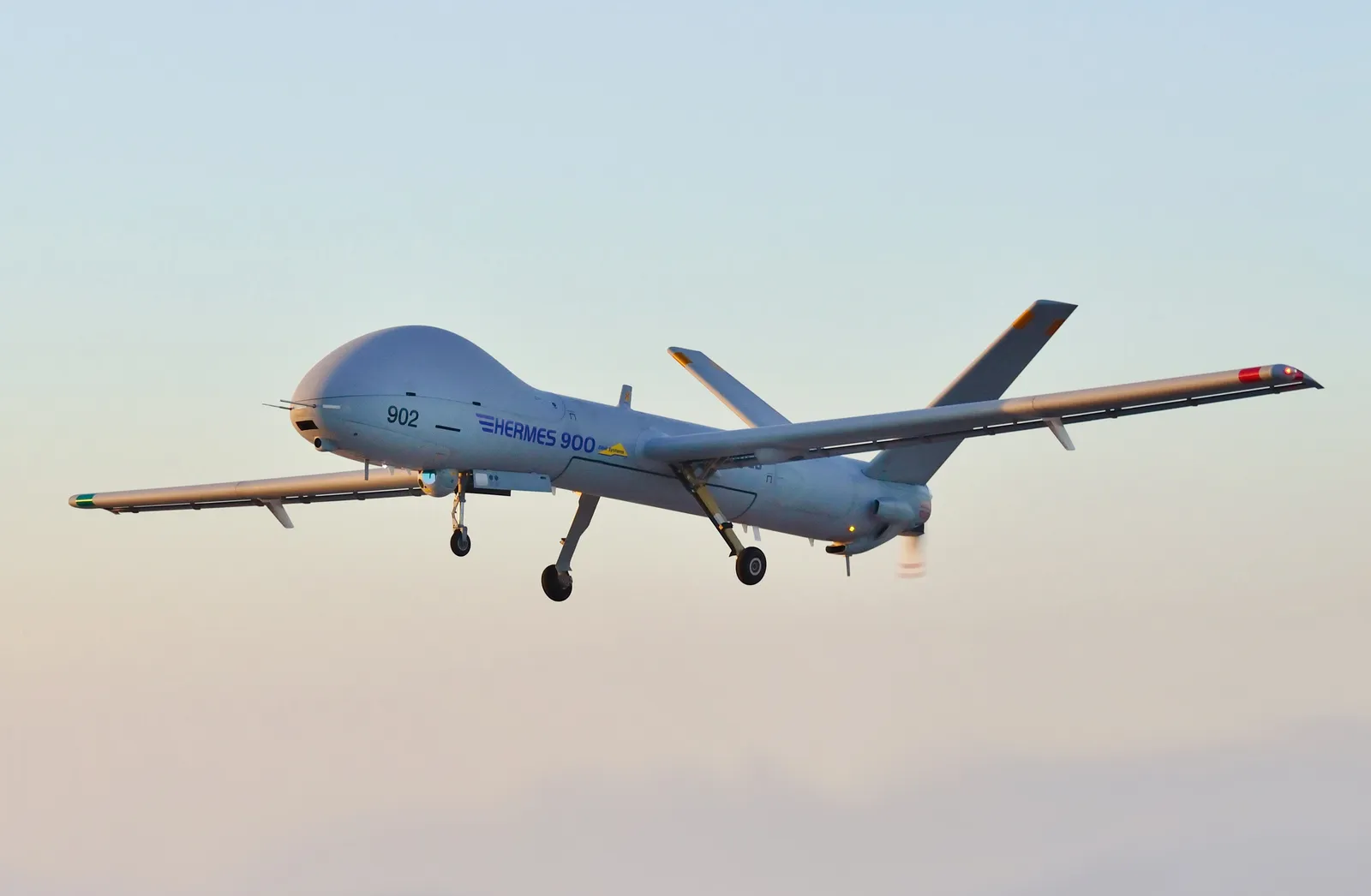
The Hermes family is Elbit’s best-known product line. The Hermes 450 has been the Israeli military’s main tactical drone since the late 1990s and forms the basis of the British Army’s Watchkeeper. The larger Hermes 900, a MALE-class aircraft, entered service in 2012; a variant designed for certification in civil airspace is marketed as StarLiner. The Skylark series covers mini-UAS requirements and the SkyStriker is a loitering munition.
On land, the former IMI PULS multiple rocket launcher became a leading export item after 2023, with several European customers. Other products include the ATMOS 2000 truck-mounted 155 mm howitzer, the Sigma next-generation gun, the Iron Fist active protection system, the Spear and Crossbow 120 mm mortar systems, and the Sabrah light tank developed for the Philippines. Elbit also supplies tank fire-control systems and turret upgrades.
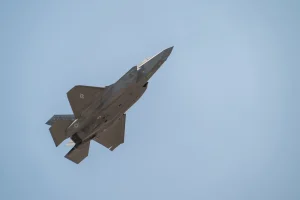
In avionics, Elbit produces the F-35 helmet-mounted display system through its joint venture with Collins Aerospace, having earlier built the JHMCS helmet sight through the same partnership. Its MUSIC and J-MUSIC directed infrared countermeasure (DIRCM) systems protect military and civil aircraft from heat-seeking missiles. Night-vision goggles, the Seagull unmanned surface vessel and thermal imagers complete the range.
| Product | Category | Main Users |
|---|---|---|
| Hermes 450 | Tactical UAS | Israel, Brazil, Azerbaijan (reported), basis of UK Watchkeeper |
| Hermes 900 / StarLiner | MALE UAS | Israel, Brazil, Chile, Colombia, Switzerland (ADS 15) |
| Skylark | Mini UAS | Israel and export customers |
| SkyStriker | Loitering munition | Israel, Azerbaijan (reported) |
| PULS | Rocket artillery | Israel, Netherlands, Denmark, Spain (SILAM), Germany (Euro-PULS) |
| ATMOS 2000 | 155 mm truck howitzer | Israel, Philippines and other export customers |
| Iron Fist | Active protection system | Israel (Eitan), Netherlands (CV90), US Bradley trials |
| F-35 HMDS | Helmet-mounted display | All F-35 operators (with Collins Aerospace) |
| J-MUSIC / MUSIC | DIRCM | Israel, German A400M, several others |
| Sabrah | Light tank | Philippines |
Exports and International Markets
Elbit earns most of its revenue outside Israel; in recent years the share has been around 70 to 75 percent. Israeli orders rose sharply after October 2023, lifting the domestic share, but Europe and North America remain the largest regions. For 2024 the company reported revenue of about $6.8 billion and a backlog above $22 billion; by 2025 the backlog was reported near $23 billion.
European PULS orders stand out. The Netherlands selected the system in 2023, as did Denmark. Spain procured a PULS-based solution for its SILAM programme together with Escribano and Rheinmetall Expal. Germany chose the Euro-PULS, developed jointly with KNDS Deutschland, for the Bundeswehr. Switzerland’s six Hermes 900 HFE aircraft, bought under the ADS 15 programme, suffered years of delay over certification and software issues and became a matter of public controversy.
In Latin America, the Brazilian Air Force operates the Hermes 450 and 900, while AEL Sistemas produces avionics locally. In Asia, the Philippines ordered Sabrah light tanks and ATMOS 2000 howitzers in 2020. Indian joint ventures with Adani and other partners build drones and electro-optics. Serbia’s acquisition of the Hermes 900 has been reported on the basis of statements by Serbian officials.
Türkiye Context
Elbit’s main Turkish programme was the M60T Sabra upgrade signed in 2002. Under a contract worth about $688 million, 170 Turkish Army M60A1 tanks received a new turret, a 120 mm gun, modern fire control and add-on armour. Early vehicles were converted in Israel and the rest at the Turkish Army’s maintenance plant in Kayseri; deliveries were completed around 2010. The project was one of the largest examples of Israeli-Turkish defence cooperation.
The Turkish Air Force’s F-4E 2020 Terminator and F-5 upgrades of the same era were carried out by Israel Aerospace Industries, not Elbit, although the two firms are often confused. Defence ties collapsed after the 2010 Mavi Marmara attack. In 2024 Türkiye suspended all trade with Israel over the assault on Gaza, and there is no known commercial relationship between Elbit and Türkiye today.
Gaza, Human Rights, Divestment and Market Position
Elbit’s products sit at the centre of Israeli military operations in Gaza and the occupied West Bank. Hermes 450 and 900 drones carry out surveillance and strike missions; IMI-origin artillery ammunition and mortar systems are used in ground operations; electro-optic and surveillance systems operate along the separation wall. UN bodies, Amnesty International and Human Rights Watch have documented the killing of tens of thousands of Palestinian civilians in Gaza since October 2023. In January 2024 the International Court of Justice, in the case brought by South Africa, ordered provisional measures after finding a plausible risk to Palestinians’ rights under the Genocide Convention.
The company has therefore long been a focus of responsible-investment debates. Norway’s Government Pension Fund Global excluded Elbit in 2009 over its supply of a surveillance system for the separation wall, and Denmark’s Danske Bank followed in 2010. Other European pension funds and banks later took similar decisions. In the United Kingdom, the group Palestine Action has staged direct actions against Elbit sites since 2020; the UK government proscribed the group in 2025. Elbit maintains that its products are sold lawfully to legitimate customers.
In market terms Elbit is one of Israel’s three major defence groups alongside the state-owned IAI and Rafael, and the only privately owned one. It appears every year in SIPRI’s list of the world’s 100 largest arms producers. Orders since 2023 have pushed revenue and the share price higher; over the same period the company has remained one of the principal targets of human-rights-based exclusion and boycott campaigns.
- 2009: Norway’s GPFG excludes Elbit over the separation-wall surveillance system
- 2010: Danske Bank removes Elbit from its investment universe
- January 2024: ICJ provisional measures (South Africa v. Israel, Case No. 192)
- 2020-2025: Palestine Action protests; group proscribed in the UK in 2025
Frequently Asked Questions
Who owns Elbit Systems?
Elbit Systems is publicly traded on NASDAQ and the Tel Aviv Stock Exchange. The controlling stake, reported at about 44 percent, is held by Federmann Enterprises, the Federmann family’s holding company. The Israeli state holds no shares.
What does Elbit Systems make?
Unmanned aircraft (Hermes 450/900, Skylark), PULS rocket artillery, ATMOS truck howitzers, active protection systems, electro-optics and night vision, electronic-warfare suites, tactical radios and the F-35 helmet-mounted display, among other products.
Are Elbit systems used in Gaza?
Yes. Hermes drones, IMI-origin munitions and surveillance systems are used by the Israeli military in Gaza and the occupied West Bank. UN agencies and human-rights groups have documented mass civilian casualties, and the ICJ ordered provisional measures in January 2024.
Which investors have divested from Elbit?
Norway’s Government Pension Fund Global excluded Elbit in 2009 and Danske Bank did so in 2010. Several other European pension funds and banks later followed. In the UK, Palestine Action has targeted Elbit facilities with protests since 2020.
Did Elbit work with Türkiye?
Yes. Between 2002 and 2010 Elbit upgraded 170 Turkish M60A1 tanks to the M60T Sabra standard. Türkiye suspended trade with Israel in 2024, and no current commercial relationship is known.
Sources
- Elbit Systems official website
- US SEC – Elbit Systems Form 20-F filings
- SIPRI Arms Industry Database
- International Court of Justice – Case No. 192 (South Africa v. Israel)