US Army Fires 18-Drone Swarm From Container-Launched UGV

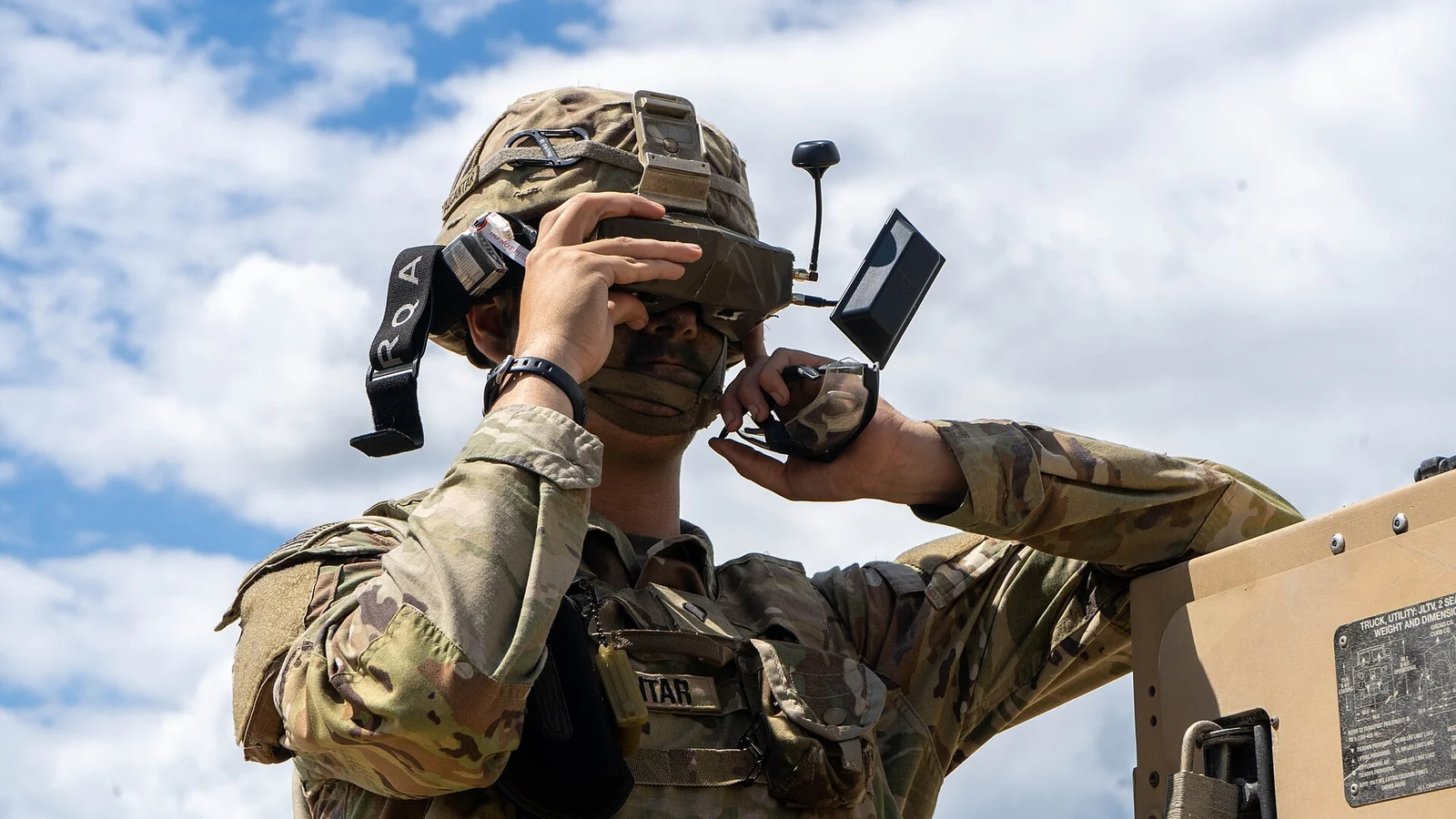
On November 12, 2026, the US Army demonstrated an unmanned ground vehicle that rolled out of a standard 20-foot shipping container and launched 18 first-person-view (FPV) drones in rapid succession at Grafenwoehr Training Area in Bavaria, Germany. The event was staged under the Remote Rapid Response Autonomous Contingency Team (R3ACT) effort, run jointly by the DEVCOM Armaments Center, US Army Europe and Africa, and the 7th Army Training Command. Soldiers from the 173rd Airborne Brigade served as the FPV operators.
The centerpiece was a ground robot called R3NEGADE, shown in two distinct configurations. The first emerged from its container and fired the 18-drone swarm through what the Army calls an HIV3 launcher. A second R3NEGADE variant carried a pair of remotely operated Javelin anti-tank missile launchers instead of drones, demonstrating the same chassis can switch roles between reconnaissance-strike and direct anti-armor fires.
Supporting vehicles rounded out the demonstration. A smaller TRV-150 laid down a smoke screen ahead of the swarm launch to mask the firing position, while a separate TRV-400 showcased a developmental anti-armor payload named FIR3FLY in its own segment of the exercise. FPV strike drones and rocket-armed resupply drones were also flown in coordinated, mixed-package attack runs during the day.
According to Army Recognition’s November 14, 2026 report, the exercise was framed as support for the Eastern Flank Deterrence Initiative (EFDI) and tied explicitly to the “Strike” and “Endurance” pillars of the Army’s October 2026 “How the Army Fights” doctrine. No procurement decision or fielding timeline was announced alongside the demonstration.
Why this matters
A container-launched robot that can unleash a multi-drone swarm on demand points toward a logistics model built for concealment and rapid repositioning: the system can be moved by truck, rail, or ship without obviously advertising its payload, then opened and fired within minutes. That is a meaningful departure from today’s standard practice of individual soldiers piloting single FPV drones, and it echoes lessons drawn from mass drone use in Ukraine, only packaged for faster, less manpower-intensive employment by forward-deployed US units in Europe.
The Army’s newly stood-up Futures and Autonomous Systems Command (FASCOM) has signaled it wants priority autonomous systems ready for acquisition decisions by fiscal year 2028, but Army Recognition’s reporting is explicit that R3ACT remains a technology evaluation rather than a program of record. Grafenwoehr has hosted a string of related drone events over the past year, including the December 2025 Best Drone Warfighter Competition and several Flytrap counter-drone exercises, suggesting this swarm demonstration is one data point in a longer-running doctrinal search rather than an isolated stunt.
Frequently asked questions
What is R3NEGADE?
R3NEGADE is the name given to unmanned ground vehicle configurations tested under the US Army’s R3ACT program. One variant launches FPV drones from a container-mounted HIV3 swarm launcher; another carries remotely operated Javelin missile launchers.
Where and when did this happen?
The demonstration took place on November 12, 2026, at Grafenwoehr Training Area in Bavaria, Germany, organized by the DEVCOM Armaments Center, US Army Europe and Africa, and the 7th Army Training Command.
Did the Army decide to buy this system?
No. Army Recognition describes it as a technology demonstration with no announced procurement decision or fielding schedule.
Sources: Army Recognition, “US Army launches 18-drone swarm attack from UGV in Germany exercise under new warfighting strategy” (Jérôme Brahy, November 14, 2026, armyrecognition.com) — used for all technical and contextual details; image credited to the US Army.