Russia’s Su-57 Felon Changes Roles: From First-Night Striker to Drone-Hunting Interceptor

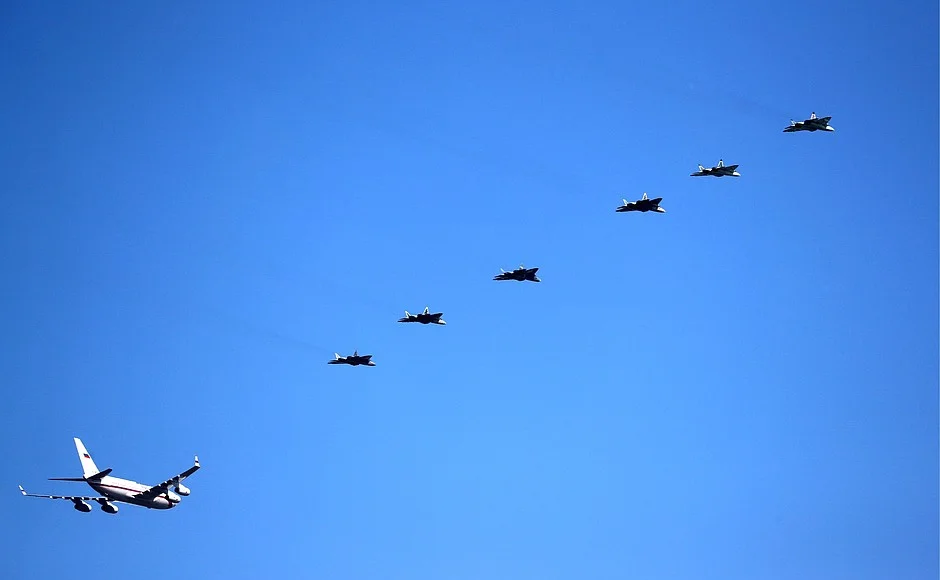
Russia’s only fifth-generation fighter, the Su-57 “Felon,” appears to be drifting away from the stealth-strike role it was designed for. Open-source imagery circulating in early June 2026 suggests the aircraft is being fitted with external missile stations — potentially turning it into an “interceptor” able to carry close to ten medium-range air-to-air missiles per sortie. The Russian Ministry of Defense has not confirmed the configuration.
At a Glance
- What: Su-57 Felon adapted to a defensive counter-air (interceptor) role
- How: 6 internal R-77M-class missiles + 4 external AKU-ASP launchers = ~10 medium-range missiles per sortie
- Against: Ukrainian long-range drones, cruise missiles and low-altitude threats
- Source: Open-source imagery (early June 2026) — unconfirmed officially
- Meaning: A high-end stealth fighter repositioned as a “sentry” against cheap but numerous aerial threats
Why turn a stealth fighter into a drone sentry?
Ukraine’s growing barrage of long-range drones and cruise missiles keeps Russia’s deep rear — airbases, energy plants, command posts and defense-industrial sites — under constant threat. One of the most expensive but fastest answers to that threat is a fighter loitering on air patrol with a large magazine of interceptor missiles. The Su-57’s new configuration seems designed to meet exactly that need.
The most striking detail in the imagery is the set of external weapon stations and AKU-ASP-type missile ejection rails beneath the fuselage. A 101KS-N targeting pod under the left engine nacelle adds long-range visual identification and passive tracking. Here, stealth takes a back seat; what matters is detection, identification, reaction time and missile availability.
Loadout and missiles
In the reported arrangement, the Su-57 carries six R-77M-class medium-range missiles in its internal bays while accommodating four more on external stations — a theoretical total of about ten medium-range missiles. R-73/R-74 infrared-guided missiles round out the package for close combat. The aircraft’s N036 multi-array AESA radar, 101KS electro-optical suite and infrared search-and-track are critical for finding and discriminating small, low-flying targets.
| Element | Detail |
|---|---|
| Internal missile capacity | 6 × R-77M-class medium-range |
| External stations | 4 × AKU-ASP launchers (additional) |
| Total (theoretical) | ~10 medium-range AAMs |
| Close combat | R-73/R-74 (range ~30 km, ±45° lock) |
| R-77 range | ~110 km in heavy ECM conditions |
| Sensors | N036 AESA, 101KS EO, 101KS-N pod |
A doctrinal shift: from first-night striker to interceptor
This picture points to a shift in the Su-57’s doctrinal place. The jet is evolving from the “first-night striker” that silently pierces enemy air defenses into a high-capacity “interceptor” operating behind friendly lines under Russia’s own PVO umbrella. It fits a broader global trend: advanced, expensive fighters increasingly tasked against cheap but numerous aerial threats.
Sources
- Army Recognition — “Russia’s Su-57 Felon Evolves from Stealth Fighter to High-Capacity Air Defense Interceptor” (2026)
- Wikipedia — Sukhoi Su-57
- Open-source visual intelligence (OSINT) assessments