What is the F-22 Raptor? The 5th generation air superiority fighter of the U.S.
Summary Not Found.
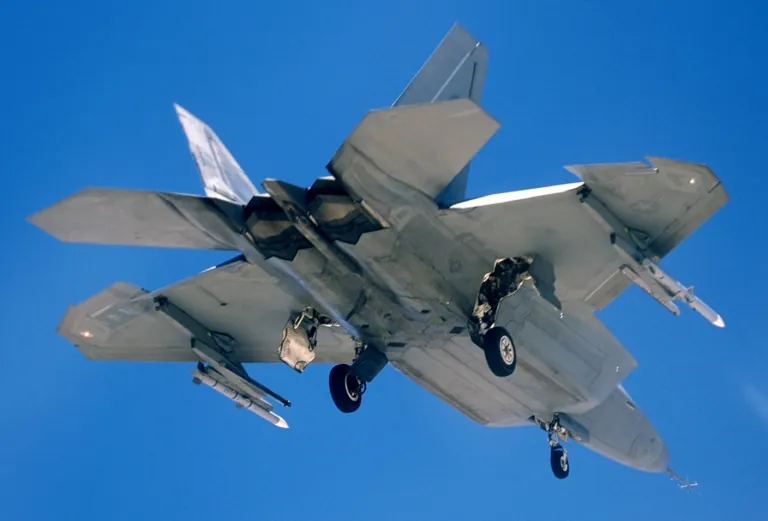
F-22 Raptor: the 5th generation air superiority fighter of the U.S. Air Force (Representative image)
The F-22 Raptor, developed by Lockheed Martin with Boeing as a partner, was the world’s first 5th generation fighter to enter serial production. Combining low radar signature (stealth), supercruise, super maneuverability through thrust vectoring, and advanced sensor fusion in a single airframe, the Raptor was primarily designed for air superiority. This file covers the characteristics of the F-22, its production history, the export ban, and its position against the F-35, Su-57, and J-20.
Contents: Overview · Features · Stealth and supercruise · Armament · Production and export ban · Comparison · Questions
Overview: why the Raptor matters
The F-22 emerged from the ATF program of the late Cold War as a platform capable of overcoming air defenses and Soviet fighters. The YF-22 demonstrator flew in 1990; the production model flew in 1997 and entered service with the U.S. Air Force in 2005.
Its design philosophy can be summed up in one phrase: see first, shoot first, remain invisible. A low radar cross-section reduces the enemy detection range, while sensor fusion provides the pilot with a unified picture of aerial combat.
Features
Attribute
Value
Manufacturer
Lockheed Martin / Boeing
Type
Single-seat, twin-engine air superiority fighter
Engines
2× Pratt & Whitney F119-PW-100 (thrust vectoring)
Max Speed
~Mach 2.25 (high altitude)
Supercruise
Above Mach 1.8 (without afterburner)
Ceiling
~19,800 m
Armament
Internal bays: AIM-120 AMRAAM, AIM-9 Sidewinder, 20 mm cannon
Units Built
195 (8 test + 187 operational)
Stealth and Supercruise: The Two Differentiators
The F-22 is the first operational fighter capable of sustained supersonic flight without afterburner (supercruise), giving it range and energy advantage over enemy missiles.
The two-dimensional thrust vectoring nozzles provide exceptional nose control even at low speeds (super maneuverability). Stealth comes not only from shape but also from radar-absorbing materials and internal weapon carriage.
Armament
To preserve its signature, the Raptor carries its armament in internal bays. A typical air-to-air loadout includes six AIM-120 AMRAAM and two AIM-9 Sidewinder. The small diameter bombs provide limited air-to-ground capability.
Production and Export Ban
The F-22 was never exported. The Obey Amendment of 1998 legally prohibited the sale of the Raptor abroad, so the aircraft only serves in the U.S. Air Force.
Production ended much earlier than expected, in 2011, with 195 units, due to budget pressures. This reduced fleet is the main reason why it is costly to sustain and modernize the type today.
F-22 vs. F-35, Su-57, and J-20
The F-22 was designed for pure air superiority; the F-35 as a multirole platform (with an emphasis on air-to-ground). They are complementary, not rivals. The Russian Su-57 and Chinese J-20 are the closest counterparts to the Raptor in the heavy fighter class.
Aircraft
Country
Seats
Engines
Max Speed
Main A-A Missile
F-22 Raptor
USA
Single
2× F119-PW-100 (TVC)
~Mach 2.25
AIM-120, AIM-9
F-35A
USA
Single
1× F135
~Mach 1.6
AIM-120, AIM-9X
Su-57
Russia
Single
2× AL-41F1 / Izdeliye 30
~Mach 2.0
R-77M, R-37M
J-20
China
Single
2× WS-10C / WS-15
~Mach 2.0
PL-15, PL-10
Note: the comparison uses data from open sources; actual combat performance depends on doctrine, sensor networks, and training.
Frequently Asked Questions
How many F-22s were built?
A total of 195 aircraft (8 prototypes, 187 operational). Production ended in 2011.
Why is the F-22 not exported?
The 1998 Obey Amendment legally prohibits its sale abroad. The Raptor only serves in the U.S. Air Force.
Is the F-22 better than the F-35?
They were built for different tasks: the F-22 excels in air superiority and the F-35 in multi-role and networked missions. It depends on the mission.
How much does an F-22 cost?
Sources place the flyaway cost per aircraft at around 150 million dollars; the unit cost of the program with R&D is higher. The cost of the package and the program should be read separately.
{“@context”: “https://schema.org”, “@type”: “FAQPage”, “mainEntity”: [{“@type”: “Question”, “name”: “How many F-22s were built?”, “acceptedAnswer”: {“@type”: “Answer”, “text”: “A total of 195 aircraft (8 prototypes, 187 operational). Production ended in 2011.”}}, {“@type”: “Question”, “name”: “Why is the F-22 not exported?”, “acceptedAnswer”: {“@type”: “Answer”, “text”: “The 1998 Obey Amendment legally prohibits its sale abroad. The Raptor only serves in the U.S. Air Force.”}}, {“@type”: “Question”, “name”: “Is the F-22 better than the F-35?”, “acceptedAnswer”: {“@type”: “Answer”, “text”: “They were built for different tasks: the F-22 excels in air superiority and the F-35 in multi-role and networked missions. It depends on the mission.”}}, {“@type”: “Question”, “name”: “How much does an F-22 cost?”, “acceptedAnswer”: {“@type”: “Answer”, “text”: “Sources place the flyaway cost per aircraft at around 150 million dollars; the unit cost of the program with R&D is higher. The cost of the package and the program should be read separately.”}}]}