UMTAS Rivals Compared: Spike-LR/ER and AGM-114 Hellfire

The main rivals of Turkey’s ROKETSAN UMTAS in the long-range anti-tank guided missile class are Israel’s Spike-LR/ER family and the American AGM-114 Hellfire. All three are launched from helicopters and drones; the real differences lie in guidance architecture, range bands, weight and platform ecosystems.
| UMTAS and Its Rivals — At a Glance | |
|---|---|
| Class | Long-range anti-tank guided missile (ATGM) |
| Systems compared | UMTAS (Turkey), Spike-LR/ER (Israel), AGM-114 Hellfire (USA) |
| UMTAS manufacturer | ROKETSAN (IIR seeker: ASELSAN) |
| Spike manufacturer | Rafael Advanced Defense Systems |
| Hellfire manufacturer | Lockheed Martin |
| UMTAS serial production | 2017 |
| UMTAS guidance | Imaging infrared (IIR) + RF datalink; L-UMTAS laser variant |
| Primary platforms | T129 ATAK, Bayraktar TB2, ground vehicles, naval helicopters |
What class does UMTAS compete in?
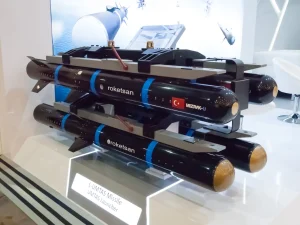
UMTAS (Long-Range Anti-Tank Missile System) is a 160 mm, 37.5 kg anti-tank guided missile designed primarily for launch from helicopters and unmanned aircraft. In serial production since 2017, it carries a tandem HEAT warhead against reactive-armour-protected main battle tanks, with blast-fragmentation and thermobaric options also offered.
The global market for this class is dominated by two established players: the AGM-114 Hellfire, produced in the tens of thousands, and the long-range members of Rafael’s Spike family, exported to roughly 40 countries. UMTAS competes with both on technical merit and, increasingly, in export markets tied to Turkish air platforms.
UMTAS: imaging infrared plus RF datalink
The baseline UMTAS engages targets between 0.5 and 8 km. Its guidance pairs an ASELSAN-built imaging infrared (IIR) seeker with an RF datalink, enabling both fire-and-forget and fire-and-update modes: after launch the operator can retarget, abort or confirm the engagement. Direct-attack and top-attack profiles are supported, and propulsion comes from an HTPB solid-fuel motor.
L-UMTAS is the semi-active laser-guided version of the same airframe, used against laser-designated targets; open sources document its combat employment from T129 ATAK helicopters and UAVs.
- Range: 0.5-8 km (baseline)
- Weight: 37.5 kg; length 1.8 m; diameter 160 mm
- Warhead: tandem HEAT / blast-fragmentation / thermobaric
- Platforms: T129 ATAK (primary), Bayraktar TB2, ground vehicles, naval helicopters
⚠ Some secondary sources cite ranges of 16-50 km for an enhanced variant referred to as UMTAS-GM. These figures have not been officially confirmed by ROKETSAN and should be treated with caution.
Spike-LR/ER: fibre optics and a multinational network
Rafael’s Spike family combines an electro-optical/IIR seeker with a fibre-optic cable (or, in newer versions, an RF datalink). The ground-focused Spike-LR reaches about 4 km, the updated Spike-LR2 5.5 km per manufacturer data. The helicopter- and vehicle-launched Spike-ER reaches roughly 8 km, while Spike-ER2 extends to around 10 km with its RF datalink, with the manufacturer quoting even longer figures for helicopter launch.
Weights vary by version: the Spike-ER missile itself weighs about 34 kg, but a complete system with launcher and sight can approach 70 kg. Spike’s greatest strength is its market footprint — co-production lines in Europe and service with dozens of armed forces, including many NATO members.
AGM-114 Hellfire: the most combat-proven of the class
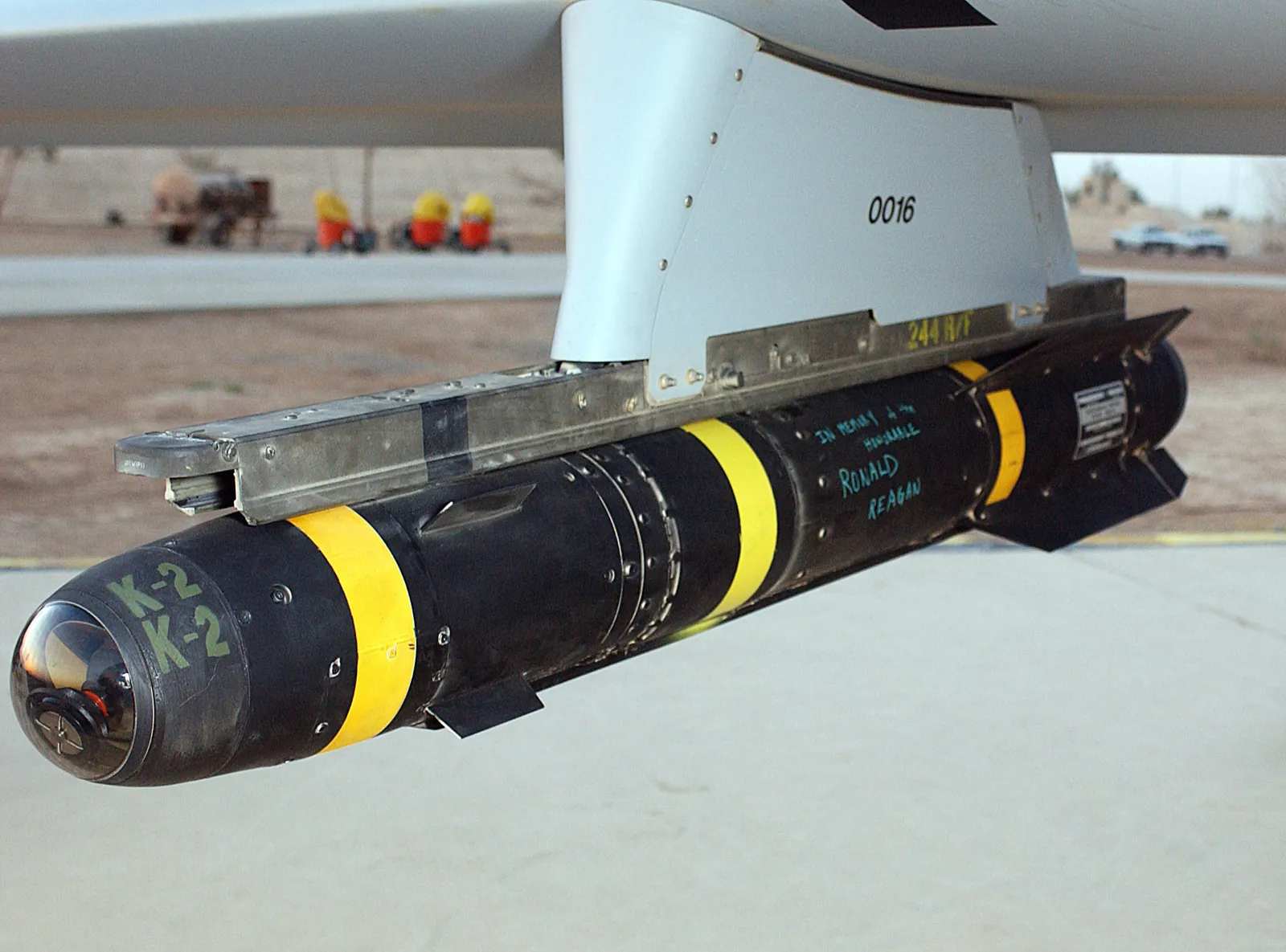
In production since the 1980s, the AGM-114 Hellfire is the most widely fielded missile in this class. Depending on the version it weighs 45-49 kg, and open sources credit it with roughly 8-9 km range from helicopters and up to about 11 km from high-altitude launch. Guidance follows two main lines: semi-active laser (SAL) versions, and the fire-and-forget AGM-114L Longbow with a millimetre-wave radar seeker.
Hellfire is integrated on the AH-64 Apache, MQ-1 Predator, MQ-9 Reaper and a long list of helicopters, drones, naval and ground platforms. Its production scale, allied user base and decades of combat records are its defining advantages. Its successor, the JAGM (Joint Air-to-Ground Missile), is entering service progressively.
The table below places the three systems side by side using open-source data. Values shift with variant and launch platform, so they are given as ranges; no single row should be read as a superiority ranking.
How the guidance philosophies diverge
The three systems answer the lock-on problem in three different ways. UMTAS and Spike both use imaging seekers that keep the operator in the loop after launch; the difference is the datalink medium — RF for UMTAS, fibre-optic cable for classic Spike versions, with Spike-ER2 moving to RF. This architecture allows post-launch target confirmation and helps reduce collateral risk. Hellfire’s mainline versions instead rely on laser designation: the shooter or a third platform must keep the target painted, a dependency the radar-seeker Longbow removes.
L-UMTAS mirrors Hellfire’s SAL logic on a Turkish airframe, meaning the ROKETSAN family offers both imaging and laser guidance on a single missile body.
Platform ecosystems and the export picture
Hellfire’s biggest asset is decades of production and ready integration across the Apache-Predator-Reaper line. Spike has built one of the widest user networks through European co-production. UMTAS has a younger ecosystem, but it rides on Turkey’s fastest-growing export platforms — the T129 ATAK and the Bayraktar TB2 — giving buyers of those aircraft a munition option that does not depend on US or Israeli export approval.
ROKETSAN has not officially named UMTAS/L-UMTAS export customers; open-source reporting links its use abroad to T129 and TB2 deliveries.
Combat records and operational maturity
Combat history is a decisive reference in this class. Hellfire has been fired in nearly every major US and allied operation since 1991, giving it the largest data set by tens of thousands of launches. The Spike family has matured through exercises and operational use across many armies. On the UMTAS/L-UMTAS side, open sources report employment — particularly of L-UMTAS — from T129 ATAK helicopters and armed drones in cross-border operations, and ROKETSAN markets the missile as combat-proven.
Operational maturity is not only launch counts but integration depth: Hellfire is certified on dozens of platforms, Spike is licence-produced in Europe, and UMTAS carries the advantage of having been developed in lockstep with Turkey’s own platform family. Maintenance, training and logistics chains follow the same pattern across the three systems.
Bottom line: which system fits which need?
The objective picture is this: Hellfire is the reference system of the class in scale, combat record and platform breadth. Spike-LR/ER is the most mature operator-in-the-loop family with one of the broadest export networks. UMTAS competes through a modern IIR-plus-RF architecture, a laser variant on the same airframe and a supply chain integrated with Turkish air platforms. Range and weight sit in the same band across all three; procurement decisions in this class usually hinge on platform fit, supply security and cost rather than raw performance.
This comparison relies on open sources. The 16-50 km range figures circulating for UMTAS-GM appear only in secondary sources and have not been officially confirmed by ROKETSAN. Spike and Hellfire values vary by version, launch platform and flight profile; table figures should be read as ranges. No claim of superiority is intended for any system.
Frequently Asked Questions
What are the main rivals of UMTAS?
The principal rivals in the long-range ATGM class are Israel’s Rafael Spike-LR/ER family and the American AGM-114 Hellfire. All three are guided missiles with tandem HEAT warheads, launched mainly from helicopters and drones.
Does Hellfire outrange UMTAS?
Baseline UMTAS reaches 0.5-8 km, while Hellfire achieves roughly 8-11 km depending on version and launch profile — largely the same band. The 16-50 km figures cited for UMTAS-GM come only from secondary sources and remain officially unconfirmed.
What is the key difference between UMTAS and Spike?
Both use imaging seekers; the difference is the datalink. UMTAS uses an RF datalink for fire-and-update, while classic Spike versions use a fibre-optic cable (Spike-ER2 has moved to RF). Spike also enjoys a much larger export network.
What is L-UMTAS?
L-UMTAS is the semi-active laser-guided version of the UMTAS airframe, functionally equivalent to Hellfire’s SAL versions. Its combat use from T129 ATAK helicopters and UAVs is documented in open sources.
Which platforms can launch UMTAS?
The primary platform is the T129 ATAK attack helicopter; the missile is also integrated on the Bayraktar TB2 UAV, ground vehicles and naval helicopters. For countries buying these platforms, UMTAS offers a munition free of US or Israeli export licensing.
Who operates UMTAS?
The confirmed operator is the Turkish Armed Forces. ROKETSAN has not officially disclosed export customers; open sources link foreign use to T129 and TB2 deliveries.
Sources
- ROKETSAN official product page (UMTAS) — roketsan.com.tr
- Rafael Advanced Defense Systems — Spike family — rafael.co.il
- AGM-114 Hellfire — Wikipedia
- Spike (missile) — Wikipedia
- UMTAS — Wikipedia
- Army Technology — UMTAS/L-UMTAS project profiles — army-technology.com