Ukraine’s Gripens Will Carry France’s AASM Guided Bombs

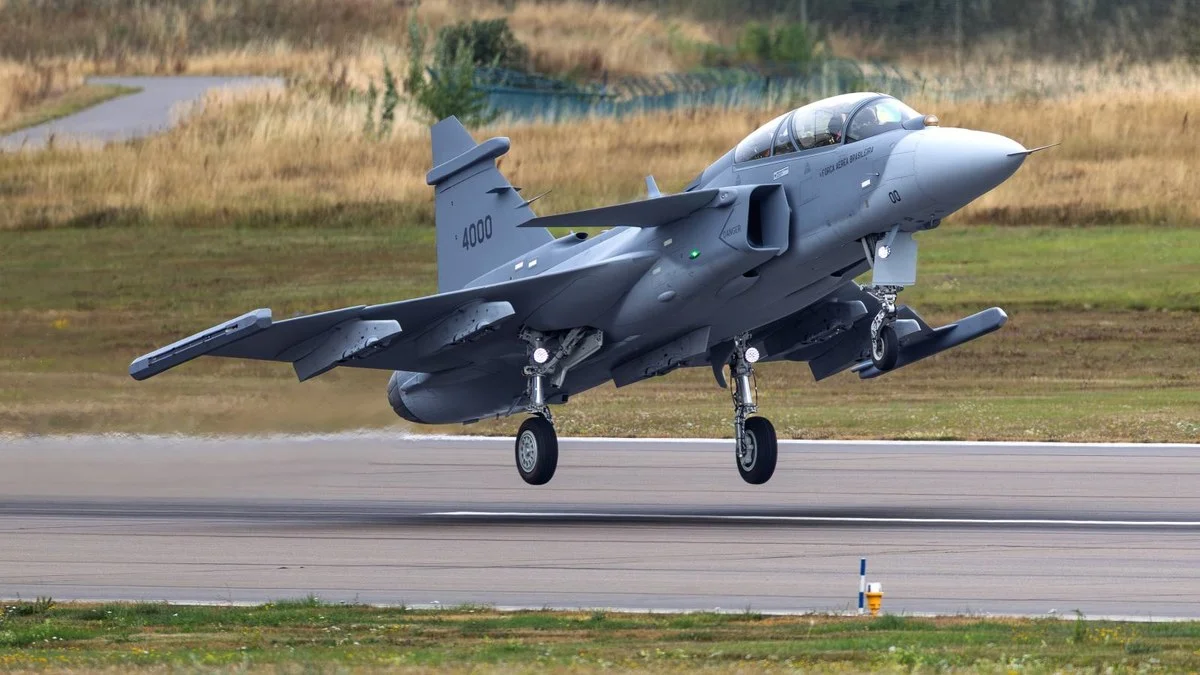
The Swedish-built Gripen fighters heading for Ukraine’s Air Force are to be modified to carry France’s AASM precision guidance kits. The decision surfaced during French Defence Minister Alice Rufo’s visit to Kyiv and was reported in the French press.
Integration work is under way, with French and Swedish engineers adapting the AASM to the Gripen. The long-range Meteor air-to-air missile is also cited as compatible with the Ukrainian aircraft.
Ukraine’s two-layer Gripen deal
Ukraine’s Gripen acquisition runs on two tracks. The first is 16 JAS-39 Gripen C/D aircraft from Sweden — used airframes that can be brought into service quickly, functioning as an interim capability. The second is an order placed in June for 16 Gripen E/F, a substantially different aircraft with new-generation avionics, the more powerful F414 engine and expanded payload capacity.
The C/D aircraft arrive while the E/F batch is still in production. The structure is designed to give Ukraine fleet depth in the short term and a capability jump later.
What AASM brings
AASM — Armement Air-Sol Modulaire — is a guidance and range-extension kit built by Safran. Fitted to a standard Mk 82-class unguided bomb, it adds three things: GPS/inertial guidance, glide range from deployable wings, and additional velocity from a rocket motor. Released at low altitude it reaches roughly 15 kilometres; from high altitude, up to 70.
For Ukraine, range is not the whole story. Electro-optical and laser-guided variants of the kit continue to function under GPS jamming. The dense electronic warfare environment Russia maintains along the front degrades the accuracy of weapons wholly dependent on satellite navigation, which gives multi-mode seekers a practical edge.
How the chain was built
President Emmanuel Macron announced in January 2024 that “several hundred” AASM would go to Ukraine. Over the following year the kit was integrated onto Ukraine’s Soviet-legacy fleet — MiG-29, Su-27 and Su-25 — with that work complete by January 2025.
In July, France authorised Ukraine to produce AASM, SCALP cruise missiles and Aster 30 interceptors under licence, and published a roadmap for delivering 16 Rafale fighters between 2027 and 2028.
The Gripen integration follows naturally. As Ukraine transitions from Soviet-legacy aircraft to Western platforms, it wants to carry across the French munitions already in its inventory and its stockpile. Without that, every platform transition would require rebuilding the weapons stock from scratch.
The engineering problem
Integrating a weapon onto a new aircraft is not a matter of hanging it on a pylon. The mission computer has to recognise the store, pass target data in the correct format, compute the release envelope and present the right symbology to the pilot. Gripen’s avionics architecture is comparatively open to this; Saab has consistently argued that the aircraft was designed as a software-defined platform and that new weapon integrations can be measured in weeks.
Against that, AASM is a French system using the NATO-standard MIL-STD-1760 interface, while Gripen’s stores management software runs on Swedish source code. Bringing two national programmes together at the software layer is an administrative process as much as a technical one, and export licences and source-code access usually take longer than the engineering.
What it says about Ukraine’s air force
This integration is a textbook case of Ukraine’s mixed-procurement model. The country now operates American F-16s, French Mirage 2000-5s, Swedish Gripens and Soviet-legacy MiG-29s and Su-27s simultaneously, with American, French, British and domestic munitions layered on top. Logistically this is extremely difficult. It also removes dependence on any single supplier — a decisive consideration in managing political risk during a war.
For European industry, the development is a concrete instance of Franco-Swedish cooperation taking shape on the Ukrainian front. France is also seeking cooperation with Sweden on pilot training. Gripen and Rafale compete directly in the European fighter market; sharing a munitions chain in Ukraine shows how far operational necessity outranks that competition.
Sources
- Statements by French Defence Minister Alice Rufo during her Kyiv visit, as reported by Le Figaro, 14 September 2026
- Opex360, “Les futurs avions Gripen ukrainiens seront modifiés pour emporter des Armements Air-Sol Modulaires français”, 14 September 2026
- French presidency announcement on AASM supply, January 2024; licensed production authorisation, July 2026