Uganda’s Military Strength 2026: Personnel, Budget and Turkey’s Growing Defense Footprint


Uganda’s Military Strength 2026: Personnel, Budget and Turkey’s Growing Defense Footprint
The Uganda People’s Defence Force (UPDF) fields around 45,000–50,000 active personnel and a defense budget in the $1.1–1.5 billion range, built around an aging but numerically large Soviet-era tank fleet, a small Su-30MK2-led air force, and a long track record of expeditionary deployments in Somalia, South Sudan and the DR Congo. Since 2019, Turkey has become a small but growing supplier — starting with Hizir mine-protected vehicles and now expanding into training agreements and talks over a local defense-manufacturing hub.
Contents
- Uganda’s military strength at a glance
- Personnel and defense budget
- Force structure: land, air and marine units
- Equipment inventory
- Deployments: Somalia, DR Congo, South Sudan
- Turkey’s footprint: Hizir MRAPs and the push for a local hub
- A note on Global Firepower
- FAQ
- Sources
Uganda’s military strength at a glance
| Metric | Figure | Source / year |
|---|---|---|
| Active personnel | ~45,000 (plus reserves and local defense units) | DefenceWeb / Wikipedia, 2022–2025 |
| Paramilitary | ~10,000 | Global Firepower, 2026 |
| Defense budget | $1.1–1.5 billion (estimates vary by source) | SIPRI-derived (2024) vs. Global Firepower (2026) |
| Budget as % of GDP | ~1.5–1.8% | SIPRI-derived estimates |
| Main battle tanks | ~260–320 (T-90S, T-72, T-55, Type 85-II-M, PT-76) | DefenceWeb / Global Firepower, 2025–2026 |
| Combat aircraft | ~6 fighters (Su-30MK2), plus MiG-21/23 in reserve status | Global Firepower, 2026 |
| Helicopters | ~30 total, including Mi-24/35 attack and Mi-17 transport types | Global Firepower, 2026 |
| Navy | Landlocked; ~200-strong Marine Unit operating on Lake Victoria and Lake Albert | DefenceWeb |
Because Uganda’s Ministry of Defence and Veteran Affairs does not publish a full, itemized order of battle, the figures above are drawn from a mix of specialist defence-industry trackers and SIPRI-derived budget estimates rather than a single official Ugandan source — treat exact unit counts as informed estimates, not government-confirmed totals.
Personnel and defense budget
Estimates of UPDF active personnel cluster around 45,000, with DefenceWeb’s most recent profile update (November 2025) breaking this down as roughly 40,000 in the Land Forces, 1,200 in the Air Force and around 200 Marines, alongside reserve and Local Defence Unit personnel that are harder to quantify from open sources. Global Firepower’s 2026 edition adds a separate paramilitary estimate of around 10,000.
Defense spending estimates diverge more than personnel figures. SIPRI-derived reporting places Uganda’s 2024 military expenditure at roughly $1.1 billion, or about 1.8% of GDP — broadly consistent with the steady rise from $286 million in 2009 to $408 million in 2018 that DefenceWeb’s profile documents. Global Firepower’s own 2026 budget figure, by contrast, is notably higher at roughly $1.5 billion. Neither figure is drawn from a single published Ugandan government budget line for defense, so this guide presents both with their source rather than picking one as definitive.
Force structure: land, air and marine units
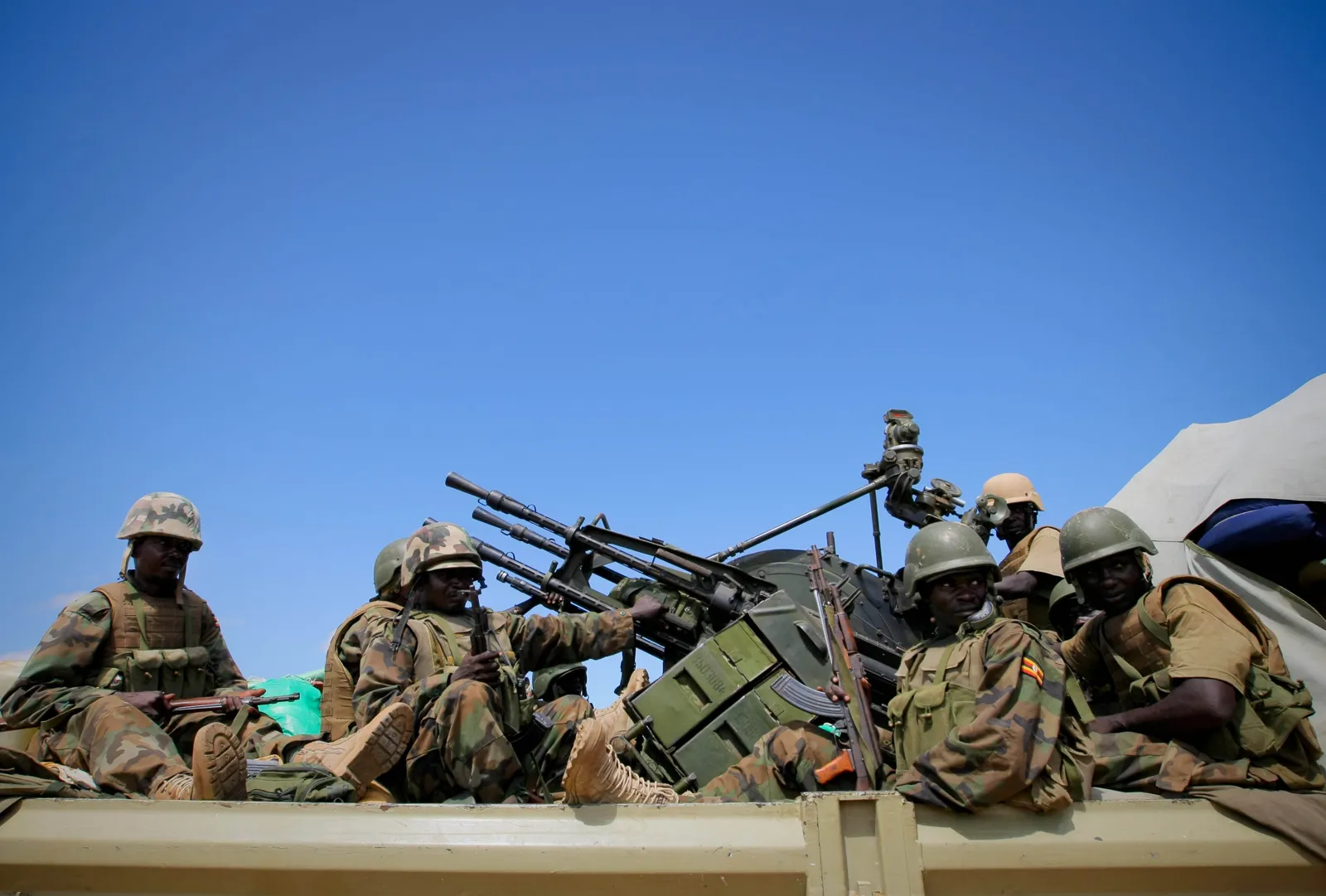
The UPDF Land Forces are organized around five division headquarters, with roughly 16 infantry brigades plus dedicated armoured, motorised infantry, artillery, engineer, commando and air-defense formations, and a Presidential Guard Brigade. The small Uganda People’s Air Force operates Uganda’s fixed-wing and rotary combat aircraft, while a Marine Unit of around 200 personnel covers Lake Victoria and Lake Albert — Uganda has no coastline, so this lake-patrol role substitutes for a conventional navy. The Special Forces Command, which also handles close protection duties, is generally described by regional defence outlets as the UPDF’s most modernized and best-equipped branch.
Equipment inventory
Uganda’s tank fleet is unusually large and equally unusually mixed in vintage: DefenceWeb and Global Firepower both converge on a total near 260–320 tanks, combining modern Russian-built T-90S (around 44 units) and T-72 variants with large residual holdings of T-55s, a handful of Chinese Type 85-II-M tanks, and PT-76 amphibious light tanks. Infantry fighting vehicles and armored personnel carriers include BMP-2s, BTR-60/80s, and smaller numbers of Western-origin vehicles such as Marder IFVs and BvS10 all-terrain carriers reported in various open-source inventories.
The air force’s combat backbone is a small squadron of Su-30MK2 multirole fighters, supplemented by older MiG-21s and MiG-23BNs that are widely reported to have limited serviceability. Rotary-wing assets include Mi-24/35 attack helicopters and Mi-17 transports, which have seen extensive use in counter-insurgency and peacekeeping deployments. Artillery holdings span towed 122mm, 130mm and 155mm systems alongside a modest number of self-propelled and multiple-rocket-launcher systems.
This inventory is overwhelmingly of Russian, Soviet-era and Chinese origin, with smaller contributions from South Africa, Israel and Western suppliers over the decades — which is what makes Turkey’s recent, still-modest entry into the market notable rather than routine.
Deployments: Somalia, DR Congo, South Sudan
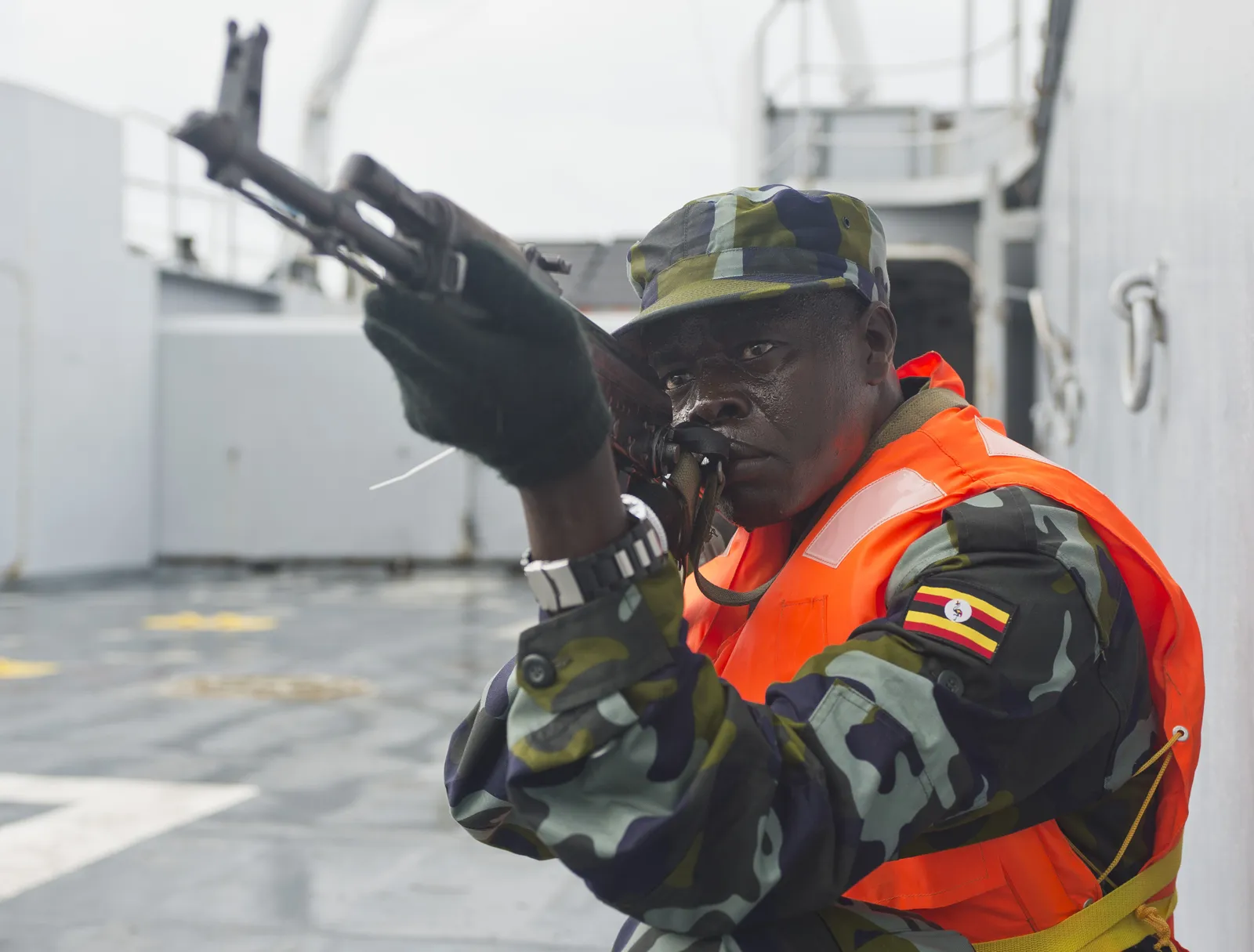
Uganda has been the largest and longest-serving troop contributor to the African Union’s Somalia mission (AMISOM, now the African Union Support and Stabilization Mission, AUSSOM), deploying more than 6,200 soldiers at various points since 2007 and taking a leading role in operations against al-Shabaab, including Operation Indian Ocean in 2014. Ugandan forces have also mounted repeated operations in eastern DR Congo and, alongside South Sudan’s neighbors, deployed troops from December 2013 to help stabilize the country and evacuate Ugandan nationals during the South Sudanese civil war. The UPDF was also a lead contributor to the multinational Central Africa Regional Task Force that pursued the Lord’s Resistance Army across South Sudan, DR Congo and the Central African Republic between 2011 and 2016.
Turkey’s footprint: Hizir MRAPs and the push for a local hub
Turkey’s defense-industrial relationship with Uganda dates to a June 2016 cooperation agreement signed during President Erdoğan’s visit to Kampala, covering production, procurement, maintenance, modernization, logistics and information-sharing. The relationship’s first confirmed hardware outcome came in 2019–2020, when Uganda ordered and received 30 Katmerciler Hizir 4×4 mine-resistant, ambush-protected (MRAP) vehicles — a delivery recorded in SIPRI’s arms transfers database rather than announced in detail by either government.
A separate, larger 2020 deal reportedly involving Otokar Arma 8×8 and Cobra II 4×4 armored vehicles, valued around $110 million, has been reported by regional defence press but was denied by the manufacturer, so this guide treats it as an unverified claim rather than a confirmed order — a useful reminder that not every reported Turkish-Africa deal reaches delivery.
Cooperation has since broadened beyond hardware. A Military Training Cooperation Agreement signed in 2022 covers exchange programs and specialized instruction for the Ugandan Army and its special forces in areas such as counter-IED work, cyber defense and intelligence. In December 2024, Uganda and Turkey held their fourth Uganda-Türkiye Defence Industries Cooperation meeting in Kampala, where Ugandan officials reportedly pressed Ankara to help establish a domestic defense-manufacturing hub covering drone and artillery components — a proposal that, as of this writing, remains under discussion rather than confirmed. Turkish firms including ASELSAN and Otokar have also exhibited at regional defense fairs such as BAMEX 2025 in Bamako, part of a wider pattern of Turkish outreach across West and East Africa; ASELSAN alone now describes a presence spanning some 21 African countries. On the lower end of the relationship, Turkish textile and uniform suppliers have used trade missions, including a July 2026 Turkish Exporters’ Assembly visit to Kampala, to court Uganda’s security-sector procurement — the kind of entry point that has preceded larger equipment deals for Turkish firms elsewhere on the continent, such as Nigeria’s broader shift toward Turkish armored vehicles and drones.
For now, Uganda’s confirmed Turkish inventory is limited to the 30 Hizir MRAPs — a fraction of the fleet size seen in Rwanda’s larger Cobra II holdings or Nigeria’s Turkish hardware mix. Whether Uganda moves from a training and trade-fair relationship to a larger equipment program will likely depend on how the manufacturing-hub talks progress and on Uganda’s broader defense-budget trajectory.
A note on Global Firepower
Global Firepower is not an official military data source; it is a privately compiled index that scores over 60 indicators (personnel, equipment counts, financial and logistical factors, geography and natural resources) into a single PwrIndx score. Its 2026 edition places Uganda 107th of 145 ranked countries with a PwrIndx score of 2.3252 (0.0000 is the index’s theoretical “perfect” score), and Uganda was among 14 African countries that improved their ranking versus the 2025 edition. Where this guide cites Global Firepower figures for equipment counts or budget, it is flagged as such; independent corroboration comes from SIPRI’s arms-transfers and military-expenditure databases and from specialist trackers such as DefenceWeb.
FAQ
How large is Uganda’s military?
The Uganda People’s Defence Force has roughly 45,000 active personnel, plus reserves, local defense units and an estimated 10,000 paramilitary personnel per Global Firepower’s 2026 count.
What is Uganda’s defense budget?
Estimates range from about $1.1 billion (SIPRI-derived, 2024, roughly 1.8% of GDP) to about $1.5 billion (Global Firepower, 2026). Uganda does not publish a single itemized defense budget that reconciles these figures.
Does Uganda operate Turkish military equipment?
Yes, but on a small scale so far: 30 Katmerciler Hizir 4×4 MRAPs delivered in 2020 are the only confirmed Turkish hardware in UPDF service. A larger 2020 Otokar Arma/Cobra II deal has been reported but denied by the manufacturer, and a 2022 training agreement plus ongoing talks over a local manufacturing hub point to a deepening but still early-stage relationship.
Where has the UPDF been deployed?
Uganda has been the largest troop contributor to the African Union mission in Somalia since 2007, and has also deployed in eastern DR Congo, South Sudan, and against the Lord’s Resistance Army across Central Africa between 2011 and 2016.
Is Global Firepower’s ranking an official measure of Uganda’s military strength?
No. It is a privately run index useful for broad comparison, not a government or defence-ministry data source. This guide uses it alongside SIPRI and specialist defence-industry reporting rather than as a standalone figure.
Sources
- DefenceWeb, “Uganda People’s Defence Force” country profile (updated November 2025)
- DefenceWeb, “Uniforms today, drones tomorrow: Turkish firms probe Uganda’s defence ambitions” (July 2026)
- Global Firepower, “2026 Uganda Military Strength”
- Stockholm International Peace Research Institute (SIPRI), Arms Transfers Database and Military Expenditure Database
- Wikipedia, “Uganda People’s Defence Force” (cross-checked against DefenceWeb and SIPRI for figures used here)
- Africa Intelligence, reporting on the December 2024 Uganda-Türkiye Defence Industries Cooperation meeting (via DefenceWeb, January 2025)
Last updated: September 2026.