TRG-300 KAPLAN Guided Missile: Range, Block Variants, Operators

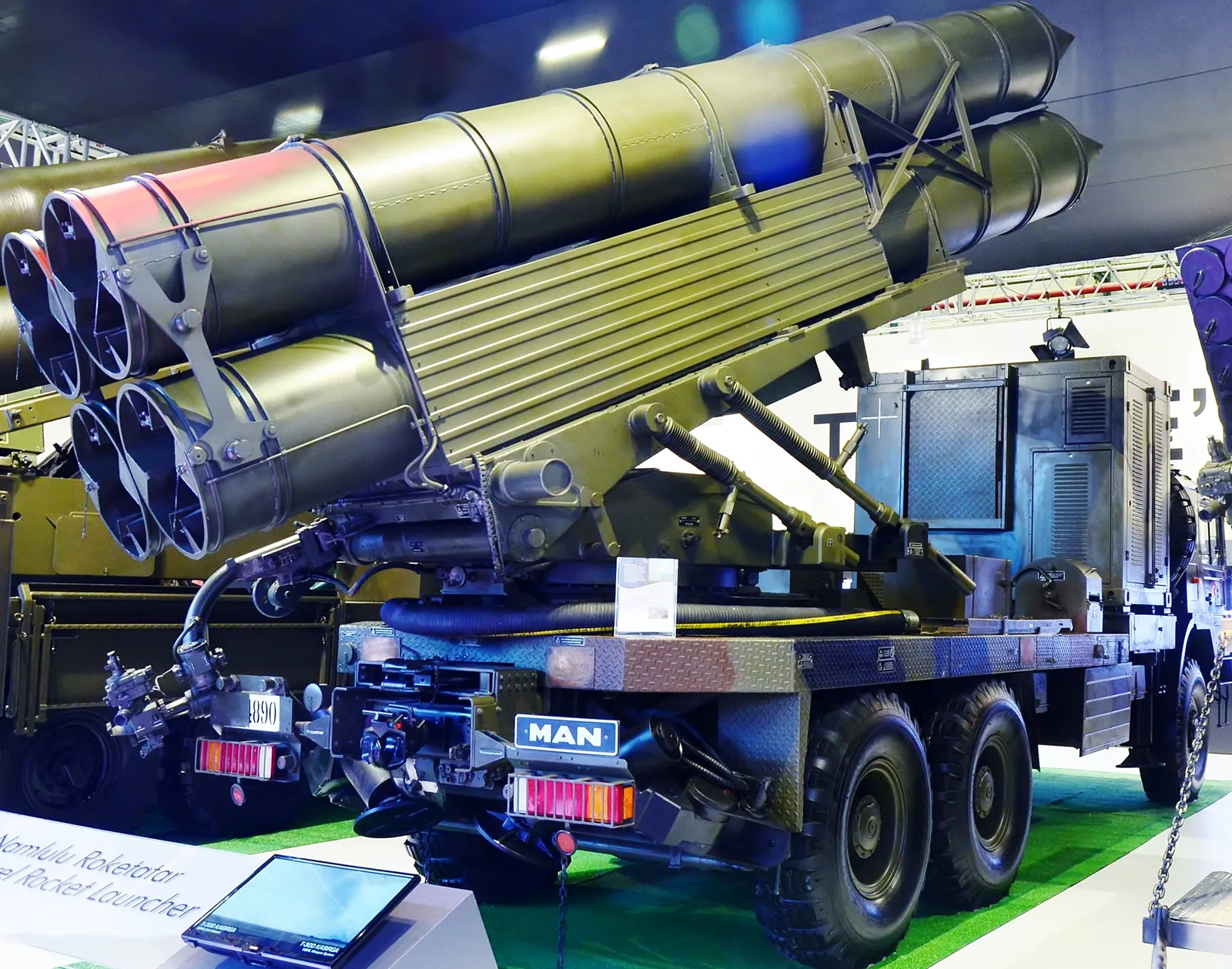
The TRG-300 (KAPLAN) is a 300 mm guided missile developed by Türkiye’s ROKETSAN. It is the guided successor to the unguided T-300 Kasırga and serves as the munition of the KAPLAN multiple launch rocket system. Using GPS+GLONASS-aided INS guidance, it achieves a CEP of 10 m or better. Block 1A reaches 30-120 km with a 105 kg warhead; Block 2 covers 20-90 km with a 180 kg warhead. Open sources report exports to Azerbaijan, Bangladesh, the UAE and Libya.
| TRG-300 KAPLAN — At a Glance | |
|---|---|
| Category | 300 mm guided missile / heavy guided rocket |
| Developer | ROKETSAN (Türkiye) |
| System | KAPLAN MBRL — guided successor to T-300 Kasırga |
| Entered service | ~2014-2016 (first export delivery to Azerbaijan, 2016) |
| Range | Block 1A: 30-120 km · Block 2: 20-90 km |
| Speed | Not officially disclosed |
| Weight | Block 1A: 585 kg · Block 2: 660 kg |
| Length / diameter | Block 1A: 5.6 m · Block 2: 6 m / 300 mm |
| Warhead | HE + steel balls; Block 2: 180 kg, effective radius ≥80 m |
| Guidance | GPS+GLONASS-aided INS, CEP ≤10 m |
| Propulsion | Composite solid propellant |
| Platform | MAN 6×6 truck, 4 pods; ROKETSAN MCL compatible |
| Operators (open sources) | Türkiye, Azerbaijan, Bangladesh, UAE, Libya |
What is the TRG-300 KAPLAN?
The TRG-300 is a 300 mm guided missile developed by ROKETSAN and fielded as the munition of the KAPLAN multiple launch rocket system. It is the guided evolution of the T-300 Kasırga, an unguided 300 mm rocket system in Turkish service since the early 2000s. By adding satellite-aided precision guidance to the same calibre class, ROKETSAN transformed an area-saturation weapon into a system capable of striking point targets.
The practical difference is decisive. Unguided 300 mm rockets are effective only when fired in salvos across a wide area, whereas the TRG-300 delivers a circular error probable (CEP) of 10 metres or less — accurate enough to engage an individual building, bridge, radar site or command post. That precision cuts ammunition expenditure and reduces the risk of collateral damage.
The missile is produced in two main variants. Block 1A stretches the range envelope to 120 km with a 105 kg warhead, while Block 2 sacrifices some reach to carry a far heavier 180 kg warhead. Together they give a battery commander a choice, from the same launcher, between longer reach and greater destructive effect.
One point of frequent confusion deserves correction: the year 2000 sometimes cited in open sources refers to the carrier T-300 system, not the guided missile. The TRG-300 itself entered the inventory around 2014-2016, with the first known export delivery going to Azerbaijan in 2016.
Technical specifications and how it works
Both variants share a common architecture: a 300 mm composite solid-propellant rocket motor, an inertial navigation system (INS) aided by GPS and GLONASS, and a high-explosive warhead loaded with steel balls for fragmentation effect. Solid propellant allows long storage life and rapid firing with minimal preparation.
Block 1A is 5.6 m long and weighs 585 kg; with its 105 kg warhead it covers 30-120 km. Block 2 is 6 m long and weighs 660 kg; its 180 kg warhead limits range to 20-90 km. Some sources quote the Block 2 warhead at 150 kg, but ROKETSAN’s current materials state 180 kg. The Block 2 warhead has an effective radius of 80 metres or more, meaning a single missile can blanket a substantial target area with fragmentation.
The engagement sequence is straightforward: target coordinates are loaded before launch; during flight the INS continuously computes the missile’s position while GPS+GLONASS updates correct accumulated drift; aerodynamic control surfaces steer the missile along the computed trajectory to a terminal accuracy of CEP ≤10 m. The missile’s maximum speed has not been officially disclosed.
The range-payload trade-off is the heart of the system’s tactical flexibility: Block 1A reaches targets 120 km deep, while Block 2 is the choice against hardened or high-value targets closer to the front line.
The TRG-300 competes in the class of 300 mm guided artillery rockets and short-range precision missiles. The table below summarises its closest international counterparts; performance figures are drawn from open sources and should be read with caution.
Platforms, operators and exports
The TRG-300’s standard launch platform is the KAPLAN multiple launch rocket system: a MAN 6×6 tactical truck carrying four missile pods, with a combat weight of roughly 23 tonnes. The wheeled chassis allows the battery to displace quickly after firing, a key survivability measure against counter-battery fire. The missile is also compatible with ROKETSAN’s Multi Calibre Launcher (MCL) architecture, which can mix munitions of different calibres on a common launcher family.
According to open sources, the operator list stands as follows:
- Türkiye: in Turkish Armed Forces inventory.
- Azerbaijan: 20 vehicles; the first known export customer, delivered in 2016.
- Bangladesh: 36+ vehicles; deliveries completed in June 2021.
- United Arab Emirates: 3 vehicles (open-source reporting).
- Libya: 4+ vehicles (open-source reporting).
This customer base — stretching from the Caucasus to South Asia and the Gulf — makes the TRG-300 one of ROKETSAN’s most widely exported guided systems and demonstrates operational use across very different climates and terrain.
Place in Türkiye’s defence industry: strengths and limits
The TRG-300 marks one of the first major steps in Türkiye’s transition from unguided rocket artillery to precision-guided fires. The 300 mm airframe and launcher experience gained with the T-300 Kasırga was married to indigenous guidance technology, producing a domestic answer to the HIMARS-style concept. That foundation now underpins ROKETSAN’s broader guided-missile family, from the laser-guided TRLG-230 to the TAYFUN ballistic missile.
Its main strengths are a proven export record, the Block structure that offers two range-payload profiles from the same launcher, and MCL compatibility. The Block 2 warhead, at 180 kg, is heavier than most counterparts in this class and gives a clear advantage against fortified targets.
The limits should be stated just as plainly: several key figures, including speed, remain officially undisclosed; satellite-aided guidance can degrade in heavy GPS/GLONASS jamming environments; and the range falls well short of ATACMS-class or TAYFUN-class ballistic missiles. The TRG-300 is therefore best understood as a weapon optimised for operational-tactical depth, not strategic strike.
The year 2000 seen in some open sources refers to the carrier T-300 Kasırga system, not the guided missile: the TRG-300 entered service around 2014-2016, with the Azerbaijan delivery in 2016. ROKETSAN’s materials give the Block 2 warhead as 180 kg, while some sources cite 150 kg. The missile’s speed is not officially disclosed. Export operators (Azerbaijan, Bangladesh, UAE, Libya) are reported by open sources, not confirmed by official announcements.
Frequently Asked Questions
What is the range of the TRG-300 missile?
It depends on the variant: Block 1A reaches 30-120 km with a 105 kg warhead, while Block 2 covers 20-90 km with a 180 kg warhead. Range and warhead weight trade off against each other.
Which countries operate the TRG-300?
Besides Türkiye, open sources report Azerbaijan (20 vehicles, 2016), Bangladesh (36+ vehicles, 2021), the UAE (3 vehicles) and Libya (4+ vehicles) as operators.
What platform launches the TRG-300?
It is fired from the KAPLAN MBRL, a MAN 6×6 tactical truck carrying four missile pods with a combat weight of about 23 tonnes. The missile is also compatible with ROKETSAN’s Multi Calibre Launcher (MCL).
What are the TRG-300’s closest rivals?
The American GMLRS/ER-GMLRS, Israeli EXTRA, Iranian Fateh-110 class and Chinese PHL-03 guided munitions are the systems most often compared with it.
When did the TRG-300 enter service?
Around 2014-2016, with the first export delivery to Azerbaijan in 2016. The year 2000 cited in some sources belongs to the unguided T-300 Kasırga carrier system.
What is the difference between Block 1A and Block 2?
Block 1A is lighter (585 kg, 5.6 m) and reaches 120 km with a 105 kg warhead; Block 2 is heavier (660 kg, 6 m) and carries a 180 kg warhead over 20-90 km, with an effective radius of 80 m or more.
Sources
- ROKETSAN official product page — roketsan.com.tr
- Wikipedia — TRG-300 Tiger
- GlobalSecurity.org — TRG-300 system profile
- Army Technology — TRG-300 Tiger Multiple Launch Rocket System