What is the AIM-120 AMRAAM? NATO’s Standard Beyond-Visual-Range Air-to-Air Missile, Explained

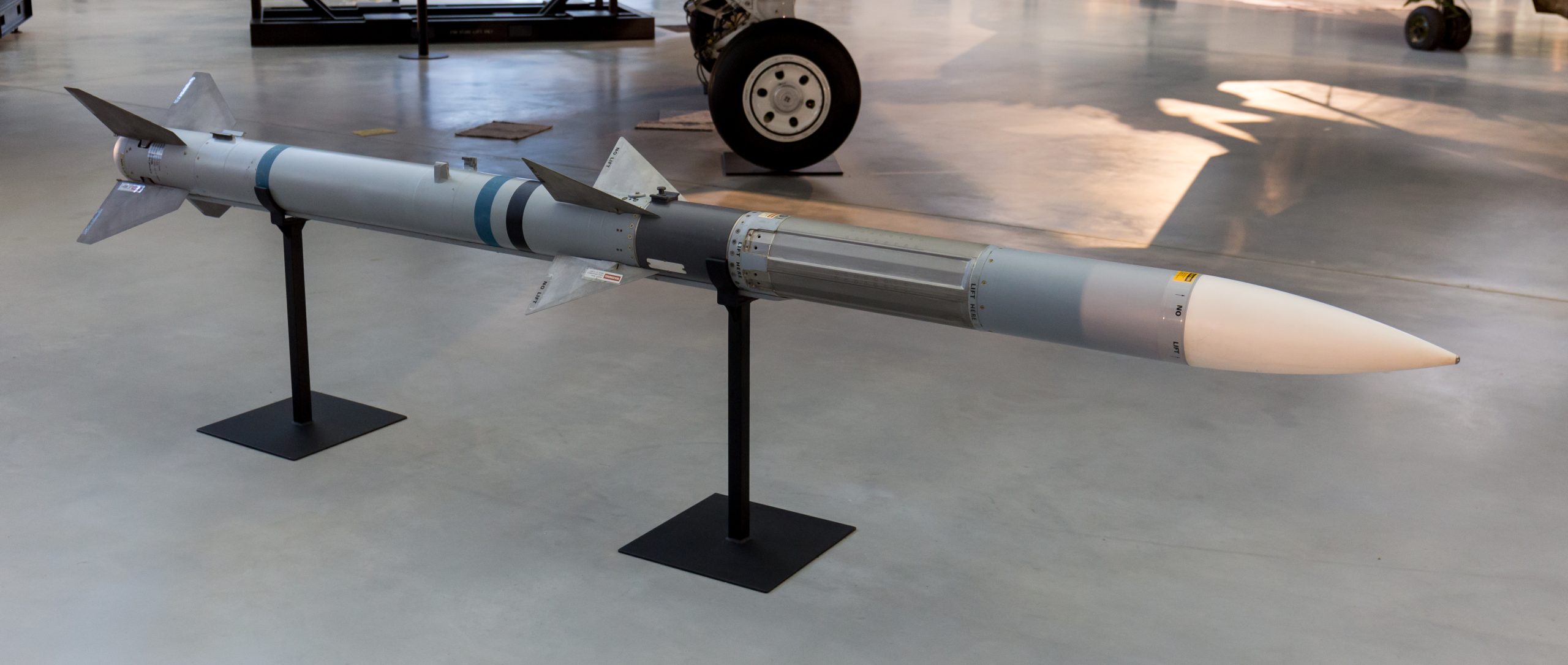
The AIM-120 AMRAAM (Advanced Medium-Range Air-to-Air Missile) is the Western beyond-visual-range (BVR) standard, built by Raytheon (RTX). With more than 30,000 rounds produced, AMRAAM is now in service with 40+ air forces and is responsible for the great majority of Western air-to-air missile kills since the late 1990s. The current AIM-120D-3 variant extends range past 160 km and adds two-way data link for cooperative engagement, while the next-generation AIM-260 JATM (joint Air Force / Navy program) is entering service to replace AMRAAM through the late 2020s.
Key facts at a glance
| Attribute | Value |
|---|---|
| Type | Beyond-visual-range air-to-air missile |
| Manufacturer | Raytheon (RTX) |
| In service | 1991 — present |
| Length | 3.66 m |
| Diameter | 178 mm |
| Weight | 152 kg (AIM-120D) |
| Range | 50 km (AIM-120A); 105 km (C-5/7); 160+ km (D / D-3) |
| Speed | Mach 4 |
| Guidance | INS + mid-course command (two-way datalink on D); active X-band radar terminal homing |
| Warhead | 18.1 kg blast-fragmentation |
| Operators | 40+ countries on F-15, F-16, F/A-18, F-22, F-35, Eurofighter, Gripen, F-CK, KF-21, AMX, and NASAMS ground-launchers |
| Unit cost | ~ USD 1.1 million (D-3, FY2024) |
Variants
| Variant | Year | Key feature |
|---|---|---|
| AIM-120A | 1991 | Initial production; 50 km range |
| AIM-120B | 1994 | Reprogrammable warhead and motor |
| AIM-120C-5 | 2000 | Clipped fins for F-22 internal carriage; 105 km range |
| AIM-120C-7 | 2006 | Improved guidance, jam resistance |
| AIM-120D | 2008 | Two-way datalink, GPS-aided INS, 160+ km |
| AIM-120D-3 | 2021 | System Improvement Program 3 — new processor, expanded software |
| AIM-120 / NASAMS | 1998 | Surface-launched AMRAAM in NASAMS battery |
| AIM-120-ER | 2022+ | Surface-launched with extended-burn booster; ground- and ship-launch |
Combat record
- 27 December 1992. First AMRAAM kill — USAF F-16D shot down an Iraqi MiG-25 over the southern no-fly zone.
- 17 January 1993. Second kill — another Iraqi MiG-23.
- 1994 — Bosnia. USAF F-16C downed four Serbian J-21 Jastreb ground-attack aircraft.
- 1999 — Kosovo. Dutch and U.S. F-16s used AMRAAM to down at least four Serbian MiG-29s.
- 2008–2018 — Yemen / Saudi Arabia. Saudi F-15s claimed multiple AMRAAM-equipped engagements against Yemeni Houthi cruise missiles and drones.
- 2017 — Syria. Australian F/A-18 confirmed AMRAAM kill of a Syrian Su-22. Same year, U.S. F/A-18E downed an Iranian-built Shahed drone.
- 2018 — Syria. Israeli F-16 used a different missile, but Israeli F-15s have separately used AMRAAM against Syrian drones.
- 2023 — Red Sea. USAF F-15Es engaged Houthi-launched UAVs and cruise missiles with AMRAAM rounds — the missile’s first sustained anti-cruise-missile combat use.
- 2023–present — Ukraine. NASAMS batteries delivered to Ukraine intercepted hundreds of Russian cruise missiles and drones using AMRAAM C-7/D rounds.
NASAMS: AMRAAM as a surface-launched SAM
Beyond air-to-air, the AMRAAM is the primary missile of the NASAMS (National Advanced Surface-to-Air Missile System) family — co-developed by Norway’s Kongsberg and Raytheon. NASAMS uses standard AIM-120C-7 or D rounds in canisters on truck-mounted launchers, providing 25–50 km range SAM coverage. Operators include Norway, Spain, Netherlands, Australia, Lithuania, Qatar, Oman, Hungary, Indonesia and Ukraine. The U.S. White House and the Capitol complex have been defended by NASAMS since 2005.
The AIM-260 JATM successor
Recognizing the increasing maximum-range superiority of the Chinese PL-15 and Russian R-37M, the U.S. Air Force and Navy launched the AIM-260 Joint Advanced Tactical Missile (JATM) program in 2017. Lockheed Martin won the prime contract. Reported attributes include 200+ km range, new dual-pulse rocket motor, enhanced datalink, and form-factor compatibility with the F-22 and F-35 internal bays. First operational deliveries reportedly began in 2022; full operational capability is forecast for 2026. The AIM-260 is intended to complement, not immediately replace, AMRAAM through the 2030s.
How AMRAAM compares
| AIM-120D-3 AMRAAM | MBDA Meteor | R-77-1 / RVV-SD | PL-15 (China) | |
|---|---|---|---|---|
| Range | 160 km | 200+ km | 110 km | 200+ km |
| Motor | Single solid pulse | Throttleable ramjet | Dual-thrust solid | Dual-pulse solid |
| Datalink | Two-way | Two-way | One-way | Two-way |
| Seeker | X-band active AESA (D-3) | X-band active | X-band active | X-band AESA |
| Combat record | Heavy | None public | Ukraine | None public |
Production today
Raytheon’s Tucson missile facility produces roughly 1,200 AMRAAMs per year. Following the Ukraine NASAMS drawdowns, Congress funded an expansion to 1,500 rounds per year by 2026, with a long-term capacity target of 2,000 rounds. The new AMRAAM-ER ground-launched variant — paired with NASAMS launchers — entered low-rate production in 2023 and is being delivered to Norway, the Netherlands and Lithuania.
Why AMRAAM matters
For more than three decades, AMRAAM has been the missile that turned BVR combat from theory into the dominant air-to-air doctrine. It is the only Western air-to-air missile with sustained combat-confirmed kills since 1992; it is the centerpiece of NATO surface-to-air doctrine through NASAMS; and its replacement, the AIM-260 JATM, will be built around the same launch interfaces. Whatever comes next, the AMRAAM family — in air-to-air, surface-to-air and now extended-range configurations — will remain in production at least through the 2030s.