ROKETSAN SOM and SOM-J: Turkey’s Stand-Off Cruise Missile Family, Explained

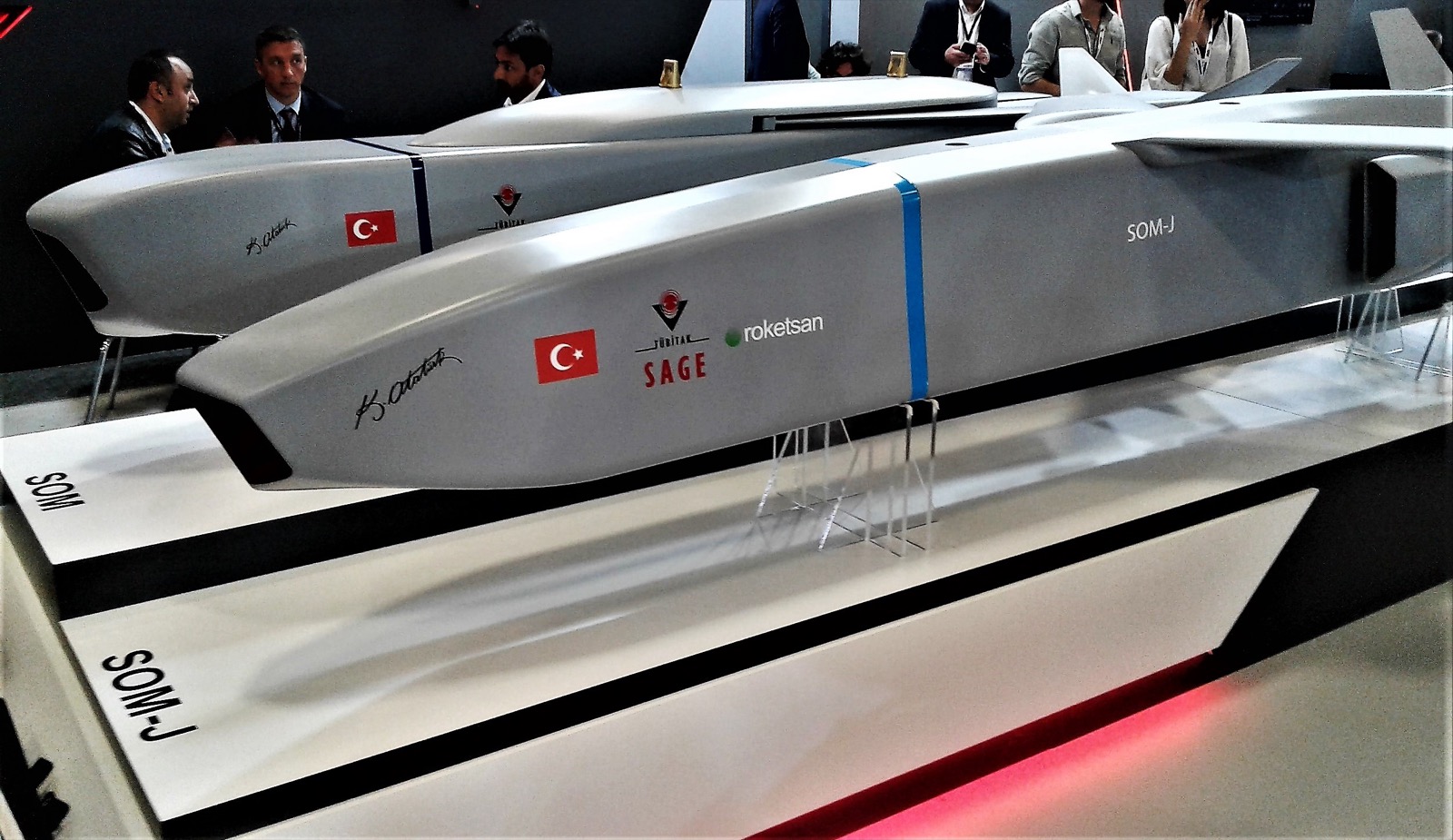
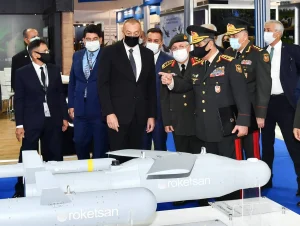
Image: ROKETSAN SOM-J (foreground) and SOM (background) cruise missiles on display. Photo by CeeGee, Wikimedia Commons, CC BY-SA 4.0.
Air strikes used to be a knife-fight. A pilot would push deep into hostile airspace, line up the target, drop a bomb, and try to escape before the enemy radar locked on. Modern air defences have ended that game: a Patriot battery or an S-400 can keep a fighter at arm’s length for hundreds of kilometres. So the war moved further out. The pilot now wants to release the weapon while still safely outside the threat ring, and let the weapon do the dangerous part. That is the job of a stand-off missile — and in the Turkish inventory, that job is done by the SOM family.
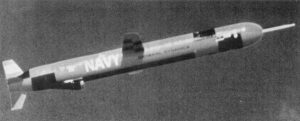
SOM (Stand-Off Mühimmatı, “stand-off munition”) is a long-range, autonomous, low-observable cruise missile developed jointly by ROKETSAN and TÜBİTAK SAGE. Once it leaves the wing of an F-16 or a Bayraktar AKINCI drone, it flies itself: terrain-hugging, GPS-checked, image-matching, with a thermal seeker for the final dive onto the target. It is built specifically to hit defended deep-strike targets — command bunkers, air-defence batteries, ships at sea — from beyond their reach.
The variant that earned international attention is SOM-J. It was designed from the start to fit inside the internal weapons bay of an F-35 Lightning II — a rare distinction for any non-American munition. Together, SOM and SOM-J are Turkey’s first homegrown air-launched stand-off cruise missiles, and they put the country into a club whose other members are the United States, France, the United Kingdom, Germany, Sweden, Russia and China.
The SOM Family at a Glance
To translate the numbers: SOM can be fired from a fighter that is still more than 250 km away from the target — well outside the engagement range of most modern surface-to-air missiles. It flies low enough to slip below radar coverage and uses an imaging-infrared seeker to match the actual target against the picture it was given before launch, which means it tends to land within metres of the intended aim point even if jammed.
What SOM Actually Does
The Drone-Launched World Record
In 2021, a Bayraktar AKINCI drone released a SOM-A cruise missile against a target — the first cruise-missile launch from an unmanned aerial vehicle anywhere in the world. That single flight was a tangible proof that the Turkish drone-and-munition ecosystem had crossed a line nobody else had crossed yet. Until that day, cruise-missile delivery had been the exclusive job of manned aircraft. With AKINCI plus SOM-A, that assumption was over.
Specifications — SOM vs SOM-J
| Specification | SOM | SOM-J |
|---|---|---|
| Length | ~4.0 m | ~3.9 m |
| Weight | ~600 kg | ~540 kg |
| Warhead Weight | ~230 kg | ~140 kg |
| Warhead Type | High-explosive fragmentation; tandem penetrator on SOM-B2 | HE, fragmentation or armour-piercing |
| Range | 250 km (135 nmi) | 275 km (150 nmi) |
| Guidance | INS + GPS + image-matching + automatic target recognition + IIR seeker | INS + GPS + TERCOM + image matching + IIR seeker |
| Speed | Subsonic | Subsonic |
| Platforms | F-4, F-16, AKINCI drone | F-35 (internal bay), F-16, KAAN (planned) |
Variants and Platforms
- SOM-A — the baseline land-attack variant with a high-explosive fragmentation warhead.
- SOM-B1 — anti-ship version with an imaging-infrared seeker.
- SOM-B2 — penetrator warhead for hardened targets like bunkers and command posts.
- SOM-C1 — image-based seeker variant for land targets.
- SOM-J — the F-35 internal-bay variant, shorter and lighter than baseline SOM.
- SOM-T (planned) — longer-range development using domestic engine options.
The launch platforms are equally diverse: the Turkish Air Force’s F-16 Fighting Falcons are the standard carriers; modernised F-4E 2020 Terminators were the first test platform back in 2011; the Bayraktar AKINCI drone proved the world-first UAV-launched cruise missile shot; KAAN and HÜRJET are on the integration roadmap. SOM-J was designed in partnership with Lockheed Martin for the F-35 — that partnership was paused when Washington removed Turkey from the F-35 programme, though SOM-J’s design heritage remains intact.
How SOM Compares Internationally
| Missile | Maker / Country | Range |
|---|---|---|
| SOM / SOM-J | ROKETSAN — Türkiye | 250 / 275 km |
| AGM-158 JASSM | Lockheed Martin — USA | 370+ km |
| Storm Shadow / SCALP-EG | MBDA — UK/France | 250+ km |
| KEPD 350 Taurus | Taurus Systems — Germany | 500+ km |
| RBS-15 Mk4 | Saab — Sweden | 300+ km |
Why It Matters for Turkey
SOM and SOM-J are the air-launched backbone of a wider Turkish stand-off strike portfolio that has slowly come together over the past decade: ATMACA for ship-to-ship and land-launched coastal defence; the planned GEZGİN for long-range cruise strike; the TAYFUN ballistic missile for the deeper targets. Together they put Turkey into the small group of countries that build their own stand-off precision-strike inventory at home, instead of buying it from a supplier whose export rules can change overnight.
The export angle matters too. Negotiations have been reported with multiple NATO and partner countries — Azerbaijan, Pakistan, Poland — looking for a stand-off missile that is not subject to US ITAR re-export licences. SOM is one of the few credible non-American options on that menu.
Summary
| Name | SOM and SOM-J |
|---|---|
| Builder | ROKETSAN and TÜBİTAK SAGE |
| Class | Air-launched, low-observable, subsonic stand-off cruise missile |
| Range | SOM 250 km, SOM-J 275 km |
| Guidance | Inertial + GPS + terrain-matching + image-matching + thermal seeker |
| Platforms | F-16, F-4, AKINCI / F-35 and KAAN (SOM-J) |
| Historic moment | 2021 — first-ever cruise-missile launch from a UAV (AKINCI + SOM-A) |
Sources: