Russians working for Ukraine and the hidden network of the intelligence war

On 19 October, the BBC World Service released “Shadowmen: Russians Working With Ukraine”, a documentary based on two years of work by Polish journalist Marcin Mamoń. Two Russian citizens, introduced under the pseudonyms “Ivan” and “Foma”, describe taking part in operations against military targets inside Russia together with Ukraine’s military intelligence agency (HUR).
The level of certainty is limited. According to the BBC, HUR confirmed that both men work with the agency. Their roles in the operations they describe, however, cannot be independently verified, and Ukraine does not officially claim targeted killings. Their identities were withheld, their voices re-recorded and their images altered with artificial intelligence. What we have, then, is the account of anonymous sources plus partial confirmation from an intelligence service. No official Russian response to the documentary could be found.
The scale of the network and Moscow’s response
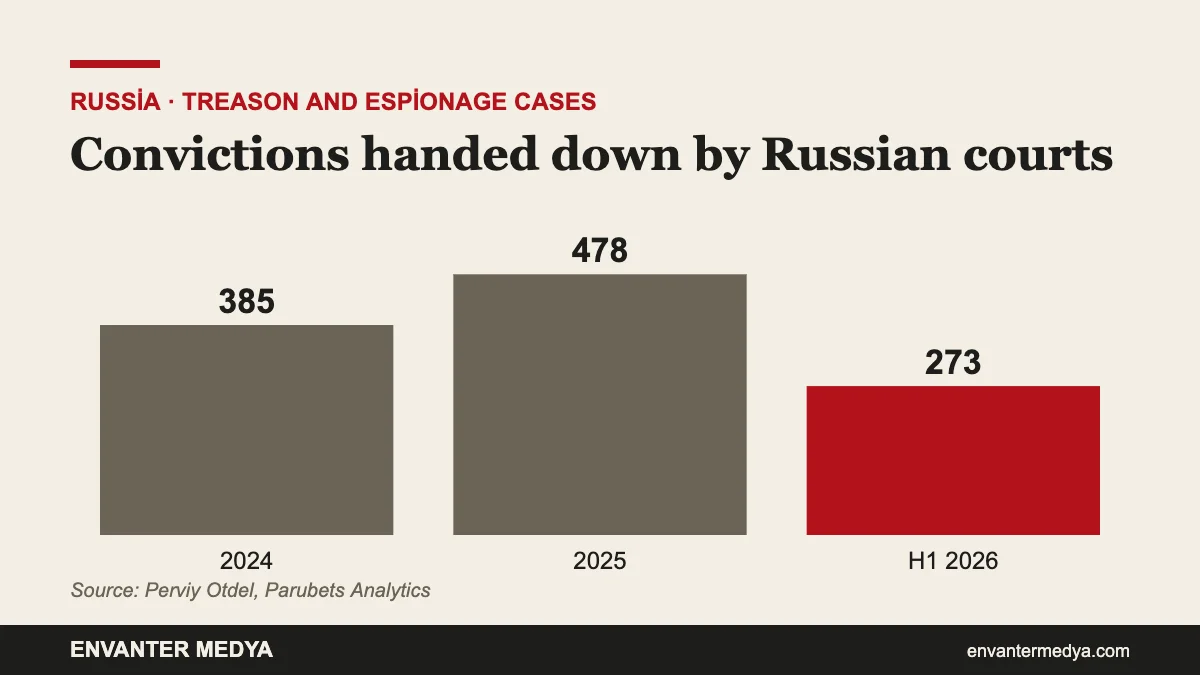
Foma estimates that 300 to 500 Russians are doing this kind of work for Ukraine. The figure cannot be verified. On the Russian side, however, there is measurable data. According to the rights project Perviy Otdel, Russian courts handed down 478 convictions in 2025 on charges of treason, espionage, confidential cooperation with foreigners and aiding the enemy, up from 385 in 2024. In the first half of 2026 there were 273 convictions, 26 percent more than in the same period a year earlier. Meduza reported that the median sentence rose from 12 to 15 years and that not a single acquittal was recorded in such cases in 2025.
The two numbers do not mirror each other. How many of the Russian convictions involve real networks is unknown. Still, the figures show how seriously Moscow views the internal threat and how much it relies on harsh sentences as a deterrent.
The operations described and the independent data
Ivan says he told Mamoń about preparations for a major operation against strategic bombers roughly a year in advance, without ever revealing where or when. In “Operation Spiderweb” on 1 June 2025, Ukraine’s Security Service (SBU) struck four air bases with 117 FPV drones smuggled into Russia in trucks. Ukraine said 41 aircraft were hit. Two US officials told Reuters that about 20 aircraft were hit and around 10 destroyed. SBU chief Vasyl Malyuk, who oversaw the operation, said its first and hardest component was getting the equipment into enemy territory, and that each operative knew only his own part.
Foma believes Ivan was involved in the June 2025 strike on the drone factory in Yelabuga. Ukraine’s General Staff confirmed that strike; Ivan’s role has not been confirmed. Foma also admits that his network tracked Lieutenant General Fanil Sarvarov, who was killed by a car bomb in Moscow in December 2025. A Ukrainian intelligence officer had earlier told the BBC that Ukraine was behind the killing of Lieutenant General Igor Kirillov in December 2024.
How the network is built
According to Foma, his network has about three dozen members. Some of them work from outside Russia on support tasks such as tracking digital footprints. HUR proposes targets, the team checks the data independently, and Foma says his people do not take part in attacks directly. Ivan says the network has no clear structure and that he has never met his collaborators in person.
This points to a classic cell structure. In a network where everyone knows only their own piece, a single arrest is less likely to expose the whole. There is a cost, though: in such a structure it is also harder to verify who can be trusted. Strong inference: the spread of long-range drones has not reduced the value of human intelligence. Target verification and moving equipment close to the target still depend on people working on the inside.
The double-agent question
The most striking part of the documentary is the question of Ivan’s reliability. The BBC was surprised that, despite his opposition past, he could leave and re-enter Russia frequently. His Ukrainian handler said he could not rule out that Ivan also works for Russian intelligence, either voluntarily or under pressure. The BBC’s counterargument: had Ivan been working for the FSB, he would likely have passed on the plan to strike the bombers.
The possible explanations:
- He works for one side only (Foma’s view): he exploits gaps in the Russian system’s controls.
- He has been detected but is being watched (speculation): Russian services may have left him free in order to map the network.
- He is passing information to both sides under pressure (possibility): the scenario raised by his own Ukrainian handler.
The documentary does not answer this question, and it cannot be answered with the available data.
What was known and what is new
Sabotage and assassinations inside Russia have long been known, but the perpetrators’ own accounts were rarely accessible. Units fighting openly against the Kremlin, such as the Russian Volunteer Corps (RDK), were also known. What is new is that the accounts of people working on the inside have reached the public together with personal confirmation from an intelligence service. It shows that the “deep strike” dimension of the war depends not only on technology but also on ideologically motivated insiders.
The legal and strategic dimension
Russia classifies these activities as terrorism. Ukraine defends strikes on military facilities, energy infrastructure and commanders as a legitimate military strategy. According to the BBC, civilians have also been killed in some drone strikes inside Russia; one person was reportedly killed in the Yelabuga strike. Target selection and civilian harm will remain at the centre of this debate.
Strategically, these networks pull Russia’s internal security resources away from the front: perimeter security at air bases, vehicle checks, communications and digital surveillance. There is a counter-effect too. Harsher sentences and broader surveillance may make volunteers harder to recruit. Which country will face a similar test is unknown. But drones pre-positioned near targets, combined with insider help, stand out as a threat model every military should consider for the security of critical sites.
What is known and what is not
Known
- According to the BBC, HUR confirmed that Ivan and Foma work with the agency.
- 117 drones were used in Operation Spiderweb. Damage estimates differ between Ukrainian and US sources.
- Espionage and treason convictions in Russia hit a record in 2025 and kept rising in 2026.
Unknown
- The real number of Russians working for Ukraine.
- Ivan’s and Foma’s exact roles in the operations they describe.
- Whether Ivan is a double agent.
- How many of the Russian convictions are linked to real networks.
Indicator to watch
The most concrete way to measure the impact of these networks is to track two datasets together. The first is the frequency of strikes on military and industrial sites deep inside Russia. The second is the conviction data Perviy Otdel will publish for the second half of the year. If convictions rise while the strikes continue, the question to ask is this: is Moscow catching the real networks, or only making the sentences harsher?
Sources
- BBC (via Yahoo News): https://ca.news.yahoo.com/inside-shadowy-world-anti-putin-000636904.html
- Intelnews: https://intelnews.org/2026/11/07/01-3468/
- Podcast Rex: https://podcastrex.com/shows/the-documentary-podcast/shadowmen-russians-working-with-ukraine
- Novaya Gazeta Europe: https://novayagazeta.eu/en/articles/2026/06/08/russia-convicted-nearly-500-people-on-espionage-related-charges-last-year-en-news
- Memorial: https://memopzk.org/en/news/kolichestvo-del-za-gosizmenu-i-shpionazh-v-etom-godu-prevysilo-chislo-del-za-vse-dovoennye-gody-pervyj-otdel/
- Meduza: https://meduza.io/en/feature/2025/12/22/a-grim-new-record
- Kyiv Independent: https://kyivindependent.com/reuters-ukraine-struck-fewer-russian-bombers-during-operation-spiderweb-than-estimated-us-officials-claim
- Interfax-Ukraine: https://ua.interfax.com.ua/news/general/1082175.html