Russia Sends 453 Drones at Western Ukraine, Hitting a Kyiv-Warsaw Train

Russia pushed its drone campaign away from the front line overnight on 12-13 September, concentrating on western Ukrainian regions that normally see far fewer attacks. Ukraine’s Air Force said 453 drones of various types and S8000 “Banderol” missiles were launched, and that 405 drones plus four Banderols had been shot down or suppressed by 08:00.
A passenger train near the Polish border
Regional authorities reported at least six civilians killed and 43 injured across the country over 24 hours. The incident that drew the sharpest political reaction was a drone strike on a Kyiv-Warsaw passenger train close to the Polish border — civilian transport infrastructure, on a line running into a NATO member state.
Ukraine’s General Staff put the 24-hour total at 863 drones, one of the heaviest windows of the war.
The composition of the swarm
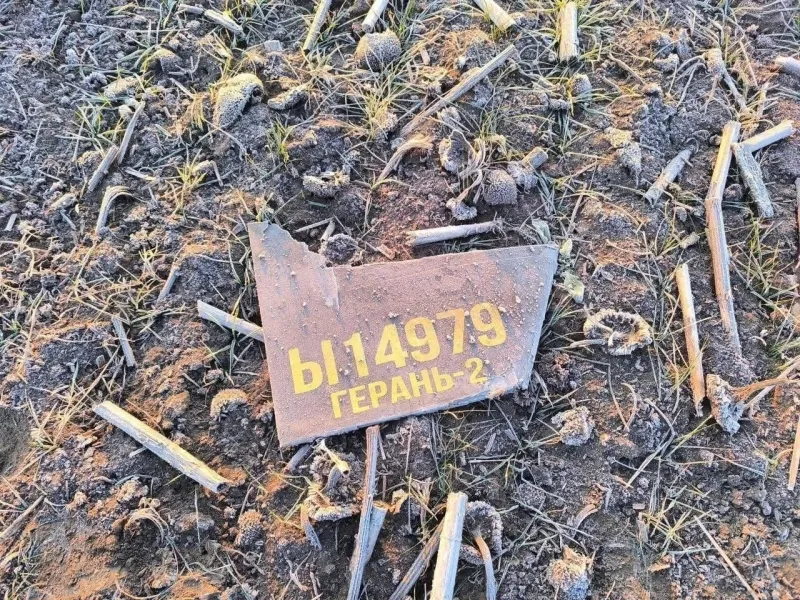
According to the Air Force, the wave combined Geran-2 airframes — the Russian-built Shahed-136 derivative — with cheaper Gerbera decoys and “Parodiya” deception drones. Jet-powered Shahed variants were also in the mix, widening the speed spread the defence has to cover.
That blend is deliberate. Decoys crowd the radar picture and drain interceptors and gun ammunition; the warhead-carrying airframes follow behind the screen. Ukraine’s roughly 90 percent attrition rate is high by any standard, but the damage caused by the handful of leakers is the reminder that percentages are not the whole story.
Heavy cloud cover during the attack added a further complication, limiting visual acquisition and the helicopter and light-aircraft interception that has become a staple of Ukraine’s low-altitude defence.
Cheap threat, expensive answer
Nights like this are the evidence base for a debate that has accelerated across Europe. Bringing down an airframe worth tens of thousands of dollars with a missile worth several hundred thousand is not sustainable at scale. In the same week, MBDA and Poland’s WITU announced completion of seeker trials for CMI, a low-cost supersonic interceptor aimed squarely at that gap.
Ukraine’s own answer has leaned toward mobile fire teams, short-range air defence, electronic warfare and — increasingly — interceptor drones, the most mature expression of meeting a swarm in its own price class.
Regional read
Coming days after Russian drones crossed into Polish airspace on 10 September, a strike this close to the border keeps NATO’s eastern flank agenda hot. Allies have already stepped up dispersed-basing drills and low-altitude air picture work.
For Türkiye, two threads stand out. The Shahed family’s saturation model has become a fixed feature of the Black Sea threat picture, raising the priority of layered defence over coastal and energy infrastructure. And the search for an affordable interceptor is opening a market that Turkish work in guided munitions, short-range air defence and directed energy intersects directly.
Sources
- Ukrainian Air Force Command daily air situation report, 13 September 2026
- General Staff of the Armed Forces of Ukraine, 24-hour summary, 13 September 2026
- Defence Blog, 13 September 2026