E-2D Advanced Hawkeye Block II clears critical design review
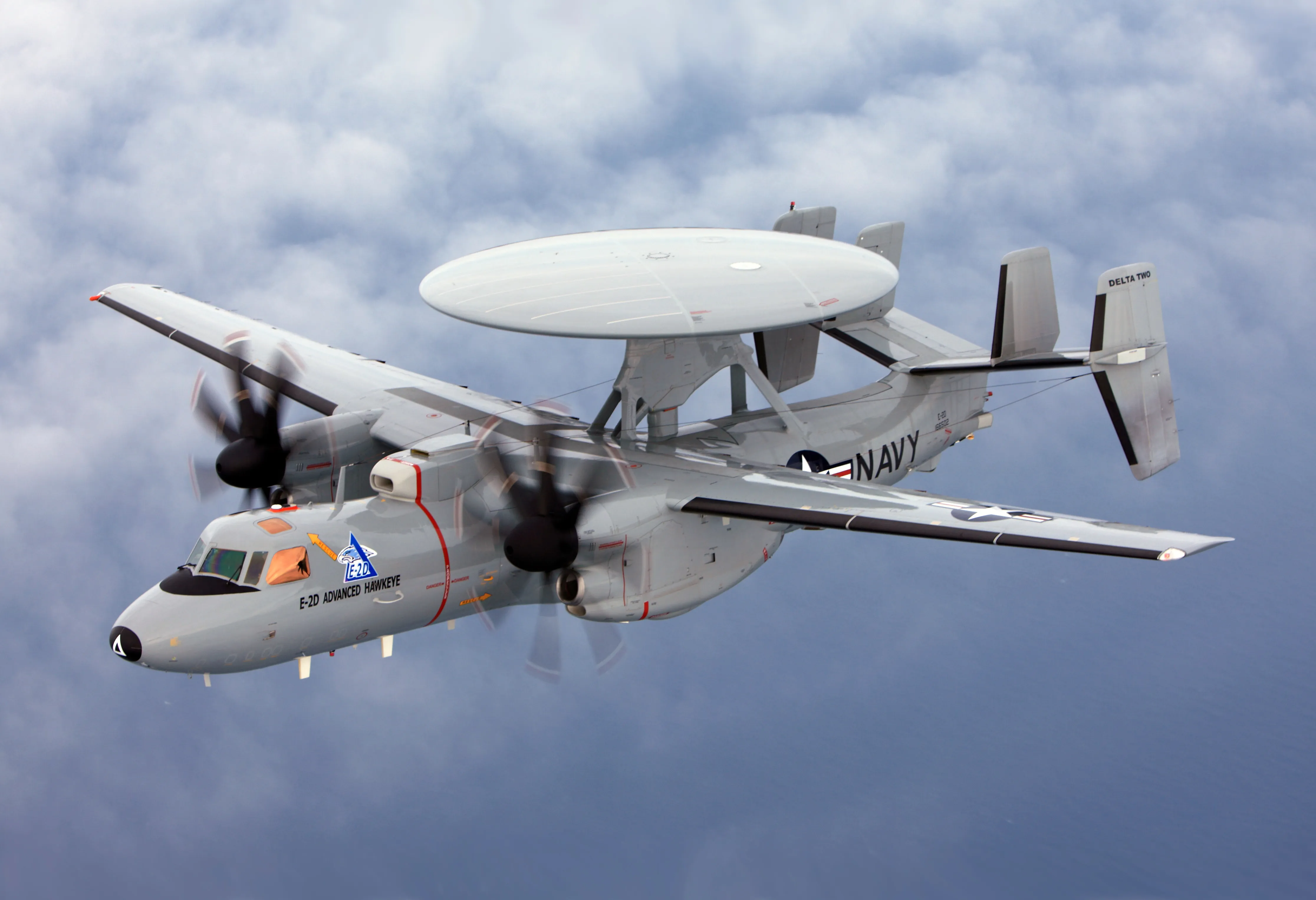
The path is now clear for a decade-long modernisation of the US Navy’s carrier-based airborne early warning fleet. The Navy has announced that Northrop Grumman’s E-2D Advanced Hawkeye Block II programme cleared its critical design review in May, formally moving the effort out of the design phase and clearing the way for retrofit work to begin.
Why the E-2D matters
The E-2D Advanced Hawkeye is the Navy’s principal carrier-capable airborne early warning and command-and-control aircraft. The AN/APY-9 active electronically scanned array radar carried in its rotodome extends the task force’s field of view far beyond the horizon limit of shipborne sensors. In practice the aircraft is the first warning ring against low-flying cruise missiles and hostile aircraft.
That role makes it far more than a radar platform. The E-2D also functions as a battle management node, directing fighters, sharing targeting data with shipboard air defence systems and assembling the common air picture for the strike group.
What Block II changes
Block II is described as the most extensive modernisation yet for an aircraft that first flew in 2007. According to the Navy, the upgrade introduces a state-of-the-art cockpit architecture, increased computing power, an open mission systems framework and hardened cybersecurity.
The most strategically significant element is the shift to open architecture. The Navy states that retrofitting the fleet with an open mission systems architecture resolves current and future parts obsolescence while enabling rapid, non-proprietary technology insertion. In practical terms, a new sensor, data link or software capability can be added in far shorter cycles than a conventional multi-year integration programme.
Northrop Grumman, for its part, argues that modular systems and commercial off-the-shelf products will lower long-term sustainment costs. The revised cockpit and flight systems are intended to reduce crew cognitive load so aircrew can concentrate on more demanding battlespace management tasks.
Janice Zilch, Northrop Grumman vice president and E-2D Advanced Hawkeye programme manager, said the upgrade enhances situational awareness, reduces crew workload and paves the way for future technology.
Schedule
With CDR complete, Northrop Grumman has authority to begin fitting the new capabilities. Flight testing is slated for fiscal year 2029. The company says integration and testing will begin immediately, with the first Block II aircraft due for delivery by the end of the decade.
Block II changes will be inserted into the active E-2D production line and retrofitted to aircraft already in service. That two-track approach is intended to limit the sustainment and training burden that would otherwise arise from operating a split-standard fleet.
Operational context
The timing is not incidental. As long-range air defence systems and cruise missiles proliferate, how early a carrier strike group detects a threat directly determines the performance of everything downstream in the defensive chain. Against a sea-skimming cruise missile, every minute gained translates into additional engagement opportunities for the defending ships.
Beyond the US Navy, the type is operated by Japan and France. Japan has been expanding its E-2D fleet to build an air picture over the East China Sea and the Western Pacific.
The wider lesson
Türkiye meets its airborne early warning requirement with Boeing 737-based E-7T Peace Eagle aircraft; it operates no carrier-based early warning platform. As the use of TCG Anadolu as a drone carrier continues to be discussed, however, the question of how a maritime air picture would be assembled remains open, with radar and battle management packages carried by uncrewed platforms among the approaches under consideration.
The broader lesson of Block II concerns architecture rather than hardware: the lifetime value of an early warning aircraft now depends less on radar range than on how quickly its sensors and software can be updated.
Sources
- US Navy announcement, 17 August 2026
- Northrop Grumman corporate statement
- DefenseScoop