Military Power of Czechia: How Many Tanks, Aircraft and Ships Are in the Inventory? (2026)

Czechia’s military inventory captures the army of a country of 10.9 million with one of Central Europe’s strongest defence industries at a moment of transition. Czechia ranks 55th out of 145 countries in the Global Firepower 2026 index with a PwrIndx score of 1.0313; the inventory holds 103 military aircraft, 53 self-propelled howitzers and no naval platforms at all. What makes the picture interesting is that almost every major class is changing at the same time: Soviet-generation T-72s have been moved to reserve and replaced by Leopard 2A4s from Germany and Switzerland, most of the BVP armour went to Ukraine and will be replaced by Swedish CV90s, and the Gripens leased from Sweden will fly until 2035 before 24 F-35As take over. This article works through Czechia’s land, air, missile and naval inventory line by line using open sources, and examines the link with the Turkish defence industry built in 2026 around co-production rather than sales.
At a Glance
- Active personnel: Global Firepower gives 30,334 active personnel, to which 4,900 active reservists and 8,475 civilian employees are added. Conscription was abolished in 2004 and the force has been fully professional since 1 January 2005
- Main battle tanks: Global Firepower gives 20; open-source inventory lists record 42 Leopard 2A4s delivered from Germany and Switzerland between 2022 and 2026 plus 30 T-72M4CZs moved to reserve. 44 Leopard 2A8s are on order
- Military aircraft: 103 (Global Firepower): 12 fighters, 16 attack aircraft, 10 transports, 21 trainers, 42 helicopters and 4 attack helicopters. The fighter fleet consists of Gripens leased from Sweden; 24 F-35As are on order
- Self-propelled howitzers: 53 (Global Firepower): all Czechoslovak-built 152 mm DANA vz. 77s, of which 48 are active in two artillery battalions. None of the 62 CAESAR 8x8s meant to replace them had been delivered as of June 2026
- Naval platforms: 0. Czechia is landlocked and Global Firepower leaves the naval line empty. The only military capability on water consists of the engineer units’ pontoon bridge sets and pusher boats
- Defence budget: Global Firepower gives 9.174 billion dollars. The 2026 state budget allocates roughly 155 billion Czech crowns to the Ministry of Defence, around 1.7 percent of GDP and below the 2.35 percent planned by the previous cabinet
Note: The inventory figures below are approximate values drawn from open sources such as Global Firepower, the IISS Military Balance and SIPRI.
About the Czechia Armed Forces
The Czech Armed Forces have five components: Land Forces, Air Force, Territorial Forces, Information and Cyber Forces and Special Forces. Land Forces Command sits at Olomouc; the combat core is formed by the 4th Rapid Deployment Brigade at Zatec and the 7th Mechanized Brigade, supported by artillery, engineer, logistics, reconnaissance, electronic warfare and CBRN defence regiments and the 43rd Airborne Regiment. The Air Force’s combat elements are at the 21st Tactical Air Base at Caslav and the 22nd Helicopter Air Base at Namest nad Oslavou, the transport fleet at the 24th Air Transport Base at Prague-Kbely, and the air defence missiles with the 25th Anti-Aircraft Missile Regiment at Strakonice.
The Global Firepower 2026 count gives 30,334 active personnel, to which 4,900 active reservists and 8,475 civilian employees are added. Conscription was abolished in 2004 and the armed forces have been fully professional since 1 January 2005. Official figures put 2,631 personnel on missions abroad in 2025. Growing the force is an explicit goal of the new leadership: Prime Minister Andrej Babis has said the government plans to increase the number of soldiers and active reservists by at least a quarter.
There were two changes at the top in 2026. The commander-in-chief is retired Army General Petr Pavel, a former chairman of the NATO Military Committee who has been president since 2023. The government was formed in December 2025 under Andrej Babis, with Jaromir Zuna, also a former general, appointed minister of defence. On 1 July 2026 Lieutenant General Miroslav Hlavac succeeded Army General Karel Rehka, who had served four years as chief of the general staff, having previously been his first deputy. Hlavac’s stated priorities for 2026-2030 include forming a heavy brigade, building multi-layered air defence, unmanned systems and digital transformation, a defence technology research centre and leading a European battlegroup in 2028.
The budget is the most contested item in these plans. The 2026 state budget allocates roughly 155 billion Czech crowns to the Ministry of Defence, around 1.7 percent of GDP and clearly below the 2.35 percent targeted by the previous cabinet. Global Firepower gives the same line as 9.174 billion dollars, the gap stemming from methodology and exchange rates. At the NATO Summit held in Ankara on 7-8 July 2026, Prime Minister Babis announced that defence spending would rise by 36 billion crowns next year and reach the 2 percent goal for the first time. Chief of the General Staff Hlavac has said the budget needs to reach about 210 billion crowns for the existing programmes to stay on schedule.
Czechia joined NATO on 12 March 1999 together with Poland and Hungary and the European Union on 1 May 2004; it did not join the eurozone and still uses the crown. It has taken on host-nation and framework-nation roles within the alliance: Czechia was the framework nation of the NATO multinational brigade in Slovakia until July 2024, when the role passed to Spain. Its Gripen fleet has also flown Baltic and Icelandic air policing rotations.
Aid to Ukraine has directly reshaped the Czech inventory. The country transferred more than 200 BVP-1 and BVP-2 armoured vehicles, T-72 tanks, 13 DANA howitzers, Mi-24/35 attack helicopters and two Kub air defence batteries; part of the Leopard 2A4 fleet arrived from Germany in return for those transfers. Beyond that, the Czech-led ammunition initiative delivered around 1.8 million large-calibre artillery rounds to Ukraine in 2025. The initiative shrank under the government that took office in December 2025: Defence Minister Zuna confirmed it would continue in 2026, but the Czech state stopped contributing from its own budget, the number of donors fell from a peak of 18 to 9 and the volume contracted for 2026 dropped to roughly 1 million rounds.
Land Forces Inventory
| System type | Est. quantity |
|---|---|
| Main battle tanks (Leopard 2A4) | 42. The fleet began with a ring-exchange with Germany in return for Soviet-generation armour sent to Ukraine and grew with refurbished vehicles from Swiss stocks; delivered between 2022 and 2026 and used as a stopgap until the Leopard 2A8s enter service |
| Main battle tanks (Leopard 2A8) | 0 in service, 44 on order. The 2025 contract with KNDS Deutschland covers 44 combat and command tanks with an option for 16 more, plus 17 vehicles planned in recovery, bridging, engineering and driver-training versions. Hulls will be produced in Czechia at Czechoslovak Group facilities, with deliveries in 2028-2031 |
| Main battle tanks (T-72M4CZ) | 30, in reserve. The deep refurbishment programme run between 2022 and 2025 for these tanks, modernised in Czechia between 2003 and 2006, failed because their bespoke Italian fire-control system could not be overhauled |
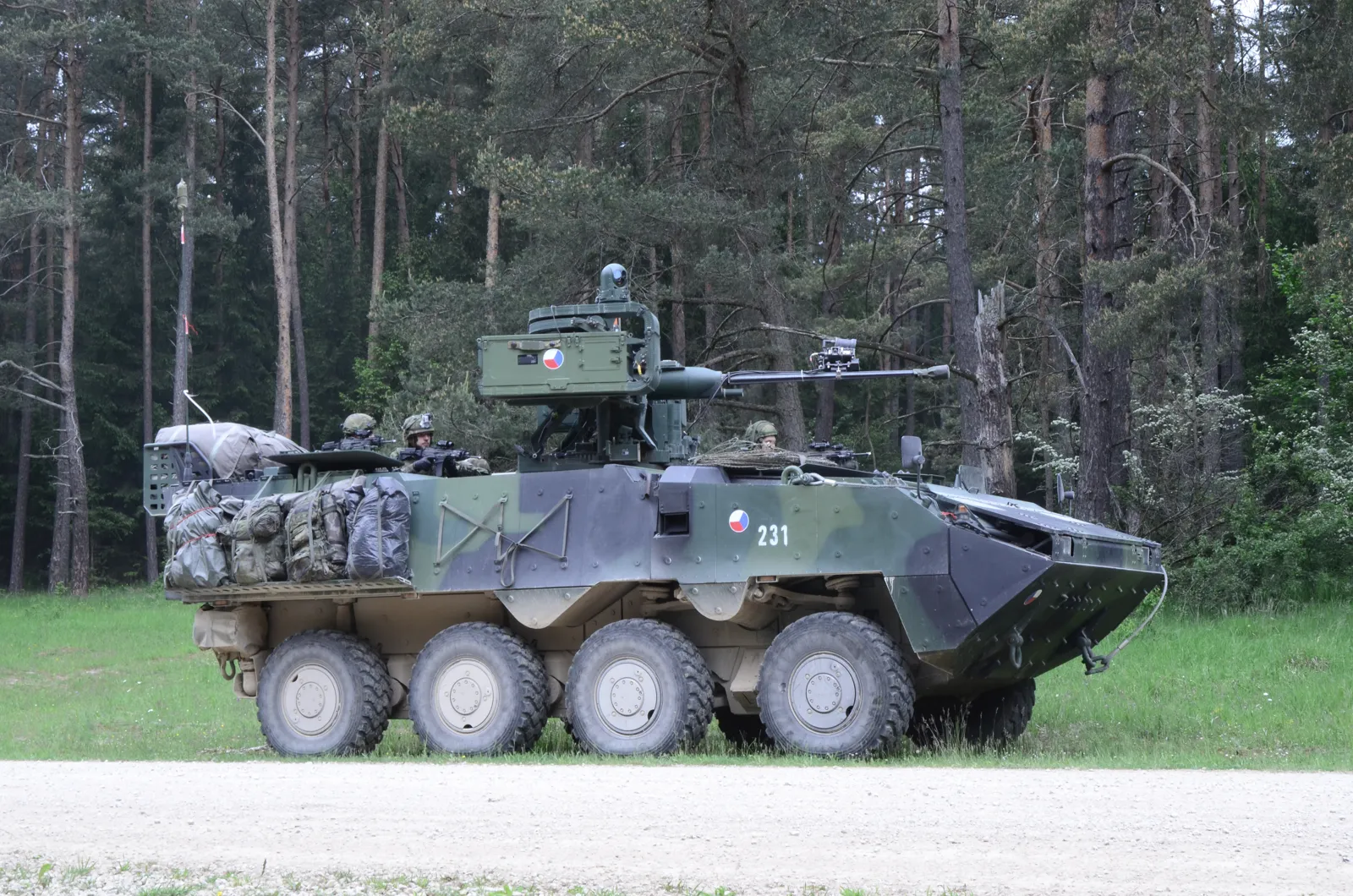
| Infantry fighting vehicles (Pandur II) | 126 vehicles: 72 infantry fighting vehicles, 11 company commander’s vehicles, 16 reconnaissance vehicles, 14 communications, 5 command and control, 4 engineering and 4 ambulance versions. Combat versions carry a Samson remote weapon station with a 30 mm Mk44 Bushmaster II and Spike LR anti-tank missiles; they are the backbone of the 4th Rapid Deployment Brigade |
| Infantry fighting vehicles (CV90 MkIV) | 0 in service, 246 on order. The May 2023 contract with BAE Systems Hagglunds covers seven variants: 141 infantry fighting vehicles, 31 company commander’s vehicles, 18 reconnaissance, 12 artillery observation, 13 engineering, 15 recovery and 16 ambulance. The programme runs from 2023 to 2030 and will replace the BVP-1s and BVP-2s |
| Infantry fighting vehicles (BVP-2) | Number unclear. More than 200 of these Czechoslovak-built versions of the BMP-2 were donated to Ukraine; the remainder are being withdrawn gradually as the CV90s arrive |
| Wheeled armoured vehicles (Nexter Titus) | 62 vehicles with 24 more on order: 6 command and control, 20 artillery command and 36 communications versions, with 22 additional command and control vehicles and 2 training vehicles ordered in 2025. The vehicle is built in Czechia under a local production partnership |
| Light armoured vehicles (Iveco LMV) | About 210 vehicles: 83 infantry carriers, 80 chemical, biological, radiological and nuclear reconnaissance, 20 ambulances, 7 command and some 20 special versions, with 18 more command vehicles and 6 artillery reconnaissance vehicles ordered in 2025 |
| Self-propelled howitzers (DANA vz. 77) | 53, of which 48 are active in two artillery battalions. A Czechoslovak 152 mm design mounted on a Tatra 8×8 chassis; 13 were sent to Ukraine and the system is to be replaced by the CAESARs |
| Self-propelled howitzers (CAESAR 8×8) | 0 in service, 62 on order. 52 vehicles were contracted in September 2021 and 10 more in December 2022, with production at the Czech branch of KNDS. The programme ran into serious trouble in 2025: the guns of the two trial vehicles failed to reach the required 40 km range in multiple-rounds-simultaneous-impact mode, and missing ammunition interoperability data blocked fire-control integration. The delivery schedule slipped from December 2026 to August 2027 and no vehicle had been delivered as of June 2026 |
| Rocket artillery and mortars | 16 MV-3 launchers; Global Firepower also gives 16 for the MLRS line. The MV-3 is designed to lay anti-tank minefields at up to three kilometres with 122 mm rockets rather than to fire conventional salvos. The mortar inventory comprises 8 SPM-85 PRAM-S self-propelled and 85 PRAM-L towed 120 mm mortars, 23 Expal 81 mm and more than 22 ANTOS 60 mm mortars |
Air Force Inventory
| Platform | Est. quantity |
|---|---|
| Total military aircraft | 103 (Global Firepower): 12 fighters, 16 attack aircraft, 10 transports, 21 trainers, 42 helicopters and 4 attack helicopters. Combat elements sit at the 21st Tactical Air Base at Caslav and the 22nd Helicopter Air Base at Namest nad Oslavou, while the transport fleet is based at the 24th Air Transport Base at Prague-Kbely |
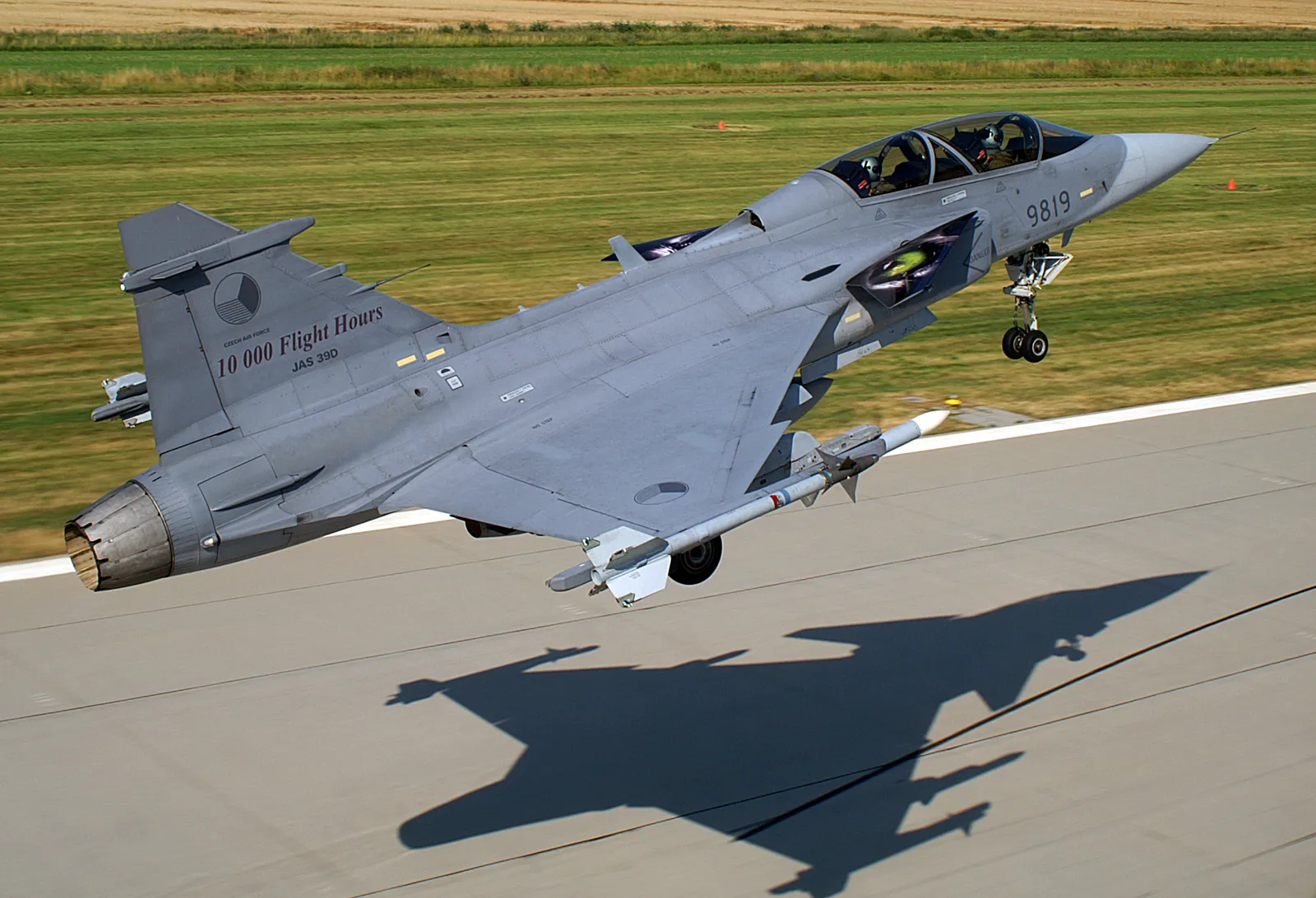
| Fighter aircraft (JAS 39 Gripen) | 14 aircraft: 12 single-seat JAS 39Cs and 2 twin-seat JAS 39Ds with the 211th Tactical Squadron at Caslav. The aircraft were not bought but leased from the Swedish Air Force. The lease was due to end in 2027; to avoid a gap before the F-35As arrive, Czechia moved to extend the lease of 12 aircraft to 2035. The package, which also covers maintenance and pilot training, was announced at 6 billion Swedish crowns (about 624 million dollars). The Gripens have also flown Baltic and Icelandic air policing missions |
| Fighter aircraft (F-35A Block 4) | 0 in service, 24 on order. The letter of offer and acceptance signed on 29 January 2024 is worth roughly 150 billion Czech crowns (about 6.6 billion dollars), the largest military purchase in the country’s history. The package also covers training, logistics and support services; production is to start in 2027, the first aircraft is to arrive in 2031 and deliveries are to be completed in 2035 |
| Light attack aircraft (L-159 ALCA) | 24 aircraft: 16 single-seat L-159As, 3 L-159T1+ and 5 L-159T2 twin-seaters, all with the 212th Tactical Squadron at Caslav. Built by Aero Vodochody, these aircraft correspond to Global Firepower’s line of 16 attack aircraft and are the only indigenous combat platform of the Czech Air Force |
| Trainers (L-39NG and L-410) | 11 L-39NGs with 4 more on order, the new-generation jet trainer developed by Aero Vodochody from the L-39 Albatros. The inventory also holds 4 L-410UVP light transports and 2 L-410FG reconnaissance and mapping aircraft |
| Transport aircraft | 13 aircraft: 1 Embraer C-390 Millennium (a second in 2027 or 2028), 4 C295Ms and 2 C295MWs, 4 L-410UVPs and 2 A319CJ government transports. The C295Ms are being modernised to the C295MW standard between 2025 and 2028 |
| Attack helicopters (AH-1Z Viper) | 4 with 6 more on order, flown by the 221st Helicopter Squadron at Namest nad Oslavou. The H-1 programme gave the Czech Air Force its first Western attack helicopter capability since its founding |
| Utility helicopters (UH-1Y Venom) | 7 with 2 more on order. The transport leg of the same H-1 package; one UH-1Y was lost in a crash on 23 July 2026, reducing the inventory from eight to seven |
| Transport helicopters (Mi-171Sh and W-3A) | 20 helicopters of the Mi-17 family: 7 Mi-171Shs, 8 Mi-171ShKMs and 5 Mi-17s (two in a government transport version). They were built between 2004 and 2006 as repayment of Soviet-era debt, and the 2025-2029 deep refurbishment of the Mi-171ShKMs extends their life to 2042. There are also 10 W-3A Sokols (4 transport, 6 search and rescue) received in 1995 in exchange for 10 MiG-29s transferred to Poland, planned for retirement in 2028 |
| Unmanned aerial vehicles | No armed unmanned aircraft. The inventory holds 10 ScanEagles, 6 RQ-11B Ravens, 5 RQ-20 Pumas, 2 Skylark I-LEs and RQ-12 Wasp AE systems, all in the reconnaissance and surveillance class. Work also continues on the indigenous STRATOM balloon designed for long-endurance surveillance at 25 km altitude |
Missile and Air-Defence Systems
| System | Type / Note |
|---|---|
| Medium-range air defence (SPYDER) | 4 batteries. Ordered from Israel in 2021 with deliveries between 2024 and 2026, the four batteries are to reach full operational capability in 2028. Each battery has 4 launchers and 1 EL/M-2084 multi-mission radar; the missile set covers Python-5 (15 km), Derby (35 km) and 48 I-Derby ER rounds (80 km) ordered in 2023 for delivery in 2027. The launchers sit on Tatra chassis and the system belongs to the 25th Anti-Aircraft Missile Regiment at Strakonice |
| Medium-range air defence (2K12 Kub-M2) | 2 batteries, being phased out as SPYDER reaches operational capability. Two batteries were transferred to Ukraine as aid in 2023 |
| Short-range air defence (MARS S-330) | 0 in service, 24 on order. The armoured very-short-range air defence vehicle contracted on 22 July 2025 is expected to be delivered between 2028 and 2030 |
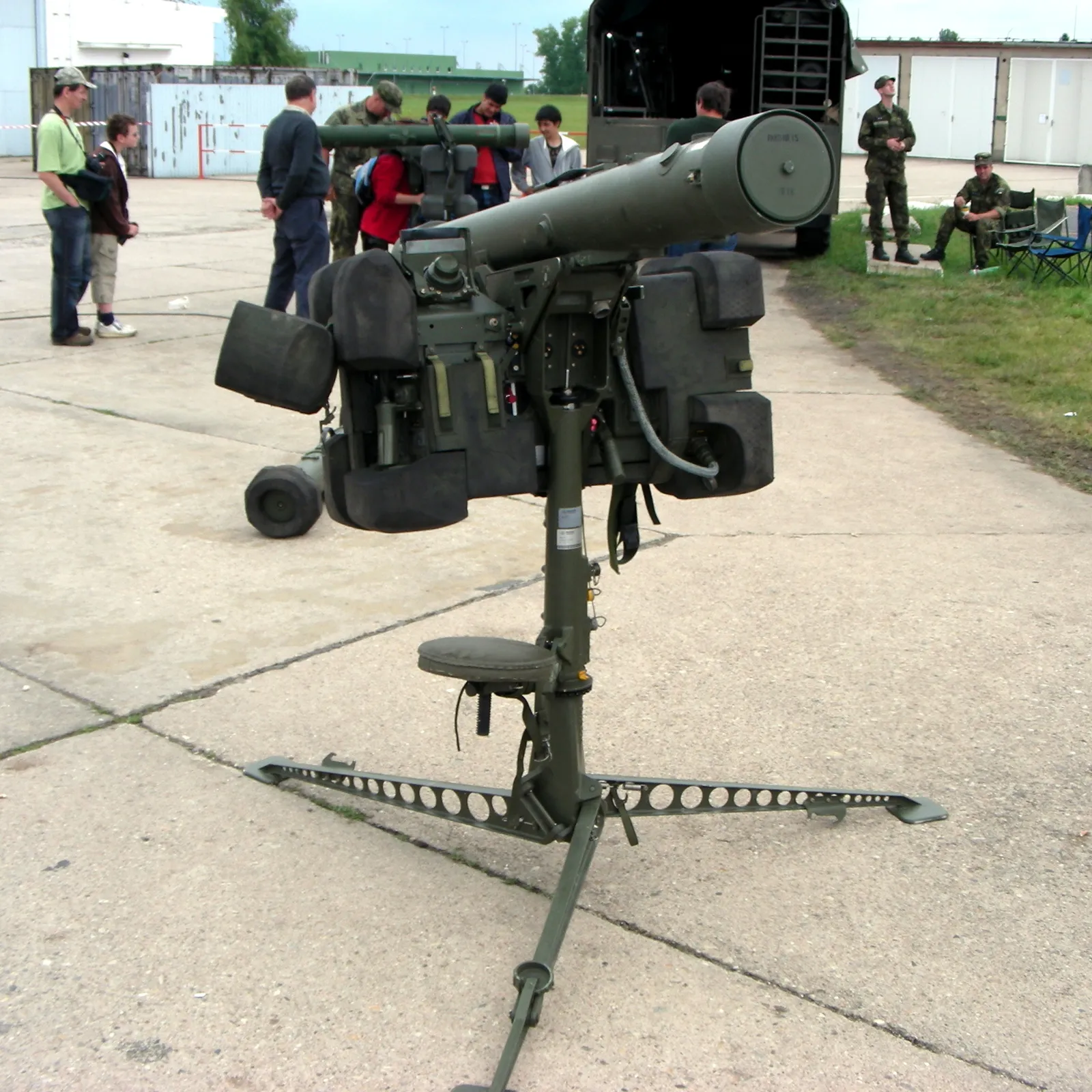
| MANPADS (RBS 70) | 32 launchers: 16 RBS 70s and 16 RBS 70NGs, with 8 more RBS 70NGs ordered in 2025. 231 missiles were delivered between 2014 and 2022 and 135 RBS 70 Mk3 rounds were ordered in 2023. For many years this was the country’s only modern air defence missile |
| Radar and early warning | 8 EL/M-2084 multi-mission radars (5 fixed, 3 vehicle-mounted, 100 km range) have been in service since 2023, complemented by a Czech-built passive radar family: 5 VERA systems (450 km, emitting targets only), 3 PLESS systems ordered in 2025 (700 km, including over-the-horizon and non-emitting targets) and 6 ReVisor radars for very-short-range air defence. Passive radar is the best-known specialism of the Czech defence industry |
| Ballistic and cruise missiles | 0. Czechia has no ground-launched ballistic or cruise missiles. The guided anti-tank layer rests on Spike LR missiles integrated on the Pandur IIs and CV90s |
Naval Power
| Class / Type | Est. quantity |
|---|---|
| Total naval platforms | 0. Czechia is landlocked and Global Firepower leaves the naval line empty; the country has no access to the sea |
| Frigates, corvettes and submarines | 0. None of these classes has appeared in the inventory since Czechia’s founding |
| Patrol vessels and mine warfare | 0. There is no combat river flotilla either; security on inland waters is a police rather than a military responsibility |
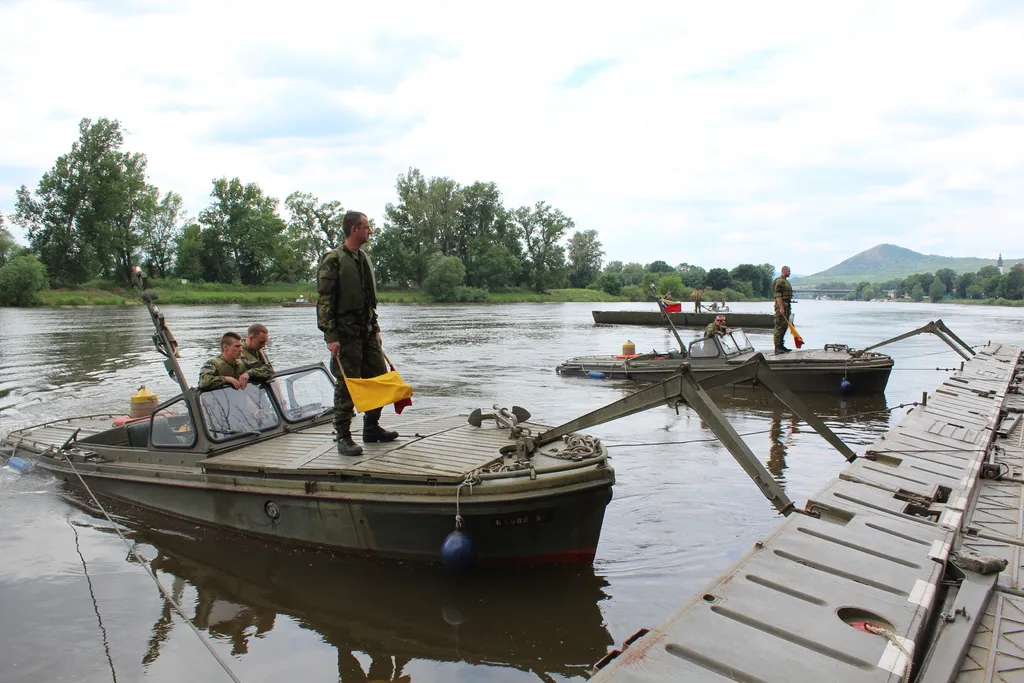
| Engineer boats and pontoon bridge sets | This is the only military capability on water. The engineer units operate MO-634 and MO-2000 Veronika pusher boats together with PMS-series pontoon bridge sets, with one MO-2000 able to replace two MO-634s. These assets are used for river crossing support and flood relief |
| Other watercraft | German-built RUSB boats and Pegas 4M hovercraft are in the inventory, with the Pegas used mainly by rescue teams for search and rescue |
| Marines and amphibious units | 0. The Czech Armed Forces have no marine branch or amphibious landing unit |
| Sea access and logistics | The country has no sea access; the maritime leg of its foreign trade runs through North Sea, Baltic and Adriatic ports. The Labe (Elbe) is the historic waterway linking Czechia to Hamburg |
| Contribution to maritime operations | Czechia’s contribution to multinational maritime operations has remained at headquarters and staff officer level; it has sent no ships or naval aviation assets |
The Turkey Angle: Turkish Defence Industry
Czechia is one of the countries in this series that holds no Turkish-built platform at all in its inventory yet has built one of the most institutional links with the Turkish defence industry. The foundation is old: diplomatic relations between Türkiye and Czechoslovakia were established in 1924, the Czech Republic created on 1 January 1993 after the dissolution of Czechoslovakia was recognised by Türkiye the same day, and the two countries have been NATO allies since 1999. The Turkish Ministry of Foreign Affairs describes the relationship as supported by intense commercial ties, defence industry cooperation and mutual tourism.
The most concrete expression of that link in 2026 is the partnership between ASELSAN and Excalibur International, a subsidiary of Czechoslovak Group. The strategic cooperation agreement announced on 4 February 2026 provides for a European Union-based joint venture focused on air defence, electronic warfare, smart munitions and border security. Its first product is the integration of ASELSAN’s KORKUT air defence system onto the Czech-built Tatra Force 6×6 wheeled platform, with production localised at CSG facilities in Czechia and Slovakia. Excalibur International chief executive Milos Sivara said the system uses highly precise programmable ammunition, so that the cost of neutralising a single drone remains comparable to the cost of the drone itself, while ASELSAN general manager Ahmet Akyol said the integration combines advanced sensor and fire-control technologies with a highly mobile platform.
The second industrial step came in land platforms. At the IDEB exhibition in Bratislava on 12 May 2026, FNSS Defence Systems and Czechoslovak Group signed a strategic cooperation agreement for the joint development and production of selected armoured platforms and unveiled the CFL-120 Karpat medium tank as their first product. The vehicle places Leonardo’s HITFACT MkII turret with a 120 mm smoothbore gun on a tracked hull derived from the FNSS Kaplan MT. Because CSG is a Czech-headquartered group, the agreement bears directly on the Czech defence industry as well; the show took place in Slovakia, but the group’s production base spans both countries.
The institutional channel is also working. The fifth meeting of the Czech-Turkish Joint Commission on defence industry cooperation was held in Ankara on 8 June 2026 with senior representatives of the Czech Ministry of Defence. That same week the Czech Embassy in Ankara, together with its defence attache, organised a Czech-Turkish Industry Day at which Excalibur Army, Excalibur International, Omnipol, Optokon, Crytur and HiLASE presented their air defence and counter-drone capabilities; the Turkish side was represented by the Presidency of Defence Industries together with ASELSAN, Roketsan, STM, MKE, Dasal, Turkish Aerospace, Baykar, Artron, HAVELSAN, Bogazici Defence and Meteksan. The programme consisted of facility tours, product demonstrations and business-to-government and business-to-business meetings.
Political contact became more frequent in 2026. Prime Minister Andrej Babis attended the NATO Summit in Ankara on 7-8 July 2026. On 8 September 2026 a delegation led by Fuat Oktay, chair of the Turkish Grand National Assembly’s Foreign Affairs Committee, met the Czech Senate and representatives of its Foreign Relations, Defence and Security Committee in Prague; Oktay said bilateral trade had reached 6.5 billion dollars and that the target was to pass 10 billion. The same talks raised the idea of taking the defence industry partnership beyond the existing ASELSAN agreements, particularly toward joint production in low and medium-altitude air defence systems.
To sum up: there is not a single Turkish-built platform in service in the Czech inventory today, and no bilateral military framework agreement has been made public. What does exist is a regularly functioning joint commission on defence industry cooperation, a joint venture under formation and a Turkish-origin air defence system slated for production on Czech soil. The shape of the relationship differs from the off-the-shelf exports seen elsewhere in this series: Czechia is less a customer than a co-production partner. The military framework agreement signed in Slovakia on 20 January 2025 and the six Bayraktar TB2s Croatia contracted in 2024 stand as regional precedents where the procurement stage has already been reached.
Frequently Asked Questions
How many tanks does Czechia have? The Global Firepower 2026 count shows 20 tanks for Czechia, but open-source inventory lists give a more detailed picture: 42 Leopard 2A4s delivered from Germany and Switzerland between 2022 and 2026 are in service, while 30 T-72M4CZs sit in reserve. The deep refurbishment programme run for the T-72M4CZs between 2022 and 2025 failed because their bespoke Italian fire-control system could not be overhauled. The real transformation comes with the 2025 contract with KNDS Deutschland: 44 Leopard 2A8 combat and command tanks were ordered with an option for 16 more, and the hulls will be produced in Czechia at Czechoslovak Group facilities. Deliveries are planned for 2028-2031.
What fighter aircraft does Czechia have? The only fighter type in the Czech Air Force is the JAS 39 Gripen. The 211th Tactical Squadron at Caslav operates 12 single-seat JAS 39Cs and 2 twin-seat JAS 39Ds, and these aircraft were not bought but leased from the Swedish Air Force. The lease was due to expire in 2027; Czechia moved to extend the lease of 12 aircraft to 2035 for about 6 billion Swedish crowns. Alongside them, the 212th Tactical Squadron flies 16 L-159A light attack aircraft built by Aero Vodochody and 8 twin-seat L-159T variants. The future fighter is the F-35A: 24 aircraft were ordered under a contract signed on 29 January 2024 worth roughly 150 billion crowns, with the first aircraft due in 2031 and deliveries to be completed in 2035.
Does Czechia have a navy? No. Czechia is landlocked and Global Firepower leaves the naval platform line empty; frigates, corvettes, submarines and patrol vessels have never appeared in the inventory, and there is no combat river flotilla either. The only military capability on water lies with the engineer units: MO-634 and MO-2000 Veronika pusher boats are used together with PMS-series pontoon bridge sets for river crossing support and flood relief. The inventory also holds German-built RUSB boats and Pegas 4M hovercraft used mainly for search and rescue. There is no marine branch and no amphibious landing unit.
What is Czechia’s air defence system? The country’s new main layer is the Israeli-built SPYDER. The four batteries ordered in 2021 were delivered between 2024 and 2026 and are to reach full operational capability in 2028. Each battery has 4 launchers and 1 EL/M-2084 multi-mission radar; the missile set covers Python-5 (15 km), Derby (35 km) and 48 I-Derby ER rounds (80 km) ordered in 2023 for delivery in 2027. The two remaining batteries of the Soviet-era 2K12 Kub-M2 are being phased out as SPYDER arrives, two batteries having been transferred to Ukraine in 2023. At short range, 32 RBS 70 launchers are in service and 24 MARS S-330 armoured vehicles are to be delivered between 2028 and 2030. Czechia has no ballistic or cruise missiles.
Is there defence cooperation between Türkiye and Czechia? Yes, but its shape is co-production rather than procurement. There is not a single Turkish-built platform in the inventory and no bilateral military framework agreement has been made public. On 4 February 2026, however, ASELSAN and Excalibur International, a subsidiary of Czechoslovak Group, signed a strategic cooperation agreement to establish a European Union-based joint venture; the first product is the integration of the KORKUT air defence system onto the Czech-built Tatra Force 6×6 platform with production localised at CSG facilities in Czechia and Slovakia. At the IDEB exhibition on 12 May 2026, FNSS and CSG signed a strategic cooperation agreement on armoured platforms and unveiled the CFL-120 Karpat medium tank. Institutionally, the fifth meeting of the Czech-Turkish Joint Commission on defence industry cooperation was held in Ankara on 8 June 2026. Bilateral trade has reached 6.5 billion dollars, with a target of passing 10 billion.
Bottom Line
The Czech inventory shows how many fronts a NATO army with its own defence industry can renew at once. The numbers are mid-sized: 30,334 active personnel, 42 tanks in service, 103 military aircraft, zero naval platforms. Yet almost every major class is either on order or awaiting delivery; taken together, 44 Leopard 2A8s, 246 CV90s, 62 CAESAR howitzers, 24 F-35As and four SPYDER batteries compress a procurement load worth several times the annual budget into a single decade. That is where the problem lies: the roughly 155 billion crowns allocated to defence in the 2026 budget amounts to around 1.7 percent of GDP, while the chief of the general staff says about 210 billion crowns is needed to keep the programmes on schedule. The fact that not a single CAESAR had been delivered as of June 2026 shows the schedule pressure is not theoretical. The weaknesses are plain: no armed unmanned aircraft, no ballistic or cruise missiles, four attack helicopters in service and a tank fleet consisting entirely of stopgap vehicles. Against that, the country holds a defence industry extraordinarily large for the size of its army: passive radar technology, Tatra military trucks, Aero Vodochody aircraft and Czechoslovak Group’s ammunition and armoured vehicle lines are the real capacity behind both export revenue and the Ukraine ammunition initiative. That is precisely where Czechia’s value lies for Türkiye: the relationship is not a platform sale but a co-production model in which ASELSAN places KORKUT on a Czech Tatra chassis and turns toward the European market. There is still no Turkish item in the inventory, but the joint venture under formation puts the first Turkish-origin air defence system produced on Czech soil on the agenda.
Related Reading
Sources
- Global Firepower — Czechia
- IISS — The Military Balance
- SIPRI — Arms Transfers Database
- Wikipedia — Czech Armed Forces
- Wikipedia — Czech Air Force
- Wikipedia — List of military equipment of the Czech Army
- Turkish Ministry of Foreign Affairs — Türkiye-Czech Republic political relations
- Anadolu Agency — ASELSAN’s new step into Europe with KORKUT
- Czech Embassy in Ankara — Czech companies deepening air defence cooperation with Turkish partners
- Government of the Czech Republic — Babis at the NATO Summit in Ankara
- Lockheed Martin — The Czech Republic joins the F-35 global team
- CZ Defence — New chief of the general staff Hlavac presents his vision
- Radio Prague International — Czech ammunition initiative to go on
- Shephard Media — Czech CAESAR howitzer order at risk